Intercultural Communication Skills for Students of Sabilul Rahmah International Islamic Boarding School Pacet, Mojokerto
DOI:
https://doi.org/10.22219/jcse.v6i1.34266Keywords:
Joint Community Service, International Service, Cross-cultural communicationAbstract
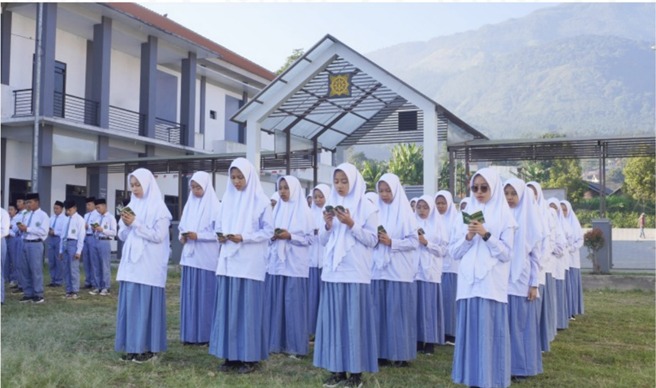
It is important to recognize that globalization has had a significant impact on the world of work. In this context, many companies recognize that cross-cultural communication skills are key to facilitating effective interactions between workers who come from heterogeneous cultural backgrounds. In addition, the phenomenon of an increasing number of individuals migrating from one country to another further strengthens the urgency of developing cross-cultural communication skills in the educational realm. The topic raised in this community service activity is in accordance with the needs of Sabilul Rahmah International Islamic Boarding School (Sabira-IIBS). Located in Sumberam, Sajen, Pacet, Mojokerto, East Java, Sabira IIBS is a pesantren education institution and Madrasah Aliyah (MA) level school with a learning system that combines traditional pesantren Islamic values with modern learning. The curriculum used is based on the national curriculum & international curriculum (Al Azhar University for diniyah & Cambridge for Math, Science & English). The school aims to prepare its graduates to become agents of change in accordance with the purpose of the graduation designation. Most santri are encouraged to continue their studies to favorite universities both domestically and abroad. This community service activity was carried out through collaboration between the Faculty of Cultural Sciences, Universitas 17 Agustus 1945 Surabaya and UniMap Malaysia Perlis. Based on the activities that have been carried out, it can be concluded that after the activity takes place there is an increase in the knowledge and understanding of the participants related to cross-cultural communication from an average understanding of 1.1 on a scale of 4 to 3.7 on a scale of 4. This indicates that the joint community service activities carried out by the academics of FIB Untag Surabaya in collaboration with the academics of Universiti Malaysia Perlis completed successfully and can achieve the goals or targets of this activity. As a result, this activity had a positive impact on increasing the knowledge and understanding of students of partners’ institution.
Downloads
References
Banks, J. A. (1974). Multicultural Education: In Search of Definitions and Goals. (J. A. Banks, Ed.). Institute on Cultural Pluralism.
Commander, N. E., Zhao, Y., Gallagher, P. A., & You, Y. (2012). Promoting Cross-cultural Understanding of Education Through Online Discussions. Social and Behavioral Sciences, 46, 4632–4642. https://doi.org/10.1016/J.SBSPRO.2012.06.310
Dogan, C. (2017). The Importance of Multiculturalism in Community Interpreting. International Journal of Business, Humanity and Technology, 7(2), 72–77.
Eliawati, T. (2018). Cross Cultural Understanding Learning Method. Journal MELT (Medium for English Language Teaching), 3(1), 17–33. https://doi.org/10.22303/MELT.3.1.2018.14-26
Grishaeva, E. B. (2012). Multiculturalism as a central concept of multiethnic and polycultural society studies. Humanities & Social Sciences, 7, 916–922.
Kazdin, A. E. (2000). Encyclopedia of psychology: 8 Volume set. American Psychological Association, 2, 357–359.
Lebrón, A. (2013). What is Culture? . Merit Research Journal of Education and Review, 1(6), 126–132.
Maulana, A. (2020). Cross Culture Understanding in EFL Teaching: An Analysis for Indonesia Context. Journal of Linguistic, 6(2), 98–107.
Ratnasari, D. (2018). The Importance of Cross-Cultural Understanding in Foreign Language Teaching in Asian Context. Bahasa Dan Seni: Jurnal Bahasa, Sastra, Seni, Dan Pengajarannya, 46(2). https://doi.org/10.17977/um015v46i22018p124
Rudy, Immanuel Simanjuntak, F., & Panigoro Simanjuntak, Z. (2022). Multicultural Values in Disney Animated Films. Apollo Project, 11(2), 97–110.
Silviana, D., & al Musadi_Q, M. (2017). Pentingnya Pemahaman Lintas Budaya dalam Proses Negosiasi Bisnis (Studi pada Startup Bisnis Manis Clothing). Jurnal Administrasi Bisnis, 49(1), 44–49.
Sood, R. (2017). Cross Cultural Communication & Effective Communication. International Journal of Research and Scientific Innovation (IJRSI) |, 4(12), 84–86.
Stanley, J., Setyadi, Y., & R Rudy. (2021). The Depiction of Tolerance in American Superhero Films. Jurnal Bahasa, Sastra Dan Studi Amerika, 27(1), 29–49.
United Nation. (n.d). The 17 goals. Retrieved October 30, 2023, from https://sdgs.un.org/goals. at 13.29
Yilmaz, F. (2018). Road to peace education: Peace and violence from the viewpoint of children. International Education Studies, 11(8), 141–152. https://doi.org/10.5539/ies.v11n8p141
Downloads
Published
How to Cite
Issue
Section
License
Copyright (c) 2025 Pariyanto, et al

This work is licensed under a Creative Commons Attribution-ShareAlike 4.0 International License.