Community empowerment through the eco-mosque program at the Ali Bin Abi Tholib Mosque Sorong
DOI:
https://doi.org/10.22219/jcse.v6i1.36601Keywords:
Eco-mosque, Environmentally friendly mosque, Mosque-based empowerment, Waste managementAbstract
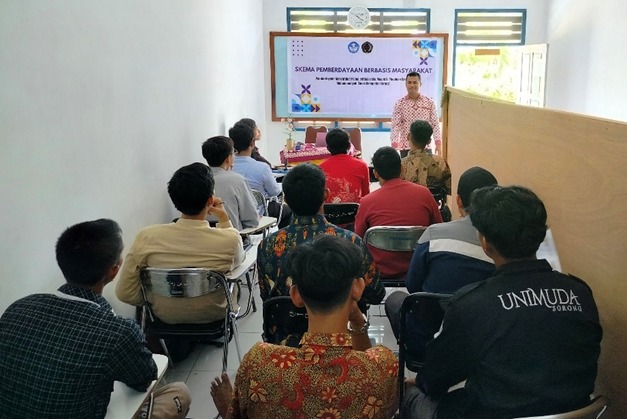
The Ali Bin Abi Thalib Mosque is a mosque that stands as a form of awareness of the Muhammadiyah organization in empowering the community. The primary problem lies in the environmentally unfriendly practices of its non-formal educational institutions. to enhance the partners' skills in rainwater harvesting and waste management so that the mosque has an environmentally friendly nuance. Participants are 20 young mosque guards. The Implementation program includes strengthening character education and environmental care movements and rainwater management for mosque guards and teenagers. These community service activities include: preparation, implementation, application of science and technology, and evaluation. This community service resulted in an increased sense of environmental responsibility among the mosque caretakers and teenagers.
Downloads
References
Abda’u, I. F., Mutakin, A., & Setiawan, A. Y. (2020). Pengelolaan lingkungan berbasis pesantren (ekopesantren) dalam menciptakan perilaku santri yang ramah lingkungan di Ponpes Baiturrahman Kec. Cipary. Geoarea, 3(2), 28–39. https://doi.org/https://ejournal.unibba.ac.id/index.php/Geoarea/article/view/645
Abdulatif, S., & Dewi, D. A. (2021). Peranan pendidikan kewarganegaraan dalam membina sikap toleransi antar siswa. Jurnal Pendidikan Dan Pengajaran Guru Sekolah Dasar, 04(2), 103–109. https://ojs.uma.ac.id/index.php/jppuma/article/download/563/403
Adnyana, I. M. D. M., Mahendra, K. A., & Raza, S. M. (2023). The importance of green education in Indonesia: An analysis of opportunities and challenges. Education Specialist, 1(2), 61–68. https://doi.org/10.59535/es.v1i2.168
As-Salafiyah, A., Uula, M. M., & Taufiq, M. (2024). Mosque and environmental issues: A research path analysis. Journal of Islamic Economics Literatures, 5(1). https://doi.org/10.58968/jiel.v5i1.541
Brahma, R. (2025). Innovations In teaching and learning for environmental education. Journal of the American Institute, 2(2), 210–224. https://doi.org/10.71364/kxrd4r73
Fayyaz, S., Lashari, A. Al., Nandwani, S., & Chang, M. A. (2023). Assessing environmental awareness and conservation behavior in schools for sustainable development. Pakistan Journal of Humanities and Social Sciences, 11(4), 4070–4081. https://doi.org/10.52131/pjhss.2023.1104.0675
Harahap, D., & Uthman, Y. O. O.-O. (2024). Bridging the gap: Environmental education as a catalyst for human-environmental harmony. Assyfa Learning Journal, 2(1), 19–39. https://doi.org/10.61650/alj.v2i1.186
Hnatyuk, V., Pshenychna, N., Kara, S., Kolodii, V., & Yaroshchuk, L. (2024). Education’s role in fostering environmental awareness and advancing sustainable development within a holistic framework. Multidisciplinary Reviews, 7, 2024spe012. https://doi.org/10.31893/multirev.2024spe012
Junaidah, J., Mahardika, N. P., & Ma`arif, M. A. (2025). Promoting green madrasa as environmental education program: How to implement and maintain it. Munaddhomah: Jurnal Manajemen Pendidikan Islam, 6(1), 39–54. https://doi.org/10.31538/munaddhomah.v6i1.1572
Khunaini, F. (2020). Program zero waste sebagai implementasi pendidikan cinta lingkungan di PPA Lubangsa Utara. Ar-Risalah: Media Keislaman, Pendidikan Dan Hukum Islam, 3(2), 20–32. https://jurnal.instika.ac.id/index.php/jpik/article/view/166
Marlina, A., Khan, H. A., Cahyadi, A., Subandoyo, A., & Barkah, A. S. (2023). The role of mosques in managing flood natural disasters through environmental education. Proceeding of International Conference on Education, 1–9. https://doi.org/10.37640/ice.02.730
Masgumelar, N. K., & Mustafa, P. S. (2021). Teori belajar konstruktivisme dan implikasinya dalam pendidikan dan pembelajaran. Ghaitsa, 2(2), 49–57. https://doi.org/10.62159/ghaitsa.v2i1.188
Oyeleke, A. S., & Onyike, I. E. (2025). Strategies to instil environmental consciousness and commitment in future generations. In Media and Communication Systems for Sustainability in Nigeria (pp. 145–160). Springer Nature Switzerland. https://doi.org/10.1007/978-3-031-75221-6_7
Pala, G. K., Pathivada, A. P., Velugoti, S. J. H., Yerramsetti, C., & Veeranki, S. (2021). Rainwater harvesting - A review on conservation, creation & cost-effectiveness. Materials Today: Proceedings, 45, 6567–6571. https://doi.org/10.1016/j.matpr.2020.11.593
Richards, S., Rao, L., Connelly, S., Raj, A., Raveendran, L., Shirin, S., Jamwal, P., & Helliwell, R. (2021). Sustainable water resources through harvesting rainwater and the effectiveness of a low-cost water treatment. Journal of Environmental Management, 286, 112223. https://doi.org/10.1016/j.jenvman.2021.112223
Santoso, B., In’am, A., Haris, A., & Wekke, I. S. (2024). Al-Islam and Kemuhammadiyahan learning based on religious moderation in multicultural campus. Al-Hayat: Journal of Islamic Education (AJIE), 10(1), 137–146. https://doi.org/10.35723/ajie.v8i1.432.
Santoso, B., Tang, A., & Jumadi, J. (2021). Pengelolaan lingkungan berbasis pesantren (ekopesantren) dalam menciptakan perilaku santri yang ramah lingkungan di Ponpes Baiturrahman Kec. Cipary. Jurnal Penelitian Pendidikan, 13(2), 1896–1904. https://ejournal.unibba.ac.id/index.php/Geoarea/article/view/645
Santoso, B., Triono, M., & Irawan, M. H. (2024). Pemberdayaan masyarakat Papua Melalui program ekopesantren berbasis pelestarian lingkungan di Panti Asuhan Muhammadiyah Malasom. Abdimasa, 7(1), 34–40. https://unimuda.e-journal.id/jurnalabdimasa/article/view/4851
Santoso, B., Triono, M., Muhammad, A. S. A., & Arifin, S. (2024). The readiness of islamic religious education teachers to enter the era of industrial society 5.0. Tafkir: Interdisciplinary Journal of Islamic Education, 5(4), 624–636. https://doi.org/10.31538/tijie.v5i4.1183
Santoso, B., Triono, M., Muzakki, M., Lestari, L., & Jaharudin, J. (2023). Learning model of al-islam and integrative muhammadiyah for students at MTs Muhammadiyah Aimas. ISTAWA: Jurnal Pendidikan Islam (IJPI), 8(1), 40–53. https://doi.org/https://journal.umpo.ac.id/index.php/istawa/article/view/7436
Sarti, M., & St. John, S. K. (2019). Raising long-term awareness: EU environmental policy and education. In Education and Public Policy in the European Union (pp. 165–181). Springer International Publishing. https://doi.org/10.1007/978-3-030-04230-1_8
Sulasmi, E. (2019). Konsep pendidikan humanis dalam pengelolaan pendidikan. https://www.scribd.com/document/556132209/Konsep-Pendidikan-Humanis-Dalam-Pengelolaan-Pendidikan-Di-Indonesia-by-Dr-Emilda-Sulasmi-M-pd-Z-lib-org
Sunesti, Y., & Zunariyah, S. (2024). Religious-based environmental movement: Mosque as a center of environmental awareness initiatives in Code River Yogyakarta. E3S Web of Conferences, 595, 03006. https://doi.org/10.1051/e3sconf/202459503006
Syofyan, H., Rosyid, A., Febrianti, N., & Ratih, R. (2021). The character of responsibility and honesty: Its impact on science learning outcomes. International Journal of Elementary Education, 6(1), 74–87. https://doi.org/10.23887/ijee.v6i1.41353
Triono, M., & Santoso, B. (2024). Character development through religious education through mathematics education in elementary school. Qalam, 12(1), 57–62. https://doi.org/10.33506/jq.v13i1.3300
Untari. (2022). Analisis nilai TDS (total disolve solid) pada air kota dan kabupaten sebagai gambaran kualitas air sumur bor. Analit: Analitical and Environmental, 7(2), 8–20. https://doi.org/10.23960/aec.v7i02.2022.p115-121
Vladova, I. (2023). Towards a more sustainable future: The importance of environmental education in developing attitudes towards environmental protection. In B. Stoykova & D. Stoyancheva (Eds.), SHS Web of Conferences (Vol. 176, p. 01009). https://doi.org/10.1051/shsconf/202317601009
Downloads
Published
How to Cite
Issue
Section
License
Copyright (c) 2025 Santoso, et al

This work is licensed under a Creative Commons Attribution-ShareAlike 4.0 International License.