Enhancing physics experiment skills using smartphone sensors for teachers in sorong regency
DOI:
https://doi.org/10.22219/jcse.v6i1.37124Keywords:
Physics experiment, Physics learning, Phyphox app, Smartphone sensor, Teacher’s skillAbstract
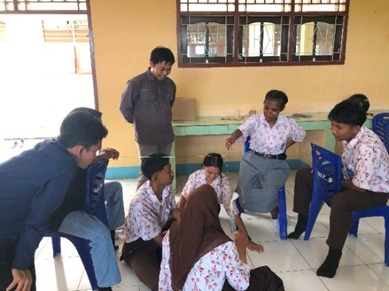
This community service program designed to enhance physics experimental skills using smartphone sensors for high school teacher aims to introduce and train teachers in utilizing simple yet effective technology in physics education. By using smartphone sensors, the goal is to enable teachers to conduct experiments that are not only captivating but also easily accessible and relevant to daily life, thus boosting students’ comprehension and interest. The program was conducted in two phases: first, a training session for teachers, followed by school visit with MGMP team to provide hands-on support, address any challenges teachers may encounter, and observe the implementation of the method. Furthermore, the effectiveness of the program was evaluated based on the results from both pre-assessment and post-assessment conducted on 20 teachers from MGMP group. The assessment results showed increases in understanding and preparing technology, collecting data, and analyzing and evaluating data. Despite several challenges such as limited access to compatible devices and varying levels of understanding regarding the concept, the training was overall successfully improved teachers’ skills in applying the technology for physics experiment.
Downloads
References
Ady, W. N., & Warliani, R. (2022). Analisis Kesulitan Belajar Siswa SMA terhadap Mata Pelajaran Fisika pada Materi Gerak Lurus Beraturan. Jurnal Pendidikan Dan Ilmu Fisika, 2(1), 104. https://doi.org/10.52434/jpif.v2i1.1599
Alfayani, C., Suana, W., & Viyanti, V. (2024). Pengaruh Pembelajaran Blended Learning Menggunakan Tracker pada Materi Gerak Harmonis Sederhana Berbasis Inkuiri Terbimbing Terhadap Peningkatan Kemampuan Berpikir Kreatif Siswa. JIPFRI (Jurnal Inovasi Pendidikan Fisika Dan Riset Ilmiah), 8(1), 29–38. https://doi.org/10.30599/jipfri.v8i1.3315
Ariyansah, D., Hakim, L., & Sulistyowati, R. (2021). Pengembangan e-LKPD Praktikum Fisika Pada Materi Gerak Harmonik Sederhana Berbantuan Aplikasi Phyphox Untuk Meningkatkan Pemahaman Konsep Peserta Didik. Jurnal Penelitian Pembelajaran Fisika, 12(2), 173–181. https://doi.org/10.26877/jp2f.v12i2.9052
Astari, I. Y., Kristanti, B. A., & Paradita, B. (2024). Sumber Daya Manusia Indonesia Yang Berdaya Saing di Era Global. In Paradita (Vol. 1, Issue 2). https://www.journal.muc-consultindo.com/index.php/jebizko
Azizah, R., Yuliati, L., & Latifah, E. (2015). Kesulitan Pemecahan Masalah Fisika Pada Siswa Sma The Physic Problem Solving Difficulties On High School Student. Jurnal Penelitian Fisika Dan Aplikasinya (JPFA), 5(2). http://journal.unesa.ac.id/index.php/jpfa
Carroll, R., & Lincoln, J. (2020). Phyphox app in the physics classroom. The Physics Teacher, 58(8), 606–607. https://doi.org/10.1119/10.0002393
Countryman, C. L. (2014). Familiarizing Students with the Basics of a Smartphone’s Internal Sensors. The Physics Teacher, 52(9), 557–559. https://doi.org/10.1119/1.4902204
Daun, N. S., Helmi, H., & Haris, A. (2020). Diagnosis Kesulitan Belajar Fisika Peserta Didik di SMA Negeri 1 Bontomarannu. Prosiding Seminar Nasional Fisika PPs UNM, 2, 37–40.
Gianino, C. (2021). Uniform circular motion measurements employing a smartphone using the phyphox app and a turntable. Physics Education, 56(1). https://doi.org/10.1088/1361-6552/abc9d4
Haerunnisa, H., Prasetyaningsih, P., & Biru, L. T. (2022). Analisis Miskonsepsi Siswa SMP pada Konsep Getaran dan Gelombang. PENDIPA Journal of Science Education, 6(2), 428–433. https://doi.org/10.33369/pendipa.6.2.428-433
Hikmatiar, H. (2019). Determination the coefficient of restitution in object as temperature function in partially elastic collision using phyphox application on smartphone. Science and Technology Indonesia, 4(4), 88–93. https://doi.org/10.26554/sti.2019.4.4.88-93
Himawan, N. A., Jumadi, J., & Purwanto, E. (2020). Identifikasi Kemampuan Penalaran Siswa Kelas XI di MAN 4 Bantul Pada Suhu Dan Kalor. EDUSAINS, 12(1), 30–37. https://doi.org/10.15408/es.v12i1.12784
Ikhwani, Y., Muflih, H., Ridho, I. I., & Rahman, F. (2022). Pelatihan Pembuatan Kuis Dan Game Edukatif Berbasis Teknologi Informasi di SDIT Anak Sholeh Mandiri Banjarmasin. Community Development Journal : Jurnal Pengabdian Masyarakat, 3(3), 1588–1591. https://doi.org/10.31004/cdj.v3i3.6974
Indriyani, R., & Supriyadi, S. (2023). Gejala Perilaku Alexithymia dan Gejala Kecemasan Sosia Dengan Kecanduan Pengguna Smartphone Pada Mahasiswa Keperawatan S1. Jurnal Perawat Indonesia, 7(3), 1596–1603. https://doi.org/10.32584/jpi.v7i3.2359
Islamiah, M., Rostati, R., & Neneng Triyunita. (2023). Pengembangan Alat Praktikum Gerak Jatuh Bebas Menggunakan Phyphox Berbasis Smartphone untuk Siswa Kelas X. JURNAL PENDIDIKAN MIPA, 13(3), 887–892. https://doi.org/10.37630/jpm.v13i3.1203
Mayampoh, L. B., Tulandi, D. A., Rende, J., Poluakan, C., & Komansilan, A. (2021). Phyphox application with PIMCA learning model. Journal of Physics: Conference Series, 1968(1). https://doi.org/10.1088/1742-6596/1968/1/012042
Monteiro, M., Stari, C., Cabeza, C., & Marti, A. C. (2015). The Atwood machine revisited using smartphones. The Physics Teacher, 53(6), 373–374. https://doi.org/10.1119/1.4928357
Nova, D. A. O., & Lestari, N. A. (2021). Analisis Persepsi Siswa Terhadap Pembelajaran Fisika Berbasis Ecopedagogy Dengan Metode Daring Selama Pandemi Covid-19. 7(1).
Nurfadilah, N., Ishafit, I., Herawati, R., & Nurulia, E. (2019). Pengembangan Panduan Eksperimen Fisika Menggunakan Smarthphone dengan Aplikasi Phyphox Pada Materi Tumbukan. Jurnal Penelitian Pembelajaran Fisika, 10(2), 101–107. https://doi.org/10.26877/jp2f.v10i2.4019
Puspa, C. I. S., Rahayu, D. N. O., & Parhan, M. (2023). Transformasi Pendidikan Abad 21 dalam Merealisasikan Sumber Daya Manusia Unggul Menuju Indonesia Emas 2045. Jurnal Basicedu, 7(5), 3309–3321. https://doi.org/10.31004/basicedu.v7i5.5030
Putri, W. A. S., Hakim, L., & Sulistyowati, R. (2022). Pengembangan E-Lkpd Materi Efek Doppler Berbasis Inkuiri Terbimbing Berbantuan Aplikasi Phyphox Untuk Meningkatkan Pemahaman Konsep Fisika. ORBITA: Jurnal Pendidikan Dan Ilmu Fisika, 8(1), 15. https://doi.org/10.31764/orbita.v8i1.6828
Rabiudin, R., Rusdin, R., & Maimuna, W. (2022). Telaah Kognitif: Pemetaan Kemampuan Mengingat Siswa Dalam Pembelajaran Fisika Dan Matematika. Jambura Physics Journal, 4(1), 1–13. https://doi.org/10.34312/jpj.v4i1.13603
Raharja, E. P., Irianti, M., Lestari, R. D., & Kabes, Y. (2024). Development of a physics experiment module based on smartphone sensors on mechanics for high school students. Jurnal Riset Dan Kajian Pendidikan Fisika, 11(1), 1–10. https://doi.org/10.12928/jrkpf.v11i1.634
Raharja, E. P., Irianti, M., Lestari, R. D., Londong, C. M., & Mudumi, S. (2024). Analyzing Physics Experiment using Sensor Smartphone in Traveling Carnival. Jurnal Penelitian Pendidikan IPA, 10(3), 1247–1254. https://doi.org/10.29303/jppipa.v10i3.6792
Raharja, E. P., & Ishafit. (2021). Development of circular motion experiment tool using sensor smartphone for high school students. Journal of Physics: Conference Series, 1806(1), 012048. https://doi.org/10.1088/1742-6596/1806/1/012048
Rochmahwati, M. R. (2023). Analisis Pengaruh Teknologi Digital Terhadap Pertumbuhan Ekonomi di Pulau Jawa. Jurnal Ilmu Ekonomi JIE, 7(03), 369–380. https://doi.org/10.22219/jie.v7i03.27050
Sahrudin, S., Wahyudi, W., & Hikmawati, H. (2019). Pengaruh Model Pembelajaran Inkuiri Dengan Metode Eksperimen Terhadap Hasil Belajar Fisika Siswa SMAN 1 Gunungsari Tahun Ajaran 2016/2017. Jurnal Pendidikan Fisika Dan Teknologi, 5(2), 335–340. https://doi.org/10.29303/jpft.v5i2.1171
Sarjono. (2018). Pentingnya Laboratorium Fisika dalam Menungjang Pembelajaran Fiaika. Jurnal Madaniyah, 8(2), 262–271.
Staacks, S., Dorsel, D., Hütz, S., Stallmach, F., Splith, T., Heinke, H., & Stampfer, C. (2022). Collaborative smartphone experiments for large audiences with phyphox. European Journal of Physics, 43(5), 055702. https://doi.org/10.1088/1361-6404/ac7830
Sugianto, R., Permana P, N. D., & Diniya, D. (2020). Meta-Analysis: Enhancing Junior High School Students’ Higher Order Thinking Skills Through Problem Solving Learning Model In Natural Sciences-Physics. Jurnal Geliga Sains: Jurnal Pendidikan Fisika, 8(1), 55. https://doi.org/10.31258/jgs.8.1.55-63
Vogt, P., & Kuhn, J. (2012). Analyzing free fall with a smartphone acceleration sensor. The Physics Teacher, 50(3), 182–183. https://doi.org/10.1119/1.3685123
Walid, I. H. B. I. (2022). Development of a Free Fall Motion Experiment based on Smart Phone using Phyphox application. Journal of Physics: Conference Series, 2309(1). https://doi.org/10.1088/1742-6596/2309/1/012085
Walidin, W. (2016). Arah Pengembangan Sumberdaya Manusia Dalam Dimensi Pendidikan Islam. JURNAL EDUKASI: Jurnal Bimbingan Konseling, 2(2), 147. https://doi.org/10.22373/je.v2i2.813
Westermann, N., Staacks, S., Heinke, H., & Möhrke, P. (2022). Measuring the magnetic field of a low frequency LC-circuit with phyphox. Physics Education, 57(6). https://doi.org/10.1088/1361-6552/ac920e
Yani, R. F., Arini, W., & Yolanda, Y. (2023). Pengembangan E-Modul Gelombang Bunyi Berbantuan Aplikasi Phyphox Untuk Meningkatkan Kemandirian Dan Hasil Belajar Siswa Kelas Xi Ipa Man 2 Lubuklinggau. Jurnal Perspektif Pendidikan, 17(1), 80–88. https://doi.org/10.31540/jpp.v17i1.2216
Yasaroh, S., Kuswanto, H., Ramadhanti, D., Azalia, A., & Hestiana, H. (2021). Utilization of the phyphox application (physical phone experiment) to calculate the moment of inertia of hollow cylinders. Jurnal Ilmiah Pendidikan Fisika Al-Biruni, 10(2), 231–240. https://doi.org/10.24042/jipfalbiruni.v10i2.9237
Downloads
Published
How to Cite
Issue
Section
License
Copyright (c) 2025 Raharja, et al

This work is licensed under a Creative Commons Attribution-ShareAlike 4.0 International License.