Green marketing education and strategy to increase circular economy adoption in Sidomukti Village community, Lamongan Regency
DOI:
https://doi.org/10.22219/jcse.v6i1.37178Keywords:
Green Marketing, Circular Economy, Pemberdayaan MasyarakatAbstract
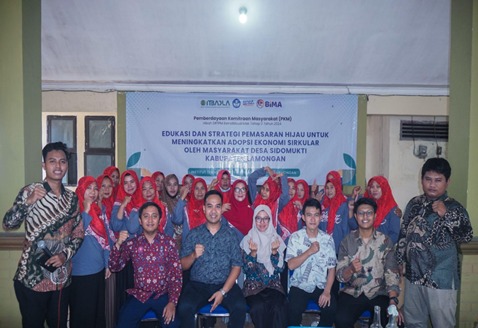
The Community Partnership Program (PKM) implemented in Sidomukti Village, Lamongan Regency, focuses on education and green marketing strategies to increase the adoption of a circular economy. The program objectives are: Empowering communities through processing coconut water waste into nata de coco. The activity is carried out by providing training on product marketing strategies, which are expected to improve the economic welfare of the community and reduce waste by encouraging local entrepreneurship. Despite challenges such as limited knowledge and facilities, ongoing training and support are expected to help communities overcome obstacles and achieve success. The benefits of the program include: Improving production infrastructure and utilizing digital marketing. The method used is to build sustainable partnerships and conduct periodic evaluations. This method is expected to provide long-term benefits for the people of Sidomukti Village. The program activities include socialization, training, technology application, mentoring, and evaluation. The community learns the production and marketing process of nata de coco, which has high economic value. As a result, the community gains new skills, increases income, and awareness of sustainable waste management. This program encourages collaboration with academics, government, and the private sector for better business development. It is that this program will succeed in improving community and environmental welfare. It is recommended to continue training and product innovation, was designed in the form of the enrichment program for weekend class was effectively run.
Downloads
References
Agyabeng-Mensah, Y., Tang, L., Afum, E., Baah, C., & Dacosta, E. (2021). Organisational identity and circular economy: Are inter and intra organisational learning, lean management and zero waste practices worth pursuing? Sustainable Production and Consumption, 28, 648–662. https://doi.org/10.1016/j.spc.2021.06.018
Alonso-Almeida, M. del M., Rodríguez-Antón, J. M., Bagur-Femenías, L., & Perramon, J. (2020). Sustainable development and circular economy: The role of institutional promotion on circular consumption and market competitiveness from a multistakeholder engagement approach. Business Strategy and the Environment, 29(6), 2803–2814. https://doi.org/10.1002/bse.2544
Arsawan, I. W. E., Koval, V., Suhartanto, D., Hariyanti, N. K. D., Polishchuk, N., & Bondar, V. (2024). Circular economy practices in SMEs: aligning model of green economic incentives and environmental commitment. International Journal of Productivity and Performance Management, 73(3), 775–793. https://doi.org/10.1108/IJPPM-03-2022-0144
Bag, S., Dhamija, P., Bryde, D. J., & Singh, R. K. (2022). Effect of eco-innovation on green supply chain management, circular economy capability, and performance of small and medium enterprises. Journal of Business Research, 141, 60–72. https://doi.org/10.1016/j.jbusres.2021.12.011
Cantú, A., Aguiñaga, E., & Scheel, C. (2021). Learning from failure and success: The challenges for circular economy implementation in SMEs in an emerging economy. Sustainability (Switzerland), 13(3), 1–34. https://doi.org/10.3390/su13031529
Centobelli, P., Cerchione, R., Esposito, E., Passaro, R., & Shashi. (2021). Determinants of the transition towards circular economy in SMEs: A sustainable supply chain management perspective. International Journal of Production Economics, 242. https://doi.org/10.1016/j.ijpe.2021.108297
Chen, T. L., Kim, H., Pan, S. Y., Tseng, P. C., Lin, Y. P., & Chiang, P. C. (2020). Implementation of green chemistry principles in circular economy system towards sustainable development goals: Challenges and perspectives. Science of the Total Environment, 716. https://doi.org/10.1016/j.scitotenv.2020.136998
D’Amato, D., & Korhonen, J. (2021). Integrating the green economy, circular economy and bioeconomy in a strategic sustainability framework. Ecological Economics, 188. https://doi.org/10.1016/j.ecolecon.2021.107143
de Souza, E. D., Kerber, J. C., Bouzon, M., & Rodriguez, C. M. T. (2022). Performance evaluation of green logistics: Paving the way towards circular economy. Cleaner Logistics and Supply Chain, 3. https://doi.org/10.1016/j.clscn.2021.100019
Dwivedi, A., & Paul, S. K. (2022). A framework for digital supply chains in the era of circular economy: Implications on environmental sustainability. Business Strategy and the Environment, 31(4), 1249–1274. https://doi.org/10.1002/bse.2953
García-Salirrosas, E. E., & Rondon-Eusebio, R. F. (2022). Green Marketing Practices Related to Key Variables of Consumer Purchasing Behavior. Sustainability (Switzerland), 14(14). https://doi.org/10.3390/su14148499
Gustavo, J. U., Trento, L. R., de Souza, M., Pereira, G. M., Lopes de Sousa Jabbour, A. B., Ndubisi, N. O., Chiappetta Jabbour, C. J., Borchardt, M., & Zvirtes, L. (2021). Green marketing in supermarkets: Conventional and digitized marketing alternatives to reduce waste. Journal of Cleaner Production, 296. https://doi.org/10.1016/j.jclepro.2021.126531
Hamam, M., Chinnici, G., Di Vita, G., Pappalardo, G., Pecorino, B., Maesano, G., & D’Amico, M. (2021). Circular economy models in agro-food systems: A review. Sustainability (Switzerland), 13(6). https://doi.org/10.3390/su13063453
Jing Shi, Deyan Yang, Zunxiao Zheng, Y. Z. (2022). Strategic investment for green product development and green marketing in a supply chain. Journal of Cleaner Production, Volume 366. https://doi.org/10.1016/j.jclepro.2022.132868
Kaur, B., Gangwar, V. P., & Dash, G. (2022). Green Marketing Strategies, Environmental Attitude, and Green Buying Intention: A Multi-Group Analysis in an Emerging Economy Context. Sustainability (Switzerland), 14(10). https://doi.org/10.3390/su14106107
Kazancoglu, I., Sagnak, M., Kumar Mangla, S., & Kazancoglu, Y. (2021). Circular economy and the policy: A framework for improving the corporate environmental management in supply chains. Business Strategy and the Environment, 30(1), 590–608. https://doi.org/10.1002/bse.2641
Kevin van Langen, S., Vassillo, C., Ghisellini, P., Restaino, D., Passaro, R., & Ulgiati, S. (2021). Promoting circular economy transition: A study about perceptions and awareness by different stakeholders groups. Journal of Cleaner Production, 316. https://doi.org/10.1016/j.jclepro.2021.128166
Khan, S. A. R., Umar, M., Asadov, A., Tanveer, M., & Yu, Z. (2022). Technological Revolution and Circular Economy Practices: A Mechanism of Green Economy. Sustainability (Switzerland), 14(8). https://doi.org/10.3390/su14084524
Kristiandi, K., Merdekawati, D., Sangkala, S., & Sari, D. (2022). Pendampingan Pembuatan Nata De Coco Dari Limbah Air Kelapa Tua Di Desa Perapakan. To Maega : Jurnal Pengabdian Masyarakat, 5(2), 223. https://doi.org/10.35914/tomaega.v5i2.1039
Kumar Kar, S., & Harichandan, S. (2022). Green marketing innovation and sustainable consumption: A bibliometric analysis. Journal of Cleaner Production, 361. https://doi.org/10.1016/j.jclepro.2022.132290
Kumar, M., Raut, R. D., Jagtap, S., & Choubey, V. K. (2023). Circular economy adoption challenges in the food supply chain for sustainable development. Business Strategy and the Environment, 32(4), 1334–1356. https://doi.org/10.1002/bse.3191
Kustyawati, M. E., Rizal, S., Suharyono, S., & Nawansih, O. (2023). Aplikasi Teknologi Fermentasi Nata Decoco Untuk Memanfaatkan Limbah Air Kelapa Di Desa Bunut Pesawaran. Jurnal Pengabdian Fakultas Pertanian Universitas Lampung, 2(1), 265. https://doi.org/10.23960/jpfp.v2i1.6985
Li, Q., Guan, X., Shi, T., & Jiao, W. (2020). Green product design with competition and fairness concerns in the circular economy era. International Journal of Production Research, 58(1), 165–179. https://doi.org/10.1080/00207543.2019.1657249
Manurung, H., Naibaho, B., & Simbolon, E. (2024). Pengaruh amonium sulfat dan gula terhadap bobot produksi, ketebalan, kekerasan dan kadar serat nata de coco. Journal of Agricultural Sciences (AJAS), 1(1), 1–10.
Mardin, H., & Lasalewo, T. (2021). Pelatihan Pembuatan Nata De Coco Dari Limbah Air Kelapa Di Desa Dunu Kecamatan Monano Kabupaten Gorontalo Utara. Jurnal Abdimas Gorontalo (JAG), 4(1), 24–28. https://doi.org/10.30869/jag.v4i1.636
Marrucci, L., Daddi, T., & Iraldo, F. (2021). The contribution of green human resource management to the circular economy and performance of environmental certified organisations. Journal of Cleaner Production, 319. https://doi.org/10.1016/j.jclepro.2021.128859
Milios, L. (2021). Overarching policy framework for product life extension in a circular economy—A bottom-up business perspective. Environmental Policy and Governance, 31(4), 330–346. https://doi.org/10.1002/eet.1927
Moreno-Mondéjar, L., Triguero, Á., & Cuerva, M. C. (2021). Exploring the association between circular economy strategies and green jobs in European companies. Journal of Environmental Management, 297. https://doi.org/10.1016/j.jenvman.2021.113437
Nayal, K., Kumar, S., Raut, R. D., Queiroz, M. M., Priyadarshinee, P., & Narkhede, B. E. (2022). Supply chain firm performance in circular economy and digital era to achieve sustainable development goals. Business Strategy and the Environment, 31(3), 1058–1073. https://doi.org/10.1002/bse.2935
Ncube, A., Mtetwa, S., Bukhari, M., Fiorentino, G., & Passaro, R. (2023). Circular Economy and Green Chemistry: The Need for Radical Innovative Approaches in the Design for New Products. Energies, 16(4). https://doi.org/10.3390/en16041752
Prieto-Sandoval, V., Torres-Guevara, L. E., & García-Díaz, C. (2022). Green marketing innovation: Opportunities from an environmental education analysis in young consumers. Journal of Cleaner Production, 363. https://doi.org/10.1016/j.jclepro.2022.132509
Sharma, N. K., Govindan, K., Lai, K. K., Chen, W. K., & Kumar, V. (2021). The transition from linear economy to circular economy for sustainability among SMEs: A study on prospects, impediments, and prerequisites. Business Strategy and the Environment, 30(4), 1803–1822. https://doi.org/10.1002/bse.2717
Suchek, N., Fernandes, C. I., Kraus, S., Filser, M., & Sjögrén, H. (2021). Innovation and the circular economy: A systematic literature review. Business Strategy and the Environment, 30(8), 3686–3702. https://doi.org/10.1002/bse.2834
Sulich, A., & Sołoducho-Pelc, L. (2022). The circular economy and the Green Jobs creation. Environmental Science and Pollution Research, 29(10), 14231–14247. https://doi.org/10.1007/s11356-021-16562-y
Tang, Y. M., Chau, K. Y., Fatima, A., & Waqas, M. (2022). Industry 4.0 technology and circular economy practices: business management strategies for environmental sustainability. Environmental Science and Pollution Research, 29(33), 49752–49769. https://doi.org/10.1007/s11356-022-19081-6
Yu, Z., Khan, S. A. R., & Umar, M. (2022). Circular economy practices and industry 4.0 technologies: A strategic move of automobile industry. Business Strategy and the Environment, 31(3), 796–809. https://doi.org/10.1002/bse.2918
Downloads
Published
How to Cite
Issue
Section
License
Copyright (c) 2025 Sulton, et al

This work is licensed under a Creative Commons Attribution-ShareAlike 4.0 International License.