Empowering physics educators through technology-based teaching material workshops: A teachers’ perspective
DOI:
https://doi.org/10.22219/jcse.v6i1.39637Keywords:
Physics learning, STEM, Technology Integration, Teaching Materials, Teacher’s WorkshopAbstract
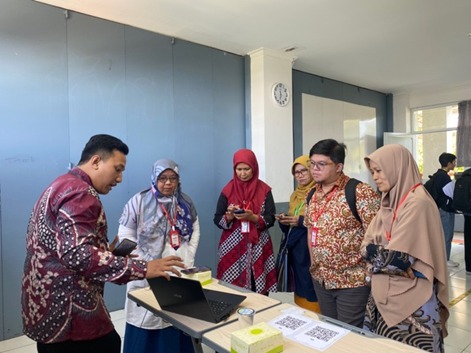
Integrating technology into physics education is critical in preparing students with 21st-century skills. However, many physics teachers in Indonesia face challenges, including limited access to technological tools, insufficient training, and low confidence in using technology. This study aimed to explore the perspectives of physics teachers on a workshop designed to empower them in developing technology-based teaching materials. The workshop, held in Bandung Barat, provided hands-on training on integrating various technologies, such as Augmented Reality, Physics Mobile, Live Worksheets, and Articulate Storylines, into physics teaching. Data were collected from 51 participating teachers using a descriptive survey method through structured questionnaires. Results indicated high satisfaction across four evaluated aspects: material comprehension (mean score: 4.29), relevance and benefits (4.15), implementation and facilitation (4.17), and outcomes and impacts (4.20). Teachers perceived an increase in their confidence and readiness tp create innovative teaching materials, though some required additional time and support for mastery. This study highlights workshops' significance in bridging the gap between technology and education. It emphasizes the need for sustained training programs and collaboration among educators, policymakers, and technology developers to enhance the quality of STEM-based physics education in Indonesia.
Downloads
References
Akudugu, M. A., & Abagale, F. K. (2024). Building inclusive ethical cultures in STEM. In Hildt, E., Laas, K., Brey, E.M., Miller, C.Z (Eds), Ethics education in science, technology, engineering and mathematics (STEM) in africa: A reflection on the successes, failures and the way forward in the era of a global pandemic. Springer. https://doi.org/10.1007/978-3-031-51560-6_7
AlAli, R. (2024). Enhancing 21st century skills through integrated stem education using project-oriented problem-based learning. GeoJournal of Tourism and Geosites, 53(2), 421–430. https://doi.org/10.30892/gtg.53205-1217
Alfira, A., Salmilah, S., & Suryani, L. (2024). Revolutionizing learning. International Journal of Asian Education, 5(2), 141–149. https://doi.org/10.46966/ijae.v5i2.385
Anderson, S. E., & Putman, R. S. (2020). Special education teachers’ experience, confidence, beliefs, and knowledge about integrating technology. Journal of Special Education Technology, 35(1), 37–50. https://doi.org/10.1177/0162643419836409
Astuti, I. A. D., Bhakti, Y. B., Sumarni, R. A., Sulisworo, D., & Toifur, M. (2021). Flipped classroom and kahoot in physics learning: improving students’ motivation learning. International Journal of Educational Management and Innovation, 2(2), 175. https://doi.org/10.12928/ijemi.v2i2.3491
Azlan, C. A., Wong, J. H. D., Tan, L. K., A.D. Huri, M. S. N., Ung, N. M., Pallath, V., Tan, C. P. L., Yeong, C. H., & Ng, K. H. (2020). Teaching and learning of postgraduate medical physics using Internet-based e-learning during the COVID-19 pandemic – A case study from Malaysia. Physica Medica, 80, 10–16. https://doi.org/10.1016/j.ejmp.2020.10.002
Basilotta Gómez-Pablos, V., Martín del Pozo, M., & García-Valcárcel Muñoz-Repiso, A. (2017). Project-based learning (PBL) through the incorporation of digital technologies: An evaluation based on the experience of serving teachers. Computers in Human Behavior, 68, 501–512. https://doi.org/10.1016/j.chb.2016.11.056
Cai, S., Liu, C., Wang, T., Liu, E., & Liang, J. (2021). Effects of learning physics using augmented reality on students’ self‐efficacy and conceptions of learning. British Journal of Educational Technology, 52(1), 235–251. https://doi.org/10.1111/bjet.13020
Creswell, J. W., & Creswell, J. D. (2018). Research Design: Qualitative, Quantitative, and Mixed Methods Approaches. Sage.
Dillman, D. A., Smyth, J. D., & Christian, L. M. (2014). Internet, phone, mail, and mixed-mode surveys: The tailored design method. John Wiley & Sons.
Dinc, E. (2019). Prospective teachers’ perceptions of barriers to technology integration in education. Contemporary Educational Technology, 10(4), 381–398. https://doi.org/10.30935/cet.634187
Dominguez, A., De la Garza, J., Quezada-Espinoza, M., & Zavala, G. (2023). integration of physics and mathematics in STEM education: use of modeling. Education Sciences, 14(1), 20. https://doi.org/10.3390/educsci14010020
Elstad, E., & Christophersen, K.-A. (2017). Perceptions of digital competency among student teachers: contributing to the development of student teachers’ instructional self-efficacy in technology-rich classrooms. Education Sciences, 7(1), 27. https://doi.org/10.3390/educsci7010027
Falloon, G. (2020). From digital literacy to digital competence: the teacher digital competency (TDC) framework. Educational Technology Research and Development, 68(5), 2449–2472. https://doi.org/10.1007/s11423-020-09767-4
Fatimah, A. S., & Santiana, S. (2017). Teaching in 21st century: students-teachers’ perceptions of technology use in the classroom. Script Journal: Journal of Linguistic and English Teaching, 2(2), 125. https://doi.org/10.24903/sj.v2i2.132
Fidan, M., & Tuncel, M. (2021). Developing a self-efficacy scale toward physics subjects for lower-secondary school students. Journal of Baltic Science Education, 20(1), 38–49. https://doi.org/10.33225/jbse/21.20.38
Fowler, F. J. (2014). The problem with survey research. Contemporary Sociology: A Journal of Reviews, 43(5), 660–662. https://doi.org/10.1177/0094306114545742f
Gamage, K. A. A., Ekanayake, S. Y., & Dehideniya, S. C. P. (2022). Embedding sustainability in learning and teaching: lessons learned and moving forward—approaches in STEM higher education programmes. Education Sciences, 12(3), 225. https://doi.org/10.3390/educsci12030225
Gleaton, E., Parcell, E., Madera, M., Catrambone, R., & Walker, B. (2023). Understanding user perspectives: what is the meaning of technology mastery?. Proceedings of the Human Factors and Ergonomics Society Annual Meeting, 67(1), 2490–2493. https://doi.org/10.1177/21695067231192628
Holmes, M. (2023). Time scarcity and student performance: instructional strategies for busy adult online students. Canadian Journal of Learning and Technology, 48(3), 1–14. https://doi.org/10.21432/cjlt28357
Jääskelä, P., Häkkinen, P., & Rasku-Puttonen, H. (2017). Teacher beliefs regarding learning, pedagogy, and the use of technology in higher education. Journal of Research on Technology in Education, 49(3–4), 198–211. https://doi.org/10.1080/15391523.2017.1343691
Juškevičienė, A., Dagienė, V., & Dolgopolovas, V. (2021). Integrated activities in STEM environment: Methodology and implementation practice. Computer Applications in Engineering Education, 29(1), 209–228. https://doi.org/10.1002/cae.22324
Kafyulilo, A., Fisser, P., & Voogt, J. (2016). Factors affecting teachers’ continuation of technology use in teaching. Education and Information Technologies, 21(6), 1535–1554. https://doi.org/10.1007/s10639-015-9398-0
Lai, C., Yeung, Y., & Hu, J. (2016). University student and teacher perceptions of teacher roles in promoting autonomous language learning with technology outside the classroom. Computer Assisted Language Learning, 29(4), 703–723. https://doi.org/10.1080/09588221.2015.1016441
Li, W., & Austria, R. S. (2023). Supervision and management of teaching quality of college teachers in h university. Journal of Education, Humanities and Social Sciences, 21, 235–240. https://doi.org/10.54097/ehss.v21i.14010
Martínez-Borreguero, G., Naranjo-Correa, F. L., & Mateos-Núñez, M. (2022). Development of STEM instructional resources for teaching optics to teachers-in-training: influence on learning and teacher self-efficacy. Education Sciences, 12(3), 186. https://doi.org/10.3390/educsci12030186
Masrek, M. N., & Baharuddin, M. F. (2023). Screens, streams, and stress: a qualitative study on how distance learning students cope with information overload. International Journal of Membrane Science and Technology, 10(5), 47–58. https://doi.org/10.15379/ijmst.v10i5.2417
Mbowane, C. K., De Villiers, J. J. R., & Braun, M. W. H. (2017). Teacher participation in science fairs as professional development in South Africa. South African Journal of Science, 113(7/8), 7. https://doi.org/10.17159/sajs.2017/20160364
McKnight, K., O’Malley, K., Ruzic, R., Horsley, M. K., Franey, J. J., & Bassett, K. (2016). Teaching in a digital age: how educators use technology to improve student learning. Journal of Research on Technology in Education, 48(3), 194–211. https://doi.org/10.1080/15391523.2016.1175856
Nikitina, I., & Ishchenko, T. (2022). Implementation of stem education system in Ukraine. Scientific Journal of Polonia University, 51(2), 108–114. https://doi.org/10.23856/5114
Omar Taky-eddine, & Redouane Madaoui. (2024). Cognitive overload in the hypertext reading environment. International Journal of English Language Studies, 6(2), 94–100. https://doi.org/10.32996/ijels.2024.6.2.13
Prayogi, S., & Verawati, N. N. S. P. (2024). Physics learning technology for sustainable development goals (SDGs): a literature study. International Journal of Ethnoscience and Technology in Education, 1(2), 155. https://doi.org/10.33394/ijete.v1i2.12316
Qi, J. (2024). Research on the construction of teachers’ lifelong learning mechanism based on the concept of quality education. Transactions on Comparative Education, 6(3). https://doi.org/10.23977/trance.2024.060304
Rahmat, A. D., Kuswanto, H., Wilujeng, I., & Perdana, R. (2023). Implementation of mobile augmented reality on physics learning in junior high school students. Journal of Education and E-Learning Research, 10(2), 132–140. https://doi.org/10.20448/jeelr.v10i2.4474
Slava, K., & Tzu-Chien, L. (2015). Guest Editorial: Managing cognitive load in technology-based learning environments. Educational Technology & Society, . Educational Technology and Society, 18(4), 1–8.
Souheyla, B., & Nassima, B. (2022). Taking the wave of digitalization: reflection on the psychological readiness of teachers in using information and communication technologies. Arab World English Journal, 8, 121–135. https://doi.org/10.24093/awej/call8.8
Topsakal, İ., Yalçın, S. A., & Çakır, Z. (2022). The effect of problem-based STEM education on the students’ critical thinking tendencies and their perceptions for problem solving skills. Science Education International, 33(2), 136–145. https://doi.org/10.33828/sei.v33.i2.1
Tupchenko. (2021). Time-management as a pedagogical technology of students’ educational activity. Problemi Ìnženerno-Pedagogìčnoï Osvìti, 73. https://doi.org/10.32820/2074-8922-2021-73-138-144
Tuveri, M., Steri, A., Fadda, D., Stefanizzi, R., Fanti, V., & Bonivento, W. M. (2024). Fostering the interdisciplinary learning of contemporary physics through digital technologies: The “gravitas” project. Digital, 4(4), 971–989. https://doi.org/10.3390/digital4040048
Uden, L., Sulaiman, F., Ching, G. S., & Rosales, J. J. (2023). Integrated science, technology, engineering, and mathematics project-based learning for physics learning from neuroscience perspectives. Frontiers in Psychology, 14. https://doi.org/10.3389/fpsyg.2023.1136246
United Nations Department of Economic and Social Affairs. The 17 Goals. https://sdgs.un.org/goals
Wang, L.-H., Chen, B., Hwang, G.-J., Guan, J.-Q., & Wang, Y.-Q. (2022). Effects of digital game-based STEM education on students’ learning achievement: a meta-analysis. International Journal of STEM Education, 9(1), 26. https://doi.org/10.1186/s40594-022-00344-0
Winter, E., Costello, A., O’Brien, M., & Hickey, G. (2021). Teachers’ use of technology and the impact of Covid-19. Irish Educational Studies, 40(2), 235–246. https://doi.org/10.1080/03323315.2021.1916559
Yulianci, S., Nurjumiati, N., Asriyadin, A., & Adiansha, A. A. (2021). The effect of interactive multimedia and learning styles on students’ physics creative thinking skills. Jurnal Penelitian Pendidikan IPA, 7(1), 87–91. https://doi.org/10.29303/jppipa.v7i1.529
Zhang, Y., Ye, H., & Chen, H. (2024). Construction of a new lifelong education system based on vector analysis algorithms for information age services. Computer Applications in Engineering Education, 32(6). https://doi.org/10.1002/cae.22774
Zheng, T., Ardolino, M., Bacchetti, A., Perona, M., & Zanardini, M. (2019). The impacts of Industry 4.0: a descriptive survey in the Italian manufacturing sector. Journal of Manufacturing Technology Management, 31(5), 1085–1115. https://doi.org/10.1108/JMTM-08-2018-0269
Downloads
Published
How to Cite
Issue
Section
License
Copyright (c) 2025 Shintya, et al

This work is licensed under a Creative Commons Attribution-ShareAlike 4.0 International License.