Towards CLIL-based international classes: Preparatory endeavours through training of English-mediated instruction
DOI:
https://doi.org/10.22219/jcse.v6i1.40320Keywords:
CLIL, International Classes, Training, Mentoring, English Mediated InstructionAbstract
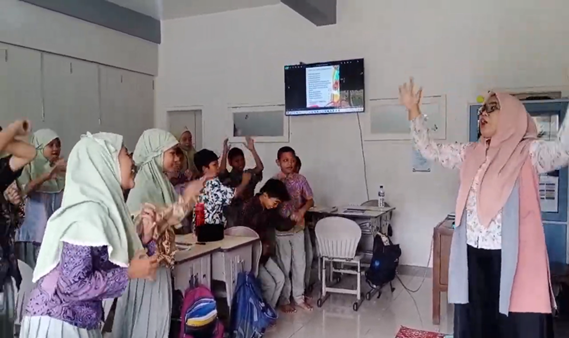
In today’s global era, the internationalization of educational institutions is crucial. SD Muhammadiyah 4 Kota Malang acknowledged this necessity and is committed to providing high-quality education by adapting international standards. To fulfill this commitment as well as to support Sustainable Development Goal (SDG) No. 4, the school aims to create an international learning environment where teachers and students use English for instructions. Content and Language Integrated Learning (CLIL) is a suitable approach for internationalizing education at this school, as it integrates subject learning with language development. This community service aimed to train and mentor teachers in using English effectively for international class preparation. The program focused on three key objectives: (1) enhancing teachers’ comprehension about CLIL, translanguaging, and trans-semiotizing concepts, (2) developing Classroom Passwords for all grade levels, and (3) implementing translanguaging and trans-semiotizing strategies. By understanding and applying CLIL, translanguaging, and trans-semiotizing, teachers can overcome anxiety about English use in the classroom. The teachers created verified Classroom Passwords which were registered for their intellectual property right and practiced translanguaging and trans-semiotizing in peer-teaching and real classroom settings as well as in virtual environment using Virtual Reality (VR).
Downloads
References
Aguilar, M., & Muñoz, C. (2014). The effect of proficiency on CLIL benefits in Engineering students in Spain. International Journal of Applied Linguistics (United Kingdom), 24(1), 1–18. https://doi.org/10.1111/ijal.12006
Dalton-Puffer, C. (2011). Content-and-language integrated learning: From practice to principles? In Annual Review of Applied Linguistics. https://doi.org/10.1017/S0267190511000092
de Oliveira, L. C., Jones, L., & Smith, S. L. (2020). Interactional scaffolding in a first-grade classroom through the teaching–learning cycle. International Journal of Bilingual Education and Bilingualism, 0(0), 1–19. https://doi.org/10.1080/13670050.2020.1798867
Fauzan, Setyaningrum, R. W., & Suparto. (2023). Pointed polysynchronous interactions in CLIL mathematics class during the COVID-19 pandemic: Translation, translanguaging, and trans-semiotizing. Cogent Education, 10(1). https://doi.org/10.1080/2331186X.2023.2208776
Fernández-Fontecha, A., O’Halloran, K. L., Wignell, P., & Tan, S. (2020). Scaffolding CLIL in the science classroom via visual thinking: A systemic functional multimodal approach. Linguistics and Education, 55, 100788. https://doi.org/10.1016/j.linged.2019.100788
Khoiriyah, K. (2021). Content and Language Integrated Learning (CLIL) in Indonesian context: An Overview. Jurnal Pendidikan Progresif, 11(November), 587–601. https://doi.org/10.23960/jpp.v11.i3.202110
Khoiriyah, K., Farah, R. R., & Anggraeni, L. (2022). Integrating Islamic values in CLIL materials: a syllabus design for Islamic primary school. Journal of English Language Studies, 7(1), 12. https://doi.org/10.30870/jels.v7i1.13297
Lestiono, R., & Lee, S. M. (2024). Virtual reality exposure therapy for reducing students’ public speaking anxiety: A systematic review. JALT CALL Journal, 20(2), 1–24. https://doi.org/10.29140/jaltcall.v20n2.1515
Lin, A. M. Y. (2015). Conceptualising the potential role of L1 in CLIL. Language, Culture and Curriculum, 28(1), 74–89. https://doi.org/10.1080/07908318.2014.1000926
Lin, A. M. Y. (2019). Theories of trans/languaging and trans-semiotizing: implications for content-based education classrooms. International Journal of Bilingual Education and Bilingualism, 22(1), 5–16. https://doi.org/10.1080/13670050.2018.1515175
Liu, Y. (2020). Translanguaging and trans-semiotizing as planned systematic scaffolding: examining feeling-meaning in CLIL classrooms. English Teaching and Learning, 44(2), 149–173. https://doi.org/10.1007/s42321-020-00057-z
Lo, Y. Y. (2015). How much L1 is too much? Teachers’ language use in response to students’ abilities and classroom interaction in Content and Language Integrated Learning. International Journal of Bilingual Education and Bilingualism, 18(3), 270–288. https://doi.org/10.1080/13670050.2014.988112
Martí, O. (2020). Content and language integrated learning: Which language? How is it integrated? What for? Caplletra, 68, 219–242. https://doi.org/10.7203/CAPLLETRA.68.16478
Ramadhan, M. N. P. (2023). The Role of SDG 4: Quality Education on the Internationalization of Indonesia’s Education. Hasanuddin Journal of Strategic and International Studies (HJSIS), 1(2), 39–51. https://doi.org/10.20956/hjsis.v1i2.27442
Rohmah, I. I. T. (2019). The Feasibility and Effectiveness of Integrating Content Knowledge and English Competences for Assessing English Proficiency in CLIL. ETERNAL (English Teaching Journal), 10(1). https://doi.org/10.26877/eternal.v10i1.3909
Setyaningrum, R. W. (2023). Translanguaging in content and anguage integrated learning classrooms at Islamic primary schools of Indonesia. Universitas Negeri Surabaya.
Setyaningrum, R. W., & Khoiriyah. (2022). Core Features of Content and Language Integrated Learning (CLIL): An Exploratory Study in Indonesian Primary Schools. Mextesol Journal, 46(3), 0–1.
Setyaningrum, R. W., & Purwati, O. (2020). Projecting the Implementation Feasibility of CLIL Approach for TEYL at Primary Schools in Indonesia. JEES (Journal of English Educators Society), 5(1), 23–30. https://doi.org/10.21070/jees.v5i1.352
Setyaningrum, R. W., Sabilah, F., & Sumarsono, P. (2020). Innovative Design for Pre-Service English for Young Learners ( EYL ) Teachers Education With Indonesian Setting. Advances in Social Science, Education and Humanities Research, 477, 621–625.
Setyaningrum, R. W., Setiawan, S., & Anam, S. (2022). Translanguaging as a scaffolded practice in a primary school content and language integrated learning context during the COVID-19 pandemic. European Journal of Educational Research, 11(3), 2043–2055.
Setyaningrum, R. W., Setiawan, S., Anam, S., & Retnaningdyah, P. (2020). Content and language integrated learning (CLIL) in science class during Covid-19 outbreak: A narrative inquiry. English Review: Journal of English Education, 9(1), 35–46.
Downloads
Published
How to Cite
Issue
Section
License
Copyright (c) 2025 Rina Wahyu Setyaningrum, Riski Lestiono, Rosalin Ismayoeng Gusdian

This work is licensed under a Creative Commons Attribution-ShareAlike 4.0 International License.