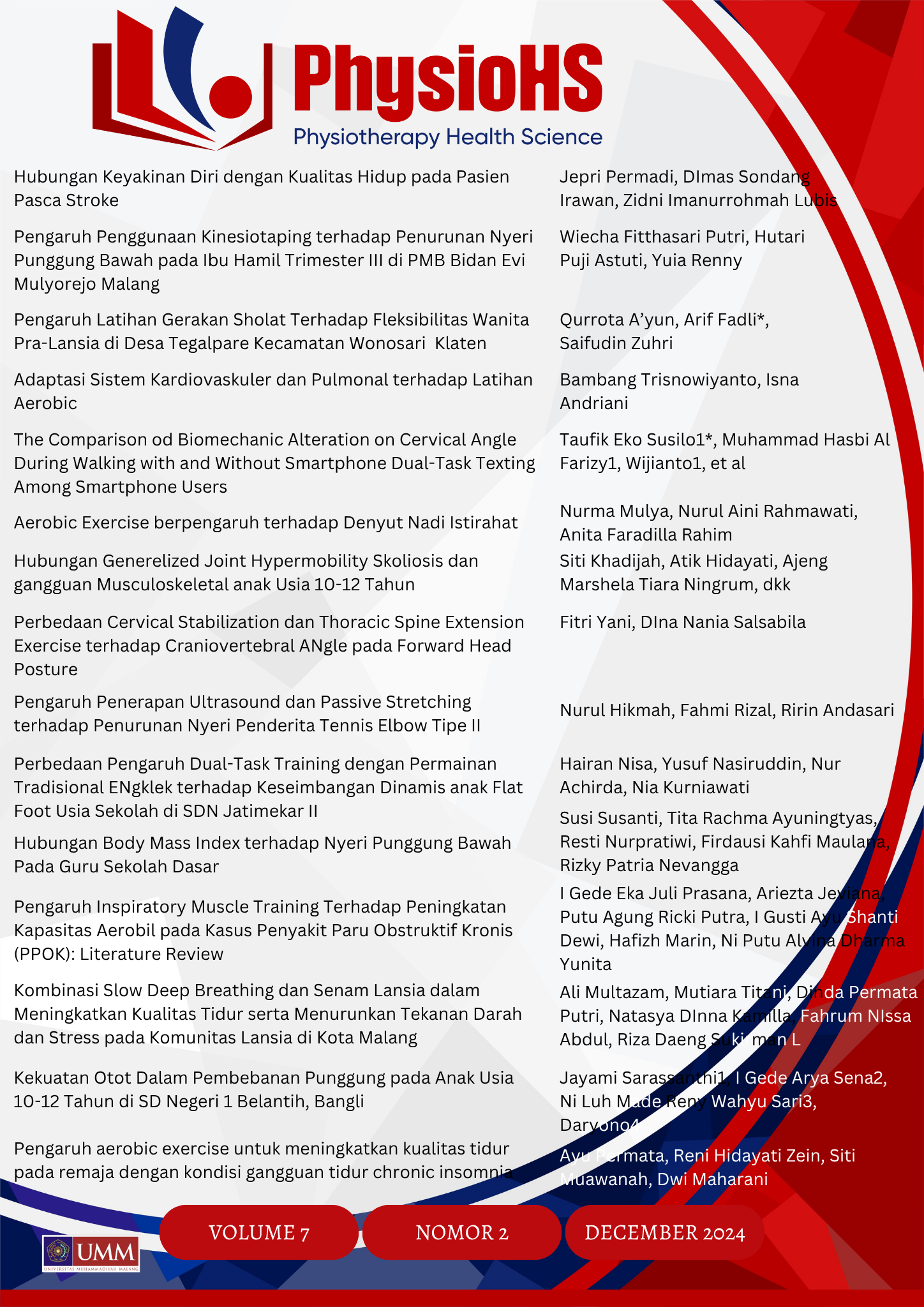
The Comparison of Biomechanic Alteration on Cervical Angle During Walking with And Without Smartphone Dual-Task Texting Among Smartphone Users
DOI:
https://doi.org/10.22219/physiohs.v7i2.35859Keywords:
cervical angle, dual-task walking, biomechanic, smartphone, textingAbstract
Background: The prevalence of smartphone usage continues to rise, becoming deeply embedded in daily routines across all age groups. Young adults are particularly significant users, often engaging in dual-tasking, such as texting while walking. This behavior may lead to biomechanical alterations, particularly in cervical posture, which could have long-term musculoskeletal implications. Objective: This study investigates the biomechanical alterations in cervical angle during walking with and without dual-task texting among smartphone users, specifically focusing on young adults. Method: A quantitative observational study was conducted using a single group repeated measurement design. Thirty male participants, aged 21.07 ± 1.05 years, were involved. Cervical angle degrees were measured using video analysis, with data processed through the Kinovea application to extract kinematic coordinates. Results: The One Way Repeated ANOVA Test revealed a significant increase (p<0.01) in cervical angle degree during texting while walking, indicating that dual-tasking notably affects cervical posture. Conclusion: The findings highlight that dual-task texting induces significant biomechanical changes in cervical posture.
Downloads
References
Agostini, V., Lo Fermo, F., Massazza, G., Knaflitz, M. J. J. o. n., & rehabilitation. (2015). Does texting while walking really affect gait in young adults? , 12, 1-10.
Bertozzi, L., Negrini, S., Agosto, D., Costi, S., Guccione, A. A., Lucarelli, P., . . . therapies, m. (2021). Posture and time spent using a smartphone are not correlated with neck pain and disability in young adults: A cross-sectional study. 26, 220-226.
Betsch, M., Kalbhen, K., Michalik, R., Schenker, H., Gatz, M., Quack, V., . . . posture. (2021). The influence of smartphone use on spinal posture–A laboratory study. 85, 298-303.
Çevik, S., Kaplan, A., & Katar, S. J. N. J. o. C. P. (2020). Correlation of cervical spinal degeneration with rise in smartphone usage time in young adults. 23(12), 1748-1752.
Chun, H.-L., Kim, K.-H., & Choi, B.-R. J. J. o. K. P. T. S. (2017). The Effects of Sitting Posture on Cervical Flexion Angle and Pain during Smart Phone Use in Young Adults. 24(3), 56-63.
Crowley, P., Madeleine, P., & Vuillerme, N. J. B. r. n. (2019). The effects of mobile phone use on walking: a dual task study. 12, 1-6.
Goadrich, M. H., & Rogers, M. P. (2011). Smart smartphone development: iOS versus Android. Paper presented at the Proceedings of the 42nd ACM technical symposium on Computer science education.
Goddard, E. C., Remler, P. T., Roos, R. H., Turchyn, R. J. W. U. R. J. H., & Sciences, N. (2018). The Effect of Texting on Balance and Temporospatial Aspects of Gait. 9(1).
Guyon Jr, P. W., Corroon, J., Ferran, K., Hollenbach, K., & Nguyen, M. J. G. p. h. (2020). Hold the phone! Cell phone-related injuries in children, teens, and young adults are on the rise. 7, 2333794X20968459.
Han, H., & Shin, G. J. A. e. (2019). Head flexion angle when web-browsing and texting using a smartphone while walking. 81, 102884.
Jacquier-Bret, J., & Gorce, P. J. B. M. D. (2023). Effect of day time on smartphone use posture and related musculoskeletal disorders risk: a survey among university students. 24(1), 725.
Kim, S.-H., Jung, J.-H., Shin, H.-j., Hahm, S.-C., & Cho, H.-y. J. P. o. (2020). The impact of smartphone use on gait in young adults: Cognitive load vs posture of texting. 15(10), e0240118.
Lee, S., Kang, H., & Shin, G. J. E. (2015). Head flexion angle while using a smartphone. 58(2), 220-226.
McGarry, L. M., & Carter, A. G. J. C. r. (2017). Prefrontal cortex drives distinct projection neurons in the basolateral amygdala. 21(6), 1426-1433.
Niederer, D., Bumann, A., Mühlhauser, Y., Schmitt, M., Wess, K., Engeroff, T., . . . posture. (2018). Specific smartphone usage and cognitive performance affect gait characteristics during free-living and treadmill walking. 62, 415-421.
Saraiva, M., Castro, M. A., & Vilas-Boas, J. P. J. H. M. S. (2023). Influence of cognitive and motor tasks using smartphone during gait: EMG and gait performance analysis–Dual-task study. 89, 103097.
Schabrun, S. M., van den Hoorn, W., Moorcroft, A., Greenland, C., & Hodges, P. W. J. P. o. (2014). Texting and walking: strategies for postural control and implications for safety. 9(1), e84312.
Susilo, T., Bovonsunthonchai, S., & Wattananon, P. J. H. M. (2022). Spatiotemporal gait and centre of mass variables while performing different smartphone tasks and confronting obstacle among young adults. 23(3), 92-103.
Xie, Y. F., Szeto, G., Madeleine, P., & Tsang, S. J. A. e. (2018). Spinal kinematics during smartphone texting–A comparison between young adults with and without chronic neck-shoulder pain. 68, 160-168.
Yano, S., Nakamura, A., Suzuki, Y., Smith, C. E., & Nomura, T. J. S. r. (2024). Smartphone usage during walking decreases the positive persistency in gait cycle variability. 14(1), 16410.
Downloads
Published
How to Cite
Issue
Section
License
Copyright (c) 2024 Taufik Eko Susilo, Muhammad Hasbi Al Farizy

This work is licensed under a Creative Commons Attribution-ShareAlike 4.0 International License.
Authors who publish with Physiotherapy Health Science (PhysioHS) agree to the following terms:
- For all articles published in Physiotherapy Health Science (PhysioHS), copyright is retained by the authors. Authors give permission to the publisher to announce the work with conditions. When the manuscript is accepted for publication, the authors agree to automatic transfer of the publishing right to the publisher.
- Authors retain copyright and grant the journal right of first publication with the work simultaneously licensed under a Creative Commons Attribution-ShareAlike 4.0 International License that allows others to share the work with an acknowledgement of the work's authorship and initial publication in this journal.
- Authors are able to enter into separate, additional contractual arrangements for the non-exclusive distribution of the journal's published version of the work (e.g., post it to an institutional repository or publish it in a book), with an acknowledgement of its initial publication in this journal.
- Authors are permitted and encouraged to post their work online (e.g., in institutional repositories or on their website) prior to and during the submission process, as it can lead to productive exchanges, as well as earlier and greater citation of published work (See The Effect of Open Access).
This work is licensed under a Creative Commons Attribution-ShareAlike 4.0 International License.