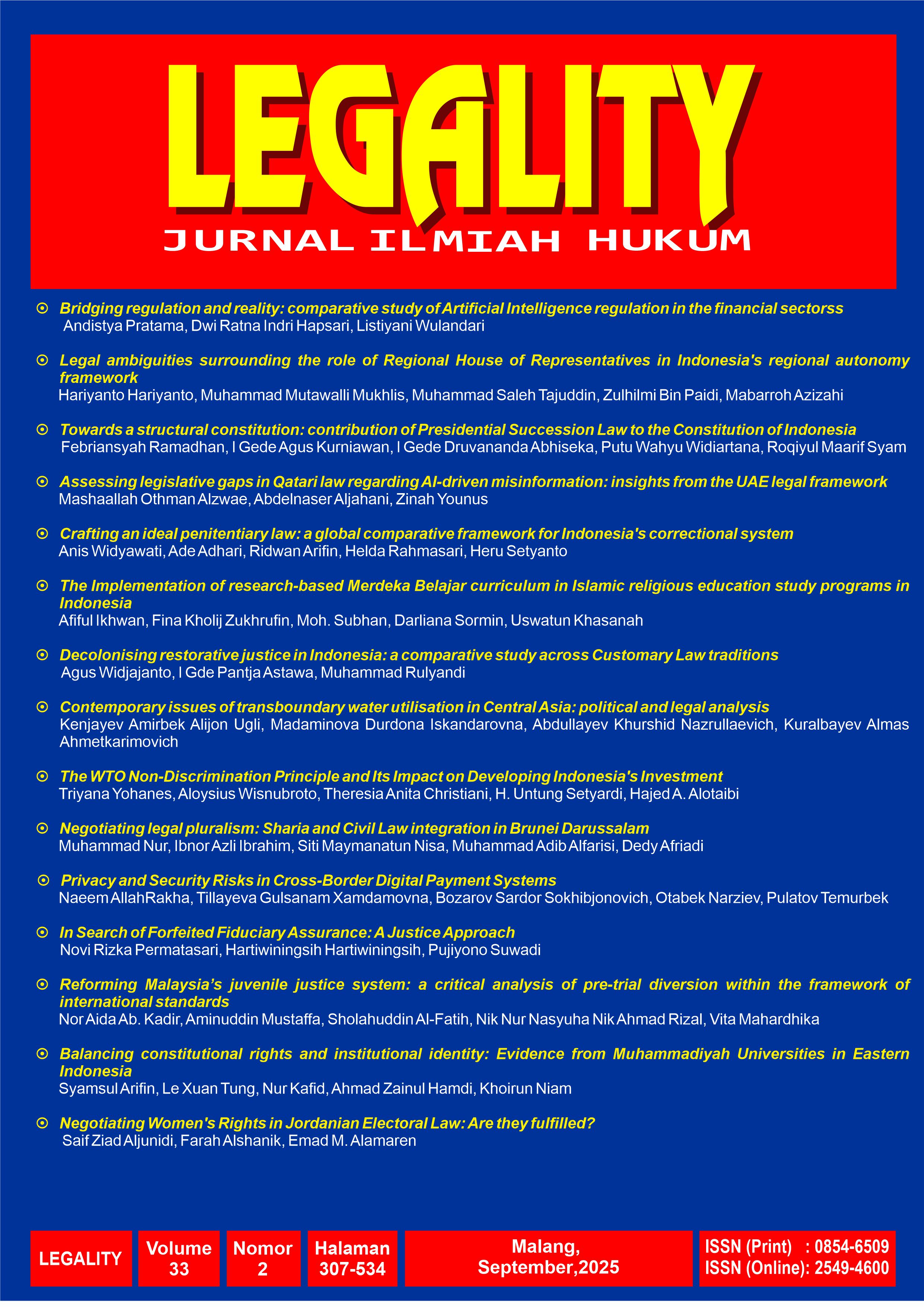
Crafting an ideal penitentiary law: a global comparative framework for Indonesia’s correctional system
DOI:
https://doi.org/10.22219/ljih.v33i2.40358Keywords:
Comparative Law, Correctional Reform, Ideal Correctional Framework, Penitentiary LawAbstract
This study develops an ideal model of penitentiary law for Indonesia's correctional system through a comparative analysis with other legal frameworks. The study examines systems in South Africa, Thailand, the Netherlands, Germany, France, Japan, and Brazil using doctrinal normative legal research and comparative legal analysis. Primary sources include legal documents, statutes, relevant legislation, and scholarly literature. The findings reveal key components of an ideal penitentiary system: a rehabilitative legal framework that aligns punishment with rehabilitation; provisions for individualised assessment and treatment; a disciplined, transparent system for grievance handling; legislative support for educational and vocational programs; and policies for community reintegration. Notable contributions from other countries include Japan's rehabilitation system, the Netherlands’ alternative sentencing approach, Germany’s vocational training programs, France’s parole systems, South Africa’s restorative justice initiatives, and Thailand’s family connection efforts. Brazil's flexible sentencing and rehabilitation strategies to address overcrowding further inform the model. This research proposes a comprehensive penitentiary law framework emphasising legal pluralism, situational flexibility, robust regulatory mandates, and a balance between security and humane treatment. The model is designed not only for Indonesia but also offers a valuable reference for other nations, grounded in empirical research on corrections and recidivism, and adhering to international human rights standards for prisoner treatment.
Downloads
References
Altobelli, E., Guergache, A. K., Galassi, F., Petrocelli, R., & Marziliano, C. (2024). Cost Analysis of Penitentiary Systems and Comparison Between the Countries of the Council of Europe. Economies, 12(11), 1–12. https://doi.org/10.3390/economies12110311
Arifin, R., Atikasari, H., & Waspiah. (2020). The Intersection of Criminal Law, Technology and Business Commercial Law on Carding as Cyber Fraud. Jurnal Hukum Novelty, 11(2), 235–246. https://doi.org/10.26555/novelty.v11i2.a15700
Auty, K. M., & Liebling, A. (2020). Exploring the Relationship between Prison Social Climate and Reoffending*. Justice Quarterly, 37(2), 358–381. https://doi.org/10.1080/07418825.2018.1538421
Barsky, B. A., & Stein, M. A. (2023). The United Nations convention on the rights of persons with disabilities, neuroscience, and criminal legal capacity. Journal of Law and the Biosciences, 10(1), 1–18. https://doi.org/10.1093/jlb/lsad010
Dewi, E., & Shafira, M. (2023). Protection Of Human Rights in the Criminal Justice System: Contemporary Challenges And Solutions. Journal of Law and Sustainable Development , 11(10), 1–23.
Dimyati, K., Nashir, H., Elviandri, E., Absori, A., Wardiono, K., & Budiono, A. (2021). Indonesia as a legal welfare state: A prophetic-transcendental basis. Heliyon, 7(8), 24. https://doi.org/10.1016/j.heliyon.2021.e07865
Faisal, Yanto, A., Rahayu, D. P., Haryadi, D., Darmawan, A., & Manik, J. D. N. (2024). Genuine paradigm of criminal justice: rethinking penal reform within Indonesia New Criminal Code. Cogent Social Sciences, 10(1), 15. https://doi.org/10.1080/23311886.2023.2301634
Florencia Magnis, Butar-butar, S. (2021). Exemptions from Liability in Indonesian Criminal Law Reform. Annals of R.S.C.B, 25(5), 5528–5533.
Fovet, T., Lancelevée, C., & Thomas, P. (2022). Mental health and criminal justice in France: State of play and some emerging issues. Bulletin de l’Academie Nationale de Medecine, 206(3), 301–309. https://doi.org/10.1016/j.banm.2021.10.011
Gabehart, K. M., Fullerton, A. H., & Stefes, C. H. (2024). Policy feedback and the enforcement of international wildlife treaties in Germany. European Policy Analysis, 10(1), 10–38. https://doi.org/10.1002/epa2.1192
Garcia, V. (2020). the Enforcement of Restorative Justice in Indonesian Criminal Law. Legality : Jurnal Ilmiah Hukum, 28(1), 22–35. https://doi.org/10.22219/ljih.v28i1.10680
Halim, A. (2023). The Application of Restorative Justice in Civil Dispute Resolution: Potentials and Challenges in Indonesia. AL-MANHAJ: Jurnal Hukum Dan Pranata Sosial Islam, 5(1), 883. https://doi.org/10.37680/almanhaj.v5i1.2729
Hasibuan, L. R. (2022). The Concept of Restorative Justice in the Juvenile Criminal Justice System: A Narrative Review of the Indonesian Context. Scholars International Journal of Law, Crime and Justice, 5(7), 264. https://doi.org/10.36348/sijlcj.2022.v05i07.004
Herlindah, H., Qurbani, I. D., & Prisilia, D. (2022). the Existence of Pancasila in Resolving Conflicts of Differing Views on Religious Rights in Indonesia. Diponegoro Law Review, 7(2), 218. https://doi.org/10.14710/dilrev.7.2.2022.212-229
Imandeka, E., Putra, P. O. H., Hidayanto, A. N., & Mahmud, M. (2024). Exploring the World of Smart Prisons: Barriers, Trends, and Sustainable Solutions. Human Behavior and Emerging Technologies, 1, 7. https://doi.org/10.1155/2024/6158154
Irwansyah, I. (2021). Penelitian Hukum, Pilihan Metode & Praktik Penulisan Artikel (A. Yunus (ed.); Cetakan 4). Mirra Buana Media.
Johnston, E. L., Runyan, K. D., Silva, F. J., & Maldonado Fuentes, F. (2023a). Diminished criminal responsibility: A multinational comparative review. International Journal of Law and Psychiatry, 91, 4. https://doi.org/10.1016/j.ijlp.2023.101919
Johnston, E. L., Runyan, K. D., Silva, F. J., & Maldonado Fuentes, F. (2023b). Diminished criminal responsibility: A multinational comparative review. International Journal of Law and Psychiatry, 91(August), 19. https://doi.org/10.1016/j.ijlp.2023.101919
Jouet, M. (2022). Foucault, prison, and human rights: A dialectic of theory and criminal justice reform. Theoretical Criminology, 26(2), 202–223. https://doi.org/10.1177/13624806211015968
Le, L. C., Hoang, Y. H., Bui, H. T., Nguyen, D. Q., Mai, S. T., & Luong, H. T. (2023). Wrongful convictions in asian countries: A systematic literature review. International Journal of Comparative and Applied Criminal Justice, 48(4), 345. https://doi.org/10.1080/01924036.2023.2188235
Liu, J. T. S. (2021). Preventive detention of dangerous inmates: a dialogue between human rights and penal regimes. International Journal of Human Rights, 25(4), 551. https://doi.org/10.1080/13642987.2020.1725486
Lucey, B. M., Kumar, S., & Sureka, R. (2023). Corruption in finance research: The state of art and future research agenda. Journal of Economic Criminology, 1(November 2022), 2. https://doi.org/10.1016/j.jeconc.2023.100001
Mancano, L. (2021). A theory of justice? Securing the normative foundations of EU criminal law through an integrated approach to independence. European Law Journal, 27(4), 477–501. https://doi.org/10.1111/eulj.12442
Maslennikova, L., Vilkova, T., & Sobenin, A. (2021). Models of the Early Stages of Criminal Justice and Ensuring Access to Justice in a Digital Environment. Proceedings of the 1st International Scientific Conference “Legal Regulation of the Digital Economy and Digital Relations: Problems and Prospects of Development” (LARDER 2020), 171(Larder 2020), 152–158. https://doi.org/10.2991/aebmr.k.210318.024
Masyhar, A., Aisy, R., Bahodirova, A. M., & Mukhanova, G. (2024). Legitimacy of Social Justice in the Terrorism Regulations: Instight From Several Contries. Bestuur, 12(1), 31. https://doi.org/https://doi.org/10.20961/bestuur.v12i1
Miron, M., Tolan, S., Gómez, E., & Castillo, C. (2021). Evaluating causes of algorithmic bias in juvenile criminal recidivism. Artificial Intelligence and Law, 29(2), 111–147. https://doi.org/10.1007/s10506-020-09268-y
Nawawi Arief, B. (2017). Reformasi Sistem Peradilan (Sistem Penegakan Hukum) di Indonesia. Badan Penerbit Universitas Diponegoro.
Niño, M., Harris, C. T., Angton, A., & Zhang, M. (2023). The racial/ethnic health consequences of the U.S. criminal justice system: How consequential is probation and other justice system contact for self-rated and chronic conditions? Journal of Criminal Justice, 87(March), 3. https://doi.org/10.1016/j.jcrimjus.2023.102073
Nishizaki, Y. (2021). Embedded in a patrimonial culture: the politicized judiciary and an undisciplined reformist party in Thailand. Critical Asian Studies, 53(2), 310–323. https://doi.org/10.1080/14672715.2021.1891444
Papagianneas, S. (2023). Automating Intervention in Chinese Justice: Smart Courts and Supervision Reform. Asian Journal of Law and Society, 10, 463–489. https://doi.org/10.1017/als.2023.5
Pascoe, D., & Novak, A. (2022). Deadly justice without mercy in East Asia? International Journal of Comparative and Applied Criminal Justice, 46(2), 141–165. https://doi.org/10.1080/01924036.2020.1824873
Prateeppornnarong, D., & Young, R. (2019). A critique of the internal complaints system of the Thai police. Policing and Society, 29(1), 18–35. https://doi.org/10.1080/10439463.2017.1356298
Prayuda, R., Warsito, T., & Surwandono. (2020). Problems faced by ASEAN in dealing with transnational drug smuggling in Southeast Asia region. Foresight, 23(3), 353–366. https://doi.org/10.1108/FS-12-2019-0106
Pundir, P., Saran, A., White, H., Subrahmanian, R., & Adona, J. (2020). Interventions for reducing violence against children in low- and middle-income countries: An evidence and gap map. Campbell Systematic Reviews, 16(4), 5. https://doi.org/10.1002/cl2.1120
Qamar, N., & Rezah, F. S. (2020). Metode Penelitian Hukum Doktrinal dan Non-Dokrtinal (Cetakan Pe). CV. Social Politic Genius (SIGn).
Rahayu, D. P., Faisal, F., Sari, R., & Satrio, N. (2020). Law Enforcement in the Context of Legal Culture in Society. Law Reform, 16(2), 276–289.
Romdoni, M. (2022). A Literature Review of Coercive Isomorphism on Corporate Legal Responsibility in Indonesia. Pranata Hukum, 17(2), 121. https://doi.org/https://doi.org/10.36448/pranatahukum.v17i2.286
Saraswati, A. A. A. N., Wicaksono, S., Ganindha, R., & Hidayat, M. (2018). Restrictions of the Rights of Freedom of Religions: Comparison of Law Between Indonesia and Germany. Indonesia Law Review, 8(3), 271. https://doi.org/10.15742/ilrev.v8n3.510
Snacken, S., Devynck, C., & Uzieblo, K. (2022). Dignity, Social Reintegration of Prisoners, and the New Penal Power: European Human Rights, Experiences of Belgian Prisoners, and Professional Practices. International Journal of Offender Therapy and Comparative Criminology, 66(9), 980. https://doi.org/10.1177/0306624X221099489
Steffensmeier, D., Slepicka, J., & Schwartz, J. (2025). International and Historical Variation in the Age-Crime Curve. Annual Review of Criminology, 8(1), 239–268. https://doi.org/10.1146/annurev-criminol-111523-122451
Sumpter, C., Wardhani, Y. K., & Priyanto, S. (2021). Testing Transitions: Extremist Prisoners Re-Entering Indonesian Society. Studies in Conflict and Terrorism, 44(6), 473–494. https://doi.org/10.1080/1057610X.2018.1560666
Sunaryo, S., & Al-Fatih, S. (2022). How Corruptor Should Be Punished? A Comparative Study Between Criminal Law, Islamic Law, and Customary Law. International Journal of Criminal Justice Sciences, 17(2), 91–100. https://ijcjs.com/menu-script/index.php/ijcjs/article/view/514
Sunaryo, S., Purnamawati, S. A., Jihadi, M., & Al-Fatih, S. (2025). The Narrating Ontology Morality of Corruption Law in Indonesia Based on Islamic Value. Jurnal Hukum, 41(1), 133–156. https://doi.org/10.26532/JH.41.1.133-156
Sutoyo, A., Renggong, R., & Hamid, A. H. (2023). Efektivitas Pembebasan Bersyarat Bagi Warga Binaan Dalam Upaya Mengatasi Kelebihan Kapasitas Di Lapas Narkotika Kelas IIa Sungguminasa. Indonesian Journal of Legality of Law, 6(1), 113. https://doi.org/10.35965/ijlf.v6i1.3822
Van Hout, M. C., Fleißner, S., Klankwarth, U. B., & Stöver, H. (2022). “Children in the prison nursery”: Global progress in adopting the Convention on the Rights of the Child in alignment with United Nations minimum standards of care in prisons. Child Abuse and Neglect, 134(December), 17. https://doi.org/10.1016/j.chiabu.2022.105829
Widyawati, A., Adhari, A., Masyhar, A., Syahputra, B. D., & Purnomo, D. (2025). Dynamics of the Penitentiary System, Transparent, and Accountable Handling of Criminal Cases in Criminal Execution Law in Southeast Asia: Convergence and Divergence of International Perspectives. Indonesia Law Review, 15(1), 17. https://doi.org/https://doi.org/10.15742/ilrev.v15n1.1
Widyawati, A., Arifin, R., Aisy, R., Abidah, S. Q., & Setyanto, H. (2024). Supervision in Integrated Justice: Legal Reform and Constructive Enforcement in the Criminal Justice System. Journal of Law and Legal Reform, 5(2), 444. https://doi.org/10.15294/jllr.vol5i2.3886
Widyawati, A., Latifiani, D., Rahmasari, H., & Adhari, A. (2024). Optimizing Oversight: Developing an Ideal Framework for Supervision Prisoners’ Right Allocation. Indonesia Journal of Criminal Law Studies, 9(2), 189. https://doi.org/https://doi.org/10.15294/ijcls.v9i2
Widyawati, A., Maskur, M. A., Aisy, R., Teeraphan, P., & Setyanto, H. (2025). The Urgency of Supervision Institutions in Implementing Prisoners’ Rights as an Effort to Restructure Criminal Execution Laws. Jambura Law Review, 7(01), 139. https://doi.org/http://dx.doi.org/10.33756/jlr.v7i1.27595
Downloads
Published
How to Cite
Issue
Section
License
Copyright (c) 2025 Anis Widyawati, Ade Adhari, Ridwan Arifin, Helda Rahmasari, Heru Setyanto

This work is licensed under a Creative Commons Attribution-ShareAlike 4.0 International License.