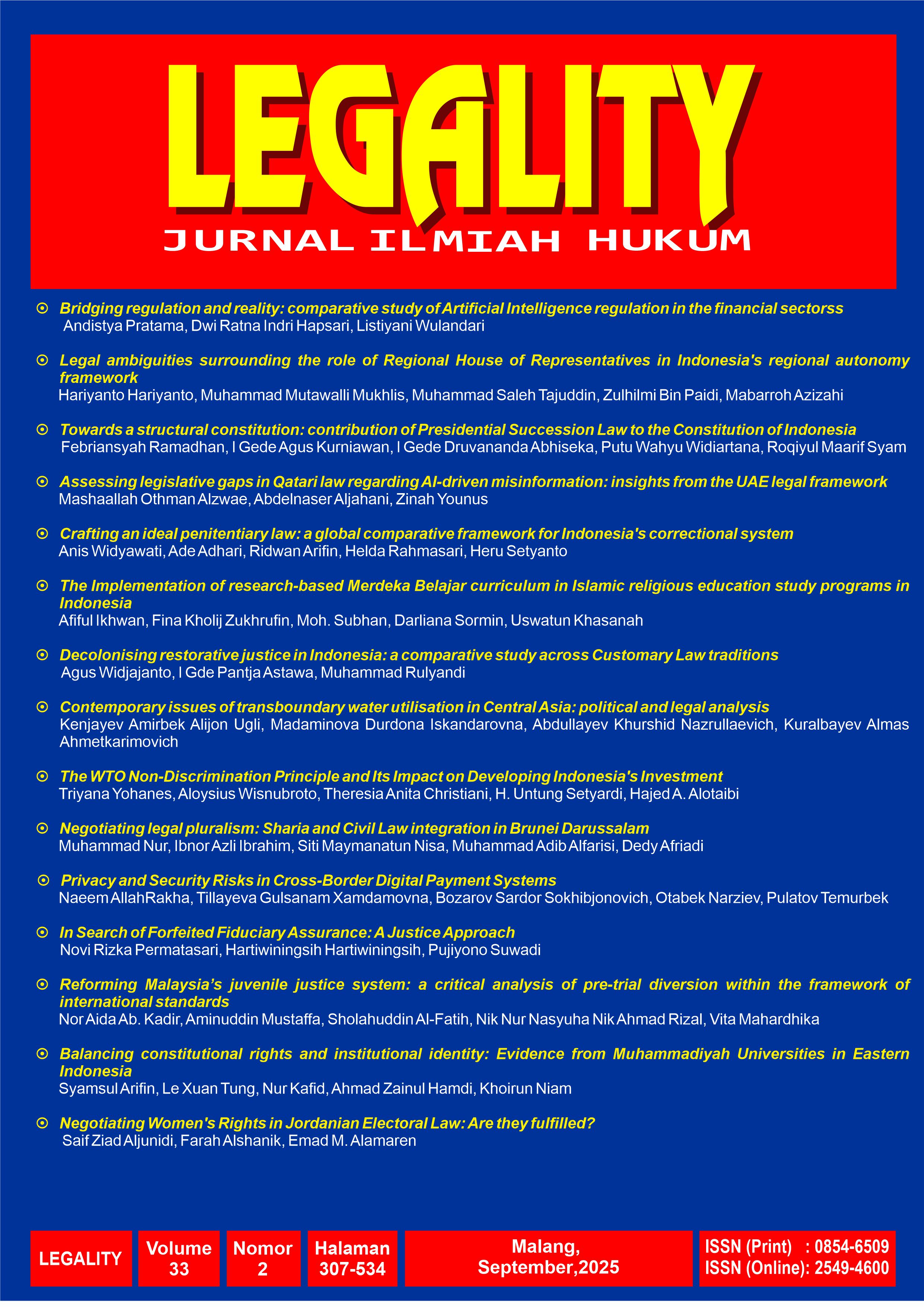
Contemporary issues of transboundary water utilisation in Central Asia: political and legal analysis
DOI:
https://doi.org/10.22219/ljih.v33i2.40449Keywords:
Amu Darya, Central Asia, International Act, Kushtepa, Transboundary Water UtilisationAbstract
This article examines the formation and development of the organisational and legal framework governing the joint use of transboundary water resources in Central Asia. The evolution of international legal instruments in transboundary water management, along with the ecological issues that accompany it, was analysed systematically using political-legal approaches and comparative historical studies. Contemporary sources and historical chronicles of the last three decades required in this study include publications of domestic and international organisations. Special focus is given to the legal regulation surrounding the construction of the controversial Kushtepa Canal. In conclusion, reaching a consensus among regional states is key to maintaining regional stability and security. The article also proposes the establishment of regional cooperation mechanisms and increasing data transparency as solutions to the challenges of water management in Central Asia.
Downloads
References
Aamer, F. (2021). International Hydro-diplomacy: Building and Strengthening Regional Institutions for Water Conflict Prevention. https://www.stimson.org/wp-content/uploads/2021/11/Final-study_Web-preview.pdf
Agentligi, O. R. P. huzuridagi S. (2024). Uzbekistan GDP parameters for 2024. https://stat.uz/img/infografikalar/infografika-sns-lotin_p91702.pdf
Akhatovich, K. A. (2023). Uzbekistan: a new look at the prospects for cooperation in Central Asia. Post-Soviet Studies, 6(3), 243–251. https://cyberleninka.ru/article/n/uzbekistan-novyy-vzglyad-na-perspektivy-sotrudnichestva-v-tsentralnoy-azii
Bishkek. (1998). Agreement on the use of water and energy resources of the Syr Darya River basin. http://www.cawater-info.net/library/rus/gov1.pdf
Collection, U. N. T. (1992). Convention on the Protection and Use of Transboundary Watercourses and International Lakes. https://treaties.un.org/pages/viewdetails.aspx?src=treaty&mtdsg_no=xxvii-5&chapter=27&clang=_en
Commission, M. R. (2021). The integrated water resources management–based Basin Development Strategy for the Lower Mekong Basin 2021–2030 and the MRC Strategic Plan 2021–2025. Vientiane: MRC Secretariat. https://www.mrcmekong.org/wp-content/uploads/2024/08/BDS-2021-2030-and-MRC-SP-2021-2025.pdf
Dadabaev, T., Sehring, J., & Djalilova, N. (2023). Central Asian water neighbourhood: A constructivist reconceptualisation of hydropolitics in Central Asia. Water Alternatives, 16(3), 930–948. https://doi.org/10.5281/zenodo.8287145
Dushanbe. (2023). The President took part in a meeting of the Council of Heads of State – founders of the International Fund for Saving the Aral Sea. https://www.akorda.kz/ru/prezident-prinyal-uchastie-v-zasedanii-soveta-glav-gosudarstv-uchrediteley-mezhdunarodnogo-fonda-spaseniya-arala-15831
e Government of the Kazakh Republic. (2000). Agreement between the Government of the Republic of Kazakhstan and the Government of the Kyrgyz Republic on the Use of Water Management Facilities of Intergovernmental Status on the Rivers Chu and Talas. http://www.cawater-info.net/library/eng/chu_talas_e.pdf
Fan, H., He, D., & Wang, H. (2015). Environmental consequences of damming the mainstream Lancang-Mekong River: A review. Earth-Science Reviews, 146, 77–91. https://doi.org/10.1016/j.earscirev.2015.03.007
General Assembly of the United Nations. (1997). The Convention on the Law of the Non-navigational Uses of International Watercourses. https://legal.un.org/ilc/texts/instruments/english/conventions/8_3_1997.pdf
Government of the Islamic Republic of Afghanistan. (2010). The Agreement between the Government of the Republic of Tajikistan and the Government of the Islamic Republic of Afghanistan on cooperation in the development and management of water resources of the Pyanj and Amu Darya rivers. http://www.cawater-info.net/bk/water_law/pdf/taj_afg_2010_ru.pdf
Guo, L., Wu, Y., Huang, F., Jing, P., & Huang, Y. (2024). An approach to complex transboundary water management in Central Asia: Evolutionary cooperation in transboundary basins under the water-energy-food-ecosystem nexus. Journal of Environmental Management, 351, 119940. https://doi.org/10.1016/j.jenvman.2023.119940
Hecht, J. S., Lacombe, G., Arias, M. E., Dang, T. D., & Piman, T. (2019). Hydropower dams of the Mekong River basin: A review of their hydrological impacts. Journal of Hydrology, 568, 285–300. https://doi.org/10.1016/j.jhydrol.2018.10.045
Horsman, S. (2018). Transboundary water management and security in Central Asia. In Limiting institutions? Manchester University Press. https://doi.org/10.7765/9781526137470.00013
International Hydrological Programme of the United Nations Educational, S. and C. O. (2016). Hydrodiplomacy, Legal and Institutional Aspects of Water Resources Governance: from the international to the domestic perspective. https://un-igrac.org/wp-content/uploads/2024/12/Manual_web-1.pdf
Interstate Commission for Water Coordination of Central Asia. (1991a). Agreement on Cooperation in the Field of Joint Management on Utilization and Protection of Water Resources from Interstate Sources. http://www.icwc-aral.uz/statute2_ru.htm
Interstate Commission for Water Coordination of Central Asia. (1991b). Statement by the heads of water management authorities of the republics of Central Asia and Kazakhstan. http://www.icwc-aral.uz/statute2_ru.htm
Interstate Commission for Water Coordination of Central Asia. (1992). Agreement on joint activities in addressing the Aral Sea and the zone around the Sea crisis, improving the environment, and enduring the social and economic development of the Aral Sea region. http://www.icwc-aral.uz/statute13.htm
Intralawan, A., Wood, D., Frankel, R., Costanza, R., & Kubiszewski, I. (2018). Tradeoff analysis between electricity generation and ecosystem services in the Lower Mekong Basin. Ecosystem Services, 30, 27–35. https://doi.org/10.1016/j.ecoser.2018.01.007
Juraev, S. (2022). New Trends In The Solution Of Systemic Problems In Central Asia (Analytical Report). Oriental Journal of History, Politics and Law, 02(02), 340–352. https://doi.org/10.37547/supsci-ojhpl-02-02-44
Kenjayev, A. (2024a). Water diplomacy of Uzbekistan in the context of maintaining regional security. [Tashkent: Tashkent State University of Oriental Studies]. https://library.ziyonet.uz/ru/book/134928
Kenjayev, A. (2024b). Water issues in Central Asia in the context of maintaining regional security: international legal aspects. Oriental Journal of Social Sciences, 3(4), 305–316.
Kinna, R., & Rieu-Clarke, A. (2017). The Governance Regime of the Mekong River Basin. BRILL. https://doi.org/10.1163/9789004345706
Mamatova, K. Y. Z. (2015). Transboundary rivers and large dams: threats, losses and safety measures. Popular Science Research. – Tashkent: “Yangi Asr Avlodi,” 102–112.
Mekong River Commission. (1995). Agreement on the Cooperation for the sustainable development of the Mekong river basin. https://www.mrcmekong.org/wp-content/uploads/2024/08/1995-Mekong-Agreement.pdf
Mukhabbatov, Y. E. P. K. M. (2021). Water resources of the Aral sea basin, water distribution and ways to resolve water deficiency. Central Asian Journal of the Geographical Researches, 69–83.
Narzullaev, O., & Bekov, I. (2024). Contemporary analysis of the use of transboundary waters in Central Asia. IOP Conference Series: Earth and Environmental Science, 1420(1), 012035. https://doi.org/10.1088/1755-1315/1420/1/012035
National Information Agency of Uzbekistan. (2025). Uzbekistan and Afghanistan have signed an agreement on joint management of the Amu Darya water basin. https://uza.uz/ru/posts/uzbekistan-i-afganistan-podpisali-soglashenie-o-sovmestnom-upravlenii-vodnym-basseynom-amudari_715483
Official website of the President of the Republic of Uzbekistan. (2023a). A transition to an emergency mode of operation to save water will take place. https://president.uz/ru/lists/view/6894
Official website of the President of the Republic of Uzbekistan. (2023b). Address by the President of the Republic of Uzbekistan Shavkat Mirziyoyev at a meeting of the Council of Heads of the Founder States of the International Fund for Saving the Aral Sea. https://president.uz/en/lists/view/6662
Omonov, Q., Abdullaev, K., Yakubova, M., Shokirova, S., Ayupova, M., Kodirov, M., & Sattorova, Z. (2024). The Role of Digital Marketing Technologies in Enhancing Business Process Management. Indian Journal of Information Sources and Services, 14(4), 159–164. https://doi.org/10.51983/ijiss-2024.14.4.25
Orazaliev, K., Mukasheva, A., Ybyray, N., & Nurekeshov, T. (2024). Current regulation of water relations in Central Asia. Regional Science Policy & Practice, 16(9), 100038. https://doi.org/10.1016/j.rspp.2024.100038
Prniyazova, A., Turaeva, S., Turgunov, D., & Jarihani, B. (2025). Sustainable Transboundary Water Governance in Central Asia: Challenges, Conflicts, and Regional Cooperation. Sustainability, 17(11), 4968. https://doi.org/10.3390/su17114968
Sharman, E. (2022). Emomali Rahmon: More than a thousand glaciers in Tajikistan have melted due to global warming. https://mir24.tv/news/16529922/emomali-rahmon-bolee-tysyachi-lednikov-tadzhikistana-rastayali-iz-za-globalnogo-potepleniya
Skoulikaris, C. (2023). Hydrodiplomacy and Climate Change: An Assessment of the Transboundary River Basins of Greece. ECWS-7 2023, 5. https://doi.org/10.3390/ECWS-7-14182
Sodikov, A. V. K. S. J. (2018). The problem of the international legal status of water resources in Central Asia. Legislation and Law, 12, 31–39. https://doi.org/10.24411/2073-3313-2018-10258
Sorvenkov, V. (2022). The ghost of the water war. The Taliban quarreled with Iran over the flow of the Helmand River - the “Afghan Nile.” https://mediazona.ca/article/2022/08/08/helmand
Sridhar, V., Ali, S. A., & Apel, H. (2024). Hydrology and water resources in the Mekong River Basin. In The Mekong River Basin (pp. 53–83). Elsevier. https://doi.org/10.1016/B978-0-323-90814-6.00003-6
Subkhonkulzoda, M. M. (2019). Prospects for the development of the water sector of the economy of the Central Asian States. https://www.dissercat.com/content/perspektivy-razvitiya-vodnogo-sektora-ekonomiki-gosudarstv-tsentralnoi-azii
United Nations. (1958). The Agreement between the Government of the USSR and the Royal Government of Afghanistan “On the regime of the Soviet-Afghan state border.” http://www.cawater-info.net/afghanistan/pdf/afghanistan_ussr_1958_ru.pdf
Uzbekistan, P. R. of. (2023). Additional opportunities and further tasks for the development of Surkhandarya were discussed. https://president.uz/ru/lists/view/6870
Valentinin K.L., Orolbaev E.E., A. A. K. (2004). Water problems of Central Asia.
Vladimirovich, S. B. S. T. A. (2018). Water problems of Central Asia: mechanisms for solution at different levels of political governance. Eurasian Integration: Economics, Law, Politics, 4(26), 34–42.
Warner, J., & de Man, R. (2020). Powering hydrodiplomacy: How a broader power palette can deepen our understanding of water conflict dynamics. Environmental Science & Policy, 114, 283–294. https://doi.org/10.1016/j.envsci.2020.08.015
World bank. (2023). Building a Water-Secure Future in Central Asia. https://www.worldbank.org/en/news/immersive-story/2024/09/26/building-a-water-secure-future-in-central-asia
Xenarios, S., Yakubov, M., Baubekova, A., Alshagirov, O., Zhalgas, Z., & Araral, E. J. (2022). Transboundary Water Governance and Small Basin Councils in Central Asia. Oxford University Press. https://doi.org/10.1093/acrefore/9780199389414.013.784
Zhiltsov, S. S. (2016). Politics of the countries of Central Asia: water and energy aspect. Series: Political Science. https://cyberleninka.ru/article/n/politika-stran-tsentralnoy-azii-vodno-energeticheskiy-aspekt
Ziganshina, D. (2015). Promoting Transboundary Water Security in the Aral Sea Basin through International Law. Brill | Nijhoff.
Ziganshina, D. (2023). Water infrastructure in Central Asia: legal and institutional frameworks. Frontiers in Climate, 5. https://doi.org/10.3389/fclim.2023.1284400
Downloads
Published
How to Cite
Issue
Section
License
Copyright (c) 2025 Kenjayev Amirbek Alijon Ugli, Madaminova Durdona Iskandarovna, Abdullayev Khurshid Nazrullaevich, Kuralbayev Almas Ahmetkarimovich

This work is licensed under a Creative Commons Attribution-ShareAlike 4.0 International License.