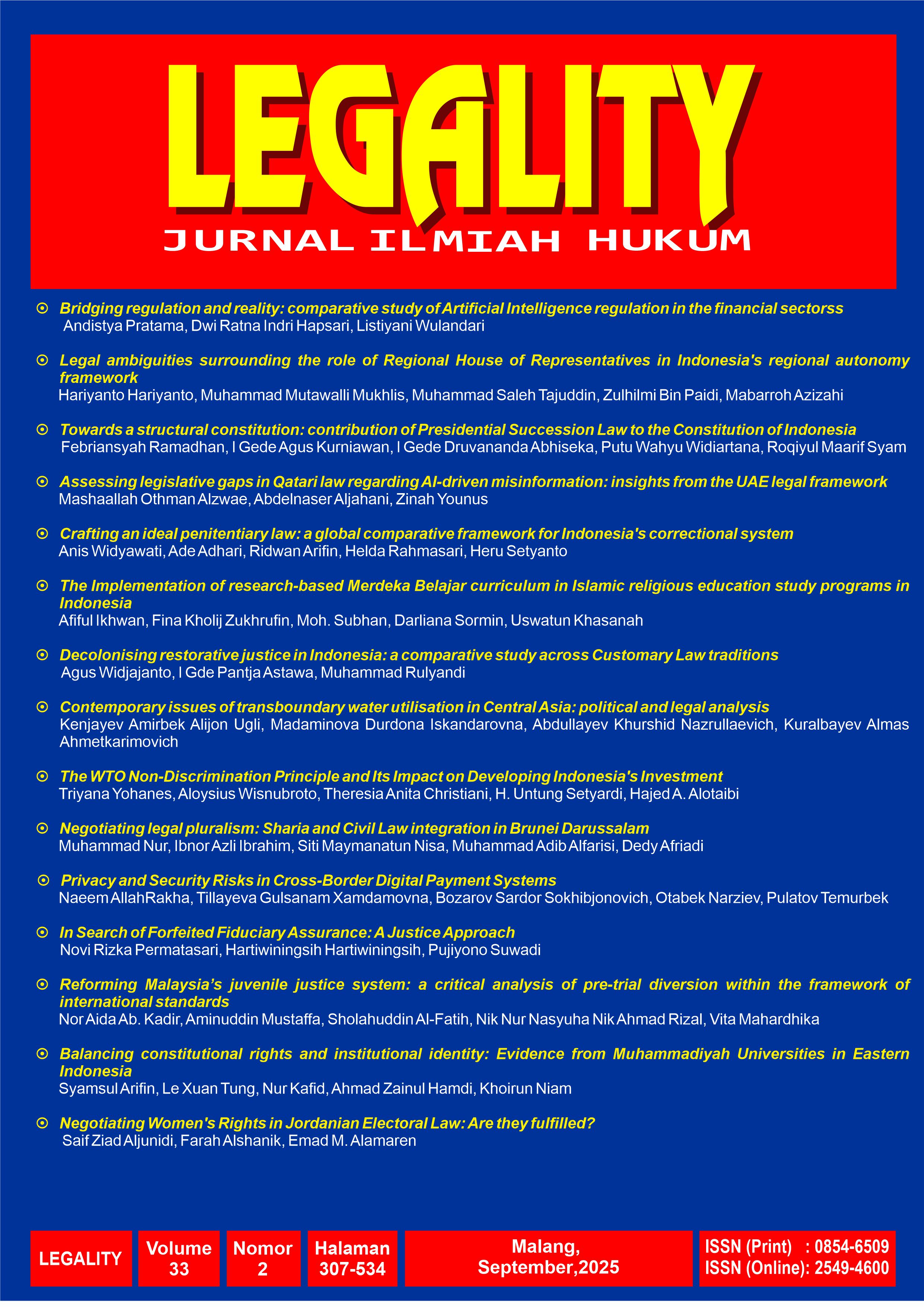
Assessing legislative gaps in Qatari law regarding AI-driven misinformation: insights from the UAE legal framework
DOI:
https://doi.org/10.22219/ljih.v33i2.40764Keywords:
Criminal Liability, Robots, Rumors, False Data, Artificial IntelligenceAbstract
This study aims to examine the weaknesses of Qatari laws and assess their effectiveness in combating this new type of crime by comparing them with the UAE's Anti-Rumours and Cybercrime Law No. 34 of 2021, Article 54”, as a strong example of legislation in this area. The study highlights Singapore's law as a Southeast Asian example that explicitly criminalises "the creation or modification of robots as an artificial intelligence system used to spread misinformation," similar to the UAE law, indicating that the UAE law is more effective and comprehensive in combating these crimes. The study adopts a comparative analytical approach, which is the most appropriate approach to addressing emerging legal issues, such as those linked to the utilisation of AI systems to spread misleading content. The findings reveal weak Qatari legislative protection in this area, pointing to the need to reform the Anti-Cybercrime Law No. 14 of 2014. This law explicitly defines bots, rumours, and misinformation, and criminalises the act of "creating or modifying an electronic bot intended to publish, republish, or circulate misleading information in the country, or enable any other person to publish, circulate, or republish such information, or delete an electronic bot after committing a crime with the intent to mislead justice." It also revisits traditional criminal liability rules to align Qatari legislation with relevant international standards and Qatar's Artificial Intelligence Strategy.
Downloads
References
Abdelaziz, D. K. A. (2025). Criminal liability for the misuse and crimes committed by AI: A comparative analysis of legislation and international conventions. Journal of Infrastructure, Policy and Development, 9(1), 10722. https://doi.org/10.24294/jipd10722
Al-Fatih, S., Roziqin, A., Asyari, M. D., & Ezzerouali, S. (2025). Legal Reform in Village Law-Making Process Using Artificial Intelligence: Is It Necessary? Journal of Law and Legal Reform, 6(2), 757–782. https://doi.org/10.15294/jllr.v6i2.21116
Andrea Widener. (2019). New AI policy guidelines adopted. C&EN Global Enterprise, 97(21), 13–13. https://doi.org/10.1021/cen-09721-polcon6
Barfield, W. (2018). Liability for Autonomous and Artificially Intelligent Robots. Paladyn, Journal of Behavioral Robotics, 9(1), 193–203. https://doi.org/10.1515/pjbr-2018-0018
Barlian, A. E. A., Latipulhayat, A., Rusmiati, E., Wulandari, W., & Sukma, A. N. A. (2025). Electronic Criminal Justice in Indonesia: Challenges and the Future Measures. Jambura Law Review, 7(1), 243–274. https://doi.org/10.33756/jlr.v7i1.27805
Cantika Aulia, Egi Nugraha, & Raja Benhard Parlindungan. (2023). Copyright Responsibilities of Artificial Intelligence in the Digital Age. Indonesia Law Reform Journal, 3(2), 145–154. https://doi.org/10.22219/ilrej.v3i2.26042
Chng, K. (2023). Falsehoods, Foreign Interference, and Compelled Speech in Singapore. Asian Journal of Comparative Law, 18(2), 235–252. https://doi.org/10.1017/asjcl.2023.9
Consulich, F. (2023). Criminal Law And Artificial Intelligence: Perspective From Italian And European Experience. European Criminal Law Review, 13(3), 270–307. https://doi.org/10.5771/2193-5505-2023-3-270
Dvornikova, P. A., & Osadchaya, A. S. (2024). Artificial Intelligence And The Law: The Challenges Of Establishing Criminal Liability In The Digital Age. Juridical Scientific and Electronic Journal, 8, 330–333. https://doi.org/10.32782/2524-0374/2024-8/77
Eliot, L. (2021). The Legal Quandary When AI Is The Criminal. SSRN Electronic Journal. https://doi.org/10.2139/ssrn.3963422
Ferrara, E. (2017). Disinformation and social bot operations in the run up to the 2017 French presidential election. First Monday. https://doi.org/10.5210/fm.v22i8.8005
Ficsor, K. (2018). Certainty and uncertainty in criminal law and the ‘clarity of norms’ doctrine. Hungarian Journal of Legal Studies, 59(3), 271–289. https://doi.org/10.1556/2052.2018.59.3.3
Flores, L. (2021). Artistic and Literary Bots. In Electronic Literature as Digital Humanities (pp. 131–143). Bloomsbury Publishing Inc. https://doi.org/10.5040/9781501363474.ch-011
Hamsin, M. K., Anggriawan, R., & Jiatrahman, F. (2023). Unveiling Ethical Implications: AI Robot Accountability in Islamic Context. Jurnal Media Hukum, 30(2), 117–135. https://doi.org/10.18196/jmh.v30i2.18524
Hariyanto, H., Idamatussilmi, I., & Rismana, D. (2024). The government’s role in legal protection of land ownership: Urutsewu case. Legality : Jurnal Ilmiah Hukum, 32(2), 277–291. https://doi.org/10.22219/ljih.v32i2.34254
Huang, T.-R., Cheng, Y.-L., & Rajaram, S. (2024). Unavoidable social contagion of false memory from robots to humans. American Psychologist, 79(2), 285–298. https://doi.org/10.1037/amp0001230
Jaconelli, J. (2018). Incitement: A Study in Language Crime. Criminal Law and Philosophy, 12(2), 245–265. https://doi.org/10.1007/s11572-017-9427-8
Jalahussein, A., Mohammad, A., Fadelmansour, A., & Jalal, B. K. (2024). Legal Liability Arising from Artificial Intelligence Activities. Journal of Ecohumanism, 3(6), 338–346. https://doi.org/10.62754/joe.v3i6.4006
JHA, R. K. (2023). Challenges of Fake News and Its Impact on Society in the Digital Era : A Critical Analysis. International Journal For Multidisciplinary Research, 5(2). https://doi.org/10.36948/ijfmr.2023.v05i02.2401
Jiang, J., Chen, X., Huang, Z., Li, X., & Du, Y. (2023). Deep reinforcement learning-based approach for rumor influence minimization in social networks. Applied Intelligence, 53(17), 20293–20310. https://doi.org/10.1007/s10489-023-04555-y
Kaawoan, G. K. (2020). Implementasi Mediasi Penal dalam Penyelesaian Body Shaming secara Siber, Mungkinkah?/The Implementation of Penal Mediation in Resolving Cyber Body Shaming, Is It Possible? De Jure: Jurnal Hukum Dan Syar’iah, 12(2), 140–155. https://doi.org/10.18860/j-fsh.v12i2.10868
Kumar, S., Villa, R. A., & Carley, K. M. (2017). Identifying Bots that Spread Fake News. SBP-BRiMS. Washington, DC.
Kurian, E., & Varghese, S. (2021). Relevance of Bots in Software and Their Impacts on Software Security. Lecture Notes In Engineering And Computer Science, 2242, 207–212.
Lagioia, F., & Sartor, G. (2020). AI Systems Under Criminal Law: a Legal Analysis and a Regulatory Perspective. Philosophy & Technology, 33(3), 433–465. https://doi.org/10.1007/s13347-019-00362-x
Mikhaleva, E. S., & Shubina, E. A. (2020). Challenges and Prospects of the Legal Regulation of Robotics. Actual Problems of Russian Law, 1(12), 26–35. https://doi.org/10.17803/1994-1471.2019.109.12.026-035
Moreno, M. C. (2017). Imprescriptible crimes and the non-retroactivity of criminal norms. Crítica Penal y Poder, 12, 140–167.
Pagallo, U. (2017). AI and bad robots: the criminology of automation. In The Routledge handbook of technology, crime and justice (pp. 642–652). Routledge.
Partow-Navid, P., & Slusky, L. (2023). The Need for International AI Activities Monitoring. Journal of International Technology and Information Management, 31(3), 114–127. https://doi.org/10.58729/1941-6679.1564
Piernas, J. (2024). The international law principle of due diligence and its application to the cyber context. Anales de Derecho, 41(1), 66–95. https://doi.org/10.6018/analesderecho.594441
Qatar Computing Research Institute. (2019). National artificial intelligence strategy for Qatar. Qatar Center for Artificial Intelligence.
Quattrocolo, S. (2018). The impact of AI on criminal law a, and its twofold procedures. In ResearchHandbook on the Law of Artificial Intelligence (pp. 385–409). Edgar Elgar.
Rachum-Twaig, O. (2020). Whose robot is it anyway?: Liability for artificial-intelligence-based robots. U. Ill. L. Rev., 1141.
Rawat, D., Rawat, D., Rawat, A., Pandey, A., Chauhan, G., & Aluvala, S. (2024). Ethics in the era of Intelligent Machines: Legal Perspective and Regulatory Implications. 2024 IEEE 1st Karachi Section Humanitarian Technology Conference (KHI-HTC), 1–7. https://doi.org/10.1109/KHI-HTC60760.2024.10481959
Saxena, A., Bhatt, R., Bansal, S., Arora, M., Mahato, N., & Gupta, T. (2024). Liability and Responsibility for AI Systems in Computer Engineering and Law. 2024 15th International Conference on Computing Communication and Networking Technologies (ICCCNT), 1–6. https://doi.org/10.1109/ICCCNT61001.2024.10725153
Shao, C., Ciampaglia, G. L., Varol, O., Yang, K.-C., Flammini, A., & Menczer, F. (2018). The spread of low-credibility content by social bots. Nature Communications, 9(1), 4787. https://doi.org/10.1038/s41467-018-06930-7
Sharkey, A., & Sharkey, N. (2021). We need to talk about deception in social robotics! Ethics and Information Technology, 23(3), 309–316. https://doi.org/10.1007/s10676-020-09573-9
Siabro, A. (2021). The Influence Of Scientific And Technological Development On The Transformation Of The Global Security Paradigm. European Political and Law Discourse, 8(5), 6–13. https://doi.org/10.46340/eppd.2021.8.5.1
Simmler, M., & Markwalder, N. (2019). Guilty Robots? – Rethinking the Nature of Culpability and Legal Personhood in an Age of Artificial Intelligence. Criminal Law Forum, 30(1), 1–31. https://doi.org/10.1007/s10609-018-9360-0
Siraj, A., Jabbi, Y., Budhiartie, A., & Mustaffa, A. (2025). Redefining Accountability: AI’s Role in Prosecuting Transnational Crimes under International Law. Audito Comparative Law Journal (ACLJ), 6(2), 124–145. https://doi.org/10.22219/aclj.v6i2.40434
Soares, H. (2024). The Spread of Fake News by Social Bots: Perspectives on Social Bot Regulation (pp. 189–204). https://doi.org/10.1007/978-3-031-47946-5_11
Sourdin, T. (2015). Justice and technological innovation. Journal of Judicial Administration, 25, 2.
Supreme Judiciary Council. (2024). Annual statistical report 2024. Supreme Judiciary Council.
Szmurlo, H., & Akhtar, Z. (2024). Digital Sentinels and Antagonists: The Dual Nature of Chatbots in Cybersecurity. Information, 15(8), 443. https://doi.org/10.3390/info15080443
Thakur, S., & Breslin, J. G. (2021). Rumour prevention in social networks with layer 2 blockchains. Social Network Analysis and Mining, 11(1), 104. https://doi.org/10.1007/s13278-021-00819-y
Tkacz, S. (2020). Zasada nullum crimen sine lege jako źródło poszukiwania językowej granicy wykładni prawa karnego? Archiwum Filozofii Prawa i Filozofii Społecznej, 81–95. https://doi.org/10.36280/AFPiFS.2020.2.81
Tomassi, A., Falegnami, A., & Romano, E. (2024). Mapping automatic social media information disorder. The role of bots and AI in spreading misleading information in society. PLOS ONE, 19(5), e0303183. https://doi.org/10.1371/journal.pone.0303183
Uyheng, J., Ng, L. H. X., & Carley, K. M. (2021). Active, aggressive, but to little avail: characterizing bot activity during the 2020 Singaporean elections. Computational and Mathematical Organization Theory, 27(3), 324–342. https://doi.org/10.1007/s10588-021-09332-1
van Kolfschooten, H., & Shachar, C. (2023). The Council of Europe’s AI Convention (2023–2024): Promises and pitfalls for health protection. Health Policy, 138, 104935. https://doi.org/10.1016/j.healthpol.2023.104935
Vosoughi, S., Roy, D., & Aral, S. (2018). The spread of true and false news online. Science, 359(6380), 1146–1151. https://doi.org/10.1126/science.aap9559
Vuletić, I. (2021). Criminal Law and the Challenges of Autonomous Intelligence: Substituting a Theory of Guilt with the Division of Labor (pp. 111–126). https://doi.org/10.1108/S0193-589520210000029007
Wang, P., Angarita, R., & Renna, I. (2018). Is this the Era of Misinformation yet. Companion of the The Web Conference 2018 on The Web Conference 2018 - WWW ’18, 1557–1561. https://doi.org/10.1145/3184558.3191610
Woolley, S. C. (2022). Digital Propaganda: The Power of Influencers. Journal of Democracy, 33(3), 115–129. https://doi.org/10.1353/jod.2022.0027
Xu, J. (2017). Representing big data as networks: new methods and insights. University of Notre Dame.
Xudaybergenov, A. (2023). Toward Legal Recognition of Artificial Intelligence Proposals for Limited Subject of law Status. International Journal of Law and Policy, 1(4). https://doi.org/10.59022/ijlp.55
Downloads
Published
How to Cite
Issue
Section
License
Copyright (c) 2025 Mashaallah Othman Alzwae, Abdelnaser Aljahani, Zinah Younus

This work is licensed under a Creative Commons Attribution-ShareAlike 4.0 International License.