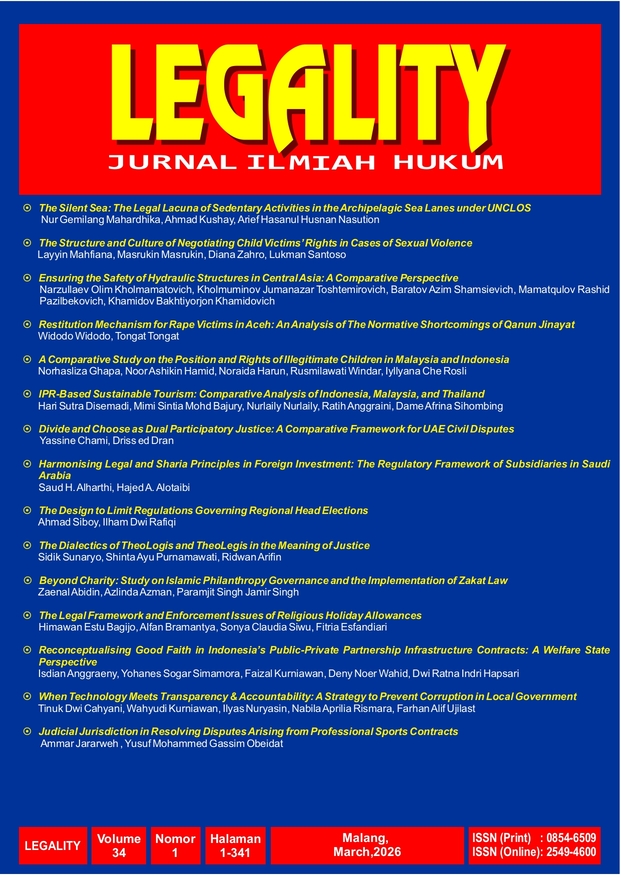
The Silent Sea: The Legal Lacuna of Sedentary Activities in the Archipelagic Sea Lanes under UNCLOS
DOI:
https://doi.org/10.22219/ljih.v34i1.41899Keywords:
Archipelagic Sea Lanes, Archipelagic Sea Lanes Passage, Legal Silence, Sedentary Activities, UNCLOSAbstract
This article maps the legal gap on provisions regarding sedentary activities on Archipelagic Sea Lanes (ASLs) under UNCLOS and subsequently charts the fairway of their governance. ASLs, already an almost uncharted regime of UNCLOS on its own, offers two freedoms for states users and archipelagic alike to enjoy: navigational rights and the consequent right to conduct sedentary activities those that are not in motion but maintain a static presence within the lanes. While the law of ASLs passage under UNCLOS is rather sufficiently defined, the Convention provides little guidance on how sedentary activities should be treated. This paper turns its attention to that silence. What will become of silent underwater activities, including cable-laying, surveillance, marine scientific research, or the unmoving presence of a submarine, which take place within these sea lanes, not as passage but as position? Article 53 of UNCLOS lies at the base of this inquiry, with its notable omission of non-navigational uses of ASLs. Through a close contextual reading of the Convention, reflected by state practice, the paper surfaces the following question: do sedentary activities fall within the scope of passage granted in ASLs, or are they subject to the sovereignty of the archipelagic state? Focusing on Indonesia, the world's largest archipelagic nation, the paper examines how sovereignty is asserted over both movement and stillness. It explores the legal lacuna in situations where the sea is not merely passed through but also silently dwelled within. The paper contributes to discussions surrounding ASLs by shedding light on them as stretches of maritime corridors where neither freedom of navigation nor sovereign control is properly articulated. This paper then concludes that this silent sea is where Indonesia is expected to take the helm in recasting the advancement of maritime law in three stanzas: devising its own domestic legal reform, regional cooperation, and international legal stratagem.
Downloads
References
Anggraini, S. D., Kusumawardhana, I., & Ramadhan, I. (2019). The Implication of Indonesia’s IUU Fishing Policy in Natuna Territorial Waters towards South China Sea Geopolitics. Jurnal Hubungan Internasional, 7(2), 118–132. https://doi.org/10.18196/HI.72130
Anghie, A. (2023). Rethinking International Law: A TWAIL Retrospective. European Journal of International Law, 34(1), 7–112. https://doi.org/10.1093/EJIL/CHAD005
Baumert, K., & Melchior, B. (2015). The Practice of Archipelagic States: A Study of Studies. Ocean Development & International Law, 46(1), 60–80. https://doi.org/10.1080/00908320.2015.995970
Bugajski, D. R. (2022). Navigational Rights in Archipelagic Waters. Polish Review of International and European Law, 11(2), 229–258. https://doi.org/10.21697/2022.12.2.10
Buntoro, Kresno. (2022). Nusantara & law of the sea. Rajawali Pers.
Butcher, J. G.., & Elson, R. E. . (2020). Sovereignty and the sea : how Indonesia became an archipelagic state. NUS Press, National University of Singapore.
Buxton, C. (2004). Property in Outer Space: The Common Heritage of Mankind Principle vs. the First in Time, First in Right, Rule of Property. Journal of Air Law and Commerce, 69(4), 689–707. https://scholar.smu.edu/jalc/vol69/iss4/3
Choong, W., & Storey, I. (2021). Southeast Asian Responses to AUKUS: Arms Racing, Non-Proliferation and Regional Stability (Issue 134). https://www.iseas.edu.sg/articles-commentaries/iseas-perspective/2021-134-southeast-asian-responses-to-aukus-arms-racing-non-proliferation-and-regional-stability-by-william-choong-and-ian-storey/
Cruz, A. P. Dela. (2024, November 19). Why the Philippines made a dramatic turnaround on the question of archipelagos in the law of the sea. Lowy Institute. https://www.lowyinstitute.org/the-interpreter/why-philippines-made-dramatic-turnaround-question-archipelagos-law-sea
Dahlman, C. (2012). The Function of Opinio Juris in Customary International Law. Nordic Journal of International Law, 81(3), 327–339. https://doi.org/10.1163/15718107-08103002
Dao, Y., Yusnaldi, Kusuma, Suwarno, P., & Widodo, P. (2024). The Concept of the Archipelagic State in Addressing Maritime Security Threats. Formosa Journal of Social Sciences (FJSS), 3(4), 939–954. https://doi.org/10.55927/FJSS.V3I4.12109
Darmawan, A. R. (2022, April 12). Does Indonesia have excessive maritime claim beyond UNCLOS? The Jakarta Post. https://www.thejakartapost.com/opinion/2022/04/11/does-indonesia-have-excessive-maritime-claim-beyond-unclos.html
Dillak, M. A., Yolando, V. D., Oenunu, R. B., Beoang, W. S., & Arman, Y. (2023). Status Hukum Pulau Pasir Oleh Autralia Berkaitan Dengan Kegiatan Nelayan Tradisional Indonesia Berdasarkan United Nation Convention On The Law Of The Sea (UNCLOS) 1982. Jurnal Relasi Publik, 1(3), 70–84. https://doi.org/10.59581/JRP-WIDYAKARYA.V1I3.1020
Djalal, H. (2009). Indonesia beyond the water’s edge : managing an archipelagic state (R. Cribb & Michele. Ford, Eds.). Institute of Southeast Asian Studies.
Djunarsjah, E., Putra, A. P., Kusumadewi, D., Yudistira, K., & Julian, M. M. (2022). The Concept of Integration between State and Provincial Sea Boundaries in Indonesia. Sustainability, 14(3), 1659. https://doi.org/10.3390/SU14031659
Dziedzic, S. (2025, March 31). Australia monitoring Chinese research vessel off south coast. ABC News. https://www.abc.net.au/news/2025-03-31/australia-monitoring-chinese-research-vessel-off-south-coast/105117188
Enyew, E. L. (2022). Sailing with TWAIL: A Historical Inquiry into Third World Perspectives on the Law of the Sea. Chinese Journal of International Law, 21(3), 439–497. https://doi.org/10.1093/CHINESEJIL/JMAC028
Golitsyn, Vladimir. (2017). Freedom of Navigation: Development of the Law of the Sea and Emerging Challenges. International Law Studies, 93(1), 262–271. https://digital-commons.usnwc.edu/ils/vol93/iss1/9/
Grotius, Hugo., & Hakluyt, Richard. (2004). The Free Sea (Hugo. Grotius & David. Armitage, Eds.). Liberty Fund Inc.
Hastuti, L. (2022). Diplomasi Maritim Sebagai Upaya Mewujudkan Indonesia Sebagai Poros Maritim Dunia: Harapan dan Tantangan. Media Iuris, 5(1SpecialIssue), 91–106. https://doi.org/10.20473/MI.V5I1SPECIALISSUE.42235
Irawati, Effendi, D., & Chotidjah, N. (2024). Strengthening Indonesia’s Position as an Archipelagic States through Coordinative Law Enforcement the Archipelagic Sealanes Passage on the Alki. KnE Social Sciences, 9(24), 35–45. https://doi.org/10.18502/KSS.V9I24.16819
Khalilieh, H. Salih. (2020). Islamic law of the sea : freedom of navigation and passage rights in islamic thought. Cambridge University Press.
Khomsin. (2022). Problem and Alternative Solutions: Impact of Changes in Law concerning Regional Government on the Law of the National Sea. Indonesian Journal of Geography, 54(2), 167–172. https://doi.org/10.22146/IJG.51237
Lestari, M. M. (2021). What is the Right, Archipelagic Sea Lanes and Passage? (According to Unclos 1982 and Practice). Indonesian Journal of International Law, 18(2), 209–228. https://doi.org/10.17304/ijil.vol18.2.809
Letts, D. (2020). Law the Development of the 1982 UN Convention on the Law of the Sea: An Australian Perspective. Indonesian Journal of International Law, 17(4), 455–476. https://doi.org/10.17304/ijil.vol17.4.795
Lukman, G. A. G. (2017). Designing The Archipelagic Sea Lanes (ASL): The “Epilogue” of the Legal Development of Indonesia’s Maritime Regime. Juris Gentium Law Review, 5(2), 33–42. https://jurnal.ugm.ac.id/jurisgentiumlaw/article/view/57146
Mahardhika, N. G. (2022). A Shallow Dive into International Maritime Law: Basic Governance and Related Sanctions - Fakultas Hukum - Universitas Islam Indonesia. In D. N. S. Heriyanto & N. G. Mahardhika (Eds.), Revitalisasi Sanksi Dalam Hukum Internasional dan Isu-Isu Terbaru Lainnya (pp. 56–68). FH UII Press. https://law.uii.ac.id/a-shallow-dive-into-international-maritime-law-basic-governance-and-related-sanctions/
Mahardhika, N. G. (2023). Space War and the Regressive Development of the Principle of Common Heritage of Humankind: Legal vs. Technological Weapons. Jurnal Hukum Ius Quia Iustum, 30(2), 324–349. https://doi.org/10.20885/IUSTUM.VOL30.ISS2.ART5
Martinez, A. (1980). Conflicting law of the sea principles: Mare Liberum versus Mare Clausum. Towson State Journal of International Affairs, XIV(2), 93–101.
McLaughlin, R. (2024). Different Pacta or Different Servanda? Grey-Zone Lawfare and Law of the Sea-Based Passage and Operational Rights. Ocean Development & International Law, 55(3), 329–342. https://doi.org/10.1080/00908320.2024.2394615
Monika, F., Baiquni, M., & Hadi, M. P. (2022). Foreign vessels’ mobility crossing the Archipelagic Sea Lanes in the Karimata Strait . AACL Bioflux, 15(4), 1712–1730.
Murphy, E., & Bryja, T. (2025). The Strategic Future of Subsea Cables: Japan Case Study. https://www.csis.org/analysis/strategic-future-subsea-cables-japan-case-study
Musyaffa, N. F., Paksi, A. K., & Myarta, L. R. (2022). Measuring The Dominant Paradigma In United Nations Convention On The Law Of The Sea. Lampung Journal of International Law, 4(2), 87–96. https://doi.org/10.25041/LAJIL.V4I2.2595
News Agencies. (2009, March 21). US blames China for naval incident | News. Al Jazeera. https://www.aljazeera.com/news/2009/3/21/us-blames-china-for-naval-incident
Noyes, J. (2011). The Common Heritage of Mankind: Past, Present, and Future. Denver Journal of International Law & Policy, 40(1), 447–471. https://digitalcommons.du.edu/djilp/vol40/iss1/24
Nugroho, S. S. (2023). Is It Illegal For Foreign Vessels To Transit Through Indonesian Waters Without Utilizing The Archipelagic Sea Lanes? Jurnal Bina Mulia Hukum, 8(1), 78–91. https://doi.org/10.23920/jbmh.v8i1.759
Puspitawati, D. (2018). Indonesia’s Archipelagic Sea Lanes (ASLs) Designation: Rights Turning to Obligations? Hasanuddin Law Review, 4(3), 265–280. https://doi.org/10.20956/HALREV.V4I3.1488
Puspitawati, D., Susanto, F. A., Rusli, M. H. M., & Fadli, M. (2023). Legitimate Interest of Coastal States in Seabed Mining: Indonesia’s Practice. Hasanuddin Law Review, 9(3), 299–316. https://doi.org/10.20956/HALREV.V9I3.4116
Reuters. (2021, April 4). Whitesun Reef: Philippines files new diplomatic protest against China. South China Morning Post. https://www.scmp.com/news/asia/southeast-asia/article/3129555/whitsun-reef-philippines-files-new-diplomatic-protest
Reuters. (2023, May 9). Chinese militia boats cross ASEAN, Indian warships exercising in South China Sea. The Jakarta Post. https://www.thejakartapost.com/world/2023/05/09/chinese-militia-boats-cross-asean-indian-warships-exercising-in-south-china-sea.html
Roisah, K., Rahayu, R., Yusliwidaka, A., Mubarok, Z., & Buditama, A. (2023). Legal Development in the Overcoming Overfishing in Indonesian Coastal Areas. Journal of Indonesian Legal Studies, 8(2), 1065–1102. https://doi.org/10.15294/JILS.V8I2.69358
Şakul, K. (2020). From Mare Clausum to Mare Liberum: Black Sea Diplomacy in the Era of Russo-Ottoman Duopoly. Kritika: Explorations in Russian and Eurasian History, 21(4), 701–732. https://doi.org/10.1353/KRI.2020.0038
Sanguin, A.-L. (1997). Geopolitical Scenarios, from the Mare Liberum to the Mare Clasum: The High Sea and the Case of the Mediterranean Basin. Geoadria, 2(1), 51–62. https://doi.org/10.15291/GEOADRIA.243
Sardinha, C. (2023). Natural Law and the Defense of Freedom of Trade and Navigation in Hugo Grotius’ Mare Liberum (1609) with Regard to the Seizure of the Portuguese Carrack Santa Catarina by the Dutch during the Reign of Philip III of Spain (1603). Journal on European History of Law, 14(1), 62–69. https://ciencia.ucp.pt/en/publications/natural-law-and-the-defense-of-freedom-of-trade-and-navigation-in
Selden, John., & Nedham, Marchamont. (2014). Of the dominion, or, Ownership of the sea. Lawbook Exchange.
Sonatha, E., Wahid, E., & Permanasari, A. (2025). Law Enforcement Against Foreign Vessels That Illegally Anchor to Maintain Indonesia’s Maritime Security. Journal of Law and Regulation Governance, 3(6), 257–268. https://doi.org/10.57185/JLARG.V3I3.119
L, S. F., Rahman, R. A., & Yusran, N. K. (2023). Rights and Duties of Foreign Ships to Indonesian Archipelagic Sea Lanes Passage. Diponegoro Law Review, 8(1), 25–40. https://doi.org/10.14710/DILREV.8.1.2023.25-40
Suseto, B., Othman, Z., & Razalli, F. M. (2018). An Overview of Indonesia’s Maritime Strategy. Indonesian Journal of Geography, 50(2), 145–154. https://doi.org/10.22146/IJG.27954
Susetyorini, P., Cahya, K., Wibawa, S., Nur, S., & Susanto, H. (2025). Maritime Sovereignty and Maritime Diplomacy of Indonesia as Instruments Toward Becoming a Global Maritime Fulcrum. Journal of Information Systems Engineering and Management, 10(53s), 552–560. https://doi.org/10.52783/JISEM.V10I53S.10947
Sutherland, H. (2021). Seaways and Gatekeepers: Trade and State in the Eastern Archipelagos of Southeast Asia. NUS Press. https://doi.org/10.2307/j.ctv1qwwhjg
Tani, I. (2024). Historic Waters: the Everlasting Anomaly of the Law of the Sea. The International Journal of Marine and Coastal Law, 39(2), 279–321. https://doi.org/10.1163/15718085-BJA10168
Vieira, M. B. (2003). Mare Liberum vs. Mare Clausum : Grotius, Freitas, and Selden’s Debate on Dominion over the Seas. Journal of the History of Ideas, 64(3), 361–377. https://doi.org/10.1353/JHI.2003.0043
Wartini, S. (2023). Strengthening the Law Applicable to Flags of Convenience States and Vessels against Overfishing on the High Seas. Journal of East Asia and International Law, 16(1), 49–70. https://doi.org/10.14330/JEAIL.2023.16.1.03
Wilson, B. (2010). An Avoidable Maritime Conflict: Disputes Regarding Military Activities in the Exclusive Economic Zone. Journal of Maritime Law & Commerce, 41(3), 421–437. https://papers.ssrn.com/sol3/papers.cfm?abstract_id=2019465
Yoga, P. R. A., & Alverdian, I. (2024). Reinterpreting the Normal Mode of Submarine in Archipelagic Sea Lane Passage. Indonesian Journal of International Law, 21(3), 4. https://doi.org/10.17304/ijil.vol21.3.5
Yoga, P. R. A., & Bautista, L. (2025). Legal Analysis of the Establishment of Exclusion Zones for Submarines in Indonesia’s Archipelagic Sea Lanes. Ocean Development & International Law, 56(3), 290–318. https://doi.org/10.1080/00908320.2025.2529801
Downloads
Published
How to Cite
Issue
Section
License
Copyright (c) 2026 Nur Gemilang Mahardika, Ahmad Kushay, Arief Hasanul Husnan Nasution

This work is licensed under a Creative Commons Attribution-ShareAlike 4.0 International License.