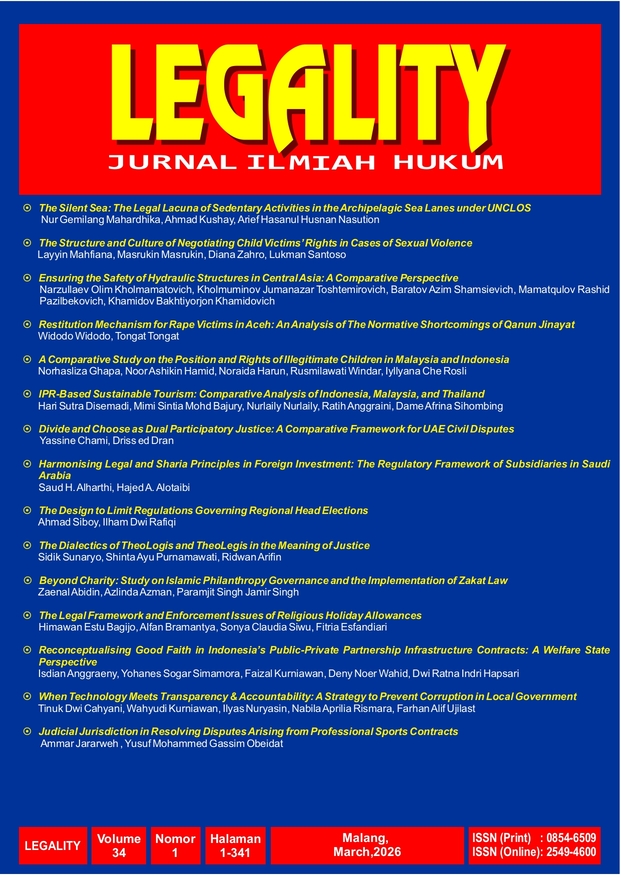
Restitution Mechanism for Rape Victims in Aceh: An Analysis of The Normative Shortcomings of Qanun Jinayat
DOI:
https://doi.org/10.22219/ljih.v34i1.42091Keywords:
Restitution, Rape, Qanun Jinayat, JusticeAbstract
This research examines the restitution mechanism for rape victims in Aceh. The rules on restitution for rape victims set out under Article 51 of Qanun Jinayat in Aceh are intended to protect the victims; however, they are deemed ineffective, given that the restitution implemented by the judges of Mahkamah Syar’iyah only covered 6% of the total victims, 9% of the prosecutions by prosecutors. The victims have no chance of recovering from the physical injuries, psychological trauma, and social trauma. This article was written based on the use of normative legal research methods. Legal materials comprise legislation, Qanun, Mahkamah Syar’iyah rulings, and district court rulings. The research results were analysed in light of the concepts of justice in Islamic criminal law and feminist legal theory. The research results reveal several points to ponder: (a) regulating the minimum uqubat for restitution at 250 grams of pure gold calculated according to the cost spent on recovering the victim, as well as the principles of justice and the maslahat (public benefit) in the context of Islamic criminal law; (b) regulating the obligations of Mahkamah Syar’iyah judges in determining the losses that the aggrieved parties have to take, particularly in terms of setting the amount of uqubat restitution according to the studies on victimology and the theory of feminist law that prioritises gender equality. If the defendant lives in poverty (gharim), the restitution status shifts to a compensation obligation to be paid by the state through baitul mal. However, the defendant must serve a jail sentence instead of probation. Rule amendments are consistent with the concept of justice and legal certainty in Islamic criminal law. The findings of this research should expand access to justice for victims, without restricting judges' freedom to decide cases or violating the human rights of defendants facing financial difficulties, thereby narrowing criminal disparities.
Downloads
References
Absar, A. A. (2020). Restorative Justice in Islam with Special Reference to the Concept of Diyya. Journal of Victimology and Victim Justice, 3(1), 38–56.
Adeniyi, O. V, Masilela, C., & Durojaiye, O. C. (2025). Seroprevalence and Risk Factors for Hepatitis B, HIV, and Syphilis Among Survivors of Sexual Violence in the Eastern Cape Province, South Africa. Pathogens, 14(3), 209. https://doi.org/10.3390/pathogens14030209
Adiningsih, A. P., & Arifin, R. (2023). Victims of Rape and The Legal Protection: Problems and Challenges in The Victimological Studies. Semarang State University Undergraduate Law and Society Review, 3(1), 47–70. https://doi.org/10.15294/lsr.v3i1.56688
Afandi, F., & Bagaskoro, L. R. (2024). Islam and State’s Legal Pluralism. Epistemé: Jurnal Pengembangan Ilmu Keislaman, 19(1), 1–26. https://doi.org/10.21274/epis.2024.19.01.1-26
Al-Fatih, S. (2023). Perkembangan Metode Penelitian Hukum di Indonesia (I). UMM Press.
Aljamalulail, S. R., Rani, F. A., & Muazzin, M. (2024). The Politics of Law on the Fulfillment of Restitution Rights for Rape Victims Based on the Qanun Jinayat in Aceh. Samarah: Jurnal Hukum Keluarga Dan Hukum Islam, 8(1), 299. https://doi.org/10.22373/sjhk.v8i1.16307
Alotaibi, H. A. (2021). The challenges of execution of Islamic criminal law in developing Muslim Countries: An analysis based on Islamic principles and existing legal system. Cogent Social Sciences, 7(1). https://doi.org/10.1080/23311886.2021.1925413
Asadi, L., Noroozi, M., Mardani, F., Salimi, H., & Jambarsang, S. (2023). The Needs of Women Survivors of Rape: A Narrative Review. Iranian Journal of Nursing and Midwifery Research, 28(6), 633–641. https://doi.org/10.4103/ijnmr.ijnmr_395_22
Asrun, A. M., & Hossein, Z. A. (2023). Evolution of Indonesian Judiciary: From Struggle of Independence to Crisis of Accountability. Russian Law Journal, 11(2). https://doi.org/10.52783/rlj.v11i2.886
Badrudduja, A., & Widowaty, Y. (2023). Analisis Pemenuhan Hak Atas Restitusi Terhadap Anak Sebagai Korban Tindak Pidana Kekerasan Seksual. Indonesian Journal of Criminal Law and Criminology, 4(2). https://doi.org/10.18196/ijclc.v4i2.19115
Baehaqi, J. (2021). Symbiosis of Mutualism in the Transformation of Islamic Law into National Law in Indonesia. Walisongo Law Review (Walrev), 3(2), 243–262. https://doi.org/10.21580/walrev.2021.3.2.15216
Barua, U., & Hossain, M. B. (2022). Patriarchy and the Rights of Rape Victims: Law and Practice. Lex Publica, 9(1), 79–93.
Basile, K. C., Smith, S. G., Chen, J., & Zwald, M. (2021). Chronic Diseases, Health Conditions, and Other Impacts Associated With Rape Victimization of U.S. Women. Journal of Interpersonal Violence, 36(23–24), NP12504–NP12520. https://doi.org/10.1177/0886260519900335
Campos, G. S., & Bedê, A. (2023). Integrity at Sentencing and the Issue of Judicial Discretion from a Dworkinian Perspective. Beijing Law Review, 14(2), 828–853. https://doi.org/10.4236/blr.2023.142045
Carroll, C. P. (2022). Accessing Rights and Mitigating Revictimization: The Role of the Victim’s Legal Counsel in the Swedish Criminal Justice System. Violence Against Women, 28(1), 255–276. https://doi.org/10.1177/1077801220988341
Darma, Y. P., Delmiati, S., & Fahmiron. (2024). Pertimbangan Hakim Menjatuhkan Pidana di Bawah Sanksi Minimum Kepada Terdakwa Tindak Pidana Pilkada Pada Tahapan Kampanye. Unes Journal of Swara Justisia, 7(4), 1364–1373. https://doi.org/10.31933/ujsj.v7i4.449
Darmawan, M. R., Kartikahadi, A. D., Rato, D., & Setyawan, F. (2024). Implementasi Hak Restitusi Korban Tindak Pidana Kekerasan Seksual. As-Syar’i: Jurnal Bimbingan & Konseling Keluarga, 6(2), 1448–1460. https://doi.org/10.47476/assyari.v6i2.6506
Devy, S., & Yunus, F. M. (2022). Protection of Women in Aceh Qanun No. 6 of 2014 concerning Jinayah Law (Acehnese Perception Analysis). Media Syari’ah: Wahana Kajian Hukum Islam Dan Pranata Sosial, 24(2), 258. https://doi.org/10.22373/jms.v24i2.15380
Dewi, A., Dimyati, K., Subakti, N., Absori, A., & Nurani, S. S. (2021). Legal Protection for Rape Victims in Indonesia: Seeking an Ideal Concept. Al-Risalah: Forum Kajian Hukum Dan Sosial Kemasyarakatan, 21(1), 121–130. https://doi.org/10.30631/al-risalah.v21i1.791
Dhaka, P., Kalola, E. M., & Steenkamp, S. (2020). Attitudes toward rape victims among University of Namibia students. Journal for Studies in Humanities and Social Sciences, 8(2), 63–78. https://doi.org/10.32642/.v8i2.1515
Djawas, M., Sumardi, D., Yusdiana, R., Nabila, A., & Yumma, C. N. S. (2024). Restitution to Victims of Rape Crimes: Examination of Judicial Decision Number 06/JN/2019/MS.Lsm. Legitimasi: Jurnal Hukum Pidana Dan Politik Hukum, 13(2). https://doi.org/10.22373/legitimasi.v13i2.27578
El-Bassiouny, N., & El-Naggar, D. H. (2025). An Islamic “Theory of Justice” commentary on consumer well-being. Management & Sustainability: An Arab Review, 4(1), 74–80. https://doi.org/10.1108/msar-02-2024-0006
Fajri, N. (2019). Ketiadaan Batas Minimum Khusus ‘Uqubat Restitusi Dalam Qanun Nomor 6 Tahun 2014 Tentang Hukum Jinayat Dalam Konteks Perkembangan Hukum Pidana. Syiah Kuala Law Journal, 3(2), 312–329. https://doi.org/10.24815/sklj.v3i2.12188
Farahi, N., & McEachern, M. (2021). Sexual Assault of Women. American Family Physician, 103(3), 168–176.
Fattah, E. A. (2002). Victimology: Past, Present and Future. Criminologie, 33(1), 17–46. https://doi.org/10.7202/004720ar
Febriandi, Y., Ansor, M., & Nursiti, N. (2021). Seeking Justice Through Qanun Jinayat: The Narratives of Female Victims of Sexual Violence in Aceh, Indonesia. Qudus International Journal of Islamic Studies, 9(1), 103. https://doi.org/10.21043/qijis.v9i1.8029
Feminist Victimology. (2010). In B. Fisher & S. Lab, Encyclopedia of Victimology and Crime Prevention. SAGE Publications, Inc. https://doi.org/10.4135/9781412979993.n130
Fryszer, L. A., Büttner, M., Etzold, S., Muetzel, E., Rall, K., Schellong, J., & David, M. (2022). Recommendations for Care and Support of Female Rape Victims. Geburtshilfe Und Frauenheilkunde, 82(4), 384–391. https://doi.org/10.1055/a-1687-9584
Green, S., Calverley, A., & O’Leary, N. (2021). A New Approach for Researching Victims: The ‘Strength-Growth-Resilience’ Framework. The British Journal of Criminology, 61(3), 852–871. https://doi.org/10.1093/bjc/azaa093
Hamdi, B. W. (2024). The Phenomenon of Disparity in a Criminal Case. Jurnal Impresi Indonesia, 3(5), 349–354. https://doi.org/10.58344/jii.v3i5.4841
Han, Y. (2025). The Impact of Expert Testimony and Victim Statements on Evaluations of Victimization Statements and Legal Judgment: An Introduction to Korea’s Crime Victimization Assessment System and Its Utility. Victims & Offenders, 1–21. https://doi.org/10.1080/15564886.2025.2551183
Hancock, K. P., Policastro, C., Crittenden, C. A., & Garland, T. S. (2021). Major Blame: Examining Male Rape Myth Acceptance across College Majors. Journal of Criminal Justice Education, 32(1), 108–125. https://doi.org/10.1080/10511253.2021.1882518
Hasbi, Y., Saputra, F., Iskandar, H., Rasyid, L. M., & Harun, H. (2025). Criminalising Women, Silencing Victims: Human Rights and Sharia Enforcement in Aceh. De Jure: Jurnal Hukum Dan Syar’iah, 17(1), 175–203. https://doi.org/10.18860/j-fsh.v17i1.29635
Hendriana, R., Raharjo, A., Prayitno, K. P., Wahyudi, S., & Retnaningrum, D. H. (2024). Development of a Restitution Model Based on Justice and Legal Certainty for Crime Victims in Indonesia. Pakistan Journal of Criminology, 16(3), 1409–1425. https://doi.org/10.62271/pjc.16.3.1409.1425
Heryanto, B., Maulana, A., Azzahra, A. A., Sopiana, M. S., Diyantie, S., & Anggraeni, R. (2020). Korban Tindak Pidana Perkosaan dalam Perspektif Viktimologi. Jurnal Hukum Mimbar Justitia, 6(1), 90. https://doi.org/10.35194/jhmj.v6i1.1094
Högbeck, I., & Möller, A. (2022). Female sexual function six months after sexual assault: Post-traumatic stress disorder strongest risk factor for impaired function. Journal of Sex & Marital Therapy, 48(2), 112–120. https://doi.org/10.1080/0092623X.2021.1958964
Hopkins, A., Dodd, S., Nolan, M., & Bartels, L. (2023). At the heart of sentencing: Exploring whether more compassionate delivery of sentencing remarks increases public concern for people who offend. Psychiatry, Psychology and Law, 30(4), 459–485. https://doi.org/10.1080/13218719.2022.2040398
Hutchinson, T. (2015). The Doctrinal Method: Incorporating Interdisciplinary Methods in Reforming the Law. Erasmus Law Review, 8(3), 130–138. https://doi.org/10.5553/ELR.000055
Hutchinson, T., & Duncan, N. (2012). Defining and Describing What We Do: Doctrinal Legal Research. Deakin Law Review, 17(1), 83. https://doi.org/10.21153/dlr2012vol17no1art70
Idoko, C. A., Nwobodo, E., & Idoko, C. I. (2020). Trends in rape cases in a Nigerian state. African Health Sciences, 20(2), 668–675. https://doi.org/10.4314/ahs.v20i2.17
Karimullah, S. K. (2022). Pursuing Legal Harmony: Indonesianization of Islamic Law Concept and Its Impact on National Law. Mazahib, 21(2). https://doi.org/10.21093/mj.v21i2.4800
Kazmi, S. M. A., Tarar, A. H., Nasir, A., & Iftikhar, R. (2023). Victim blaming, prior history to sexual victimization, support for sexually assaulted friends, and rape myths acceptance as predictors of attitudes towards rape victims in the general population of Pakistan. Egyptian Journal of Forensic Sciences, 13(1), 20. https://doi.org/10.1186/s41935-023-00340-7
Kidie, A. A., Masresha, S. A., Ayal, B. G., Mekuria, K., Kodo, T. K., Boye, A. T., Tiruneh, M. G., Bizuneh, F. K., & Fenta, E. T. (2025). A study on sexual violence among women in Northern Ethiopia’s 2022 conflict: Mixed methods. Frontiers in Global Women’s Health, 5. https://doi.org/10.3389/fgwh.2024.1340038
Krisna, L. A., Nurjaya, I. N., Djatmika, P., & Aprilianda, N. (2021). Discourse on the formulation of the Jarimah of sexual violence against children in the Aceh Qanun Jinayat. Research, Society and Development, 10(11), e531101120059. https://doi.org/10.33448/rsd-v10i11.20059
Kristanto, B., & Waluyo, B. (2022). The Restitution Payment for the Child Victims of Sexual Crime or Violence Borne by the State. International Journal of Social Science And Human Research, 05(12), 5914–5920. https://doi.org/10.47191/ijsshr/v5-i12-76
Lawang, K., A Kadir, M., Nur, S., & Sasralina, R. (2022). Sanksi Tindak Pidana Kekerasan Seksual: Studi Komparatif Fiqh, Qanun Aceh dan KUHP. AT-TURAS: Jurnal Studi Keislaman, 9(1), 102–121. https://doi.org/10.33650/at-turas.v9i1.3439
Martin, K. D., & Fowle, M. Z. (2020). Restitution without Restoration? Exploring the Gap between the Perception and Implementation of Restitution. Sociological Perspectives, 63(6), 1015–1037. https://doi.org/10.1177/0731121420970599
Ma’shumiyyah, M. C. A. (2023). Unveiling the Issues: Feminist Legal Theory’s Critique on Rape Formulation in Indonesia. Walisongo Law Review, 5(2), 221–244. https://doi.org/10.21580/walrev.2023.5.2.13555
Matskevich, I. M. (2023). ONCE AGAIN ABOUT VICTIMOLOGY. Bulletin of the Eurasian Law Academy Named after D.A. Kunayev, 2023(1), 86–92. https://doi.org/10.61995/bela/2023.1.129
Mazur, L. B. (2024). “The victim” and the democratization of victimhood. Journal of Theoretical and Philosophical Psychology. https://doi.org/10.1037/teo0000290
McGlynn, C., & Westmarland, N. (2019). Kaleidoscopic Justice: Sexual Violence and Victim-Survivors’ Perceptions of Justice. Social & Legal Studies, 28(2), 179–201. https://doi.org/10.1177/0964663918761200
McLeer, A. (1998). Saving the Victim: Recuperating the Language of the Victim and Reassessing Global Feminism. Hypatia, 13(1), 41–55. https://doi.org/10.1111/j.1527-2001.1998.tb01351.x
Miers, D. (2014). Offender and state compensation for victims of crime: Two decades of development and change. International Review of Victimology, 20(1), 145–168. https://doi.org/10.1177/0269758013508683
Miers, D. (2019). Victims, Criminal Justice and State Compensation. Societies, 9(2), 29. https://doi.org/10.3390/soc9020029
Miles, L. W., Valentine, J. L., Mabey, L. J., Hopkins, E. S., Stodtmeister, P. J., Rockwood, R. B., & Moxley, A. N. H. (2024). A Systematic Review of Evidence-Based Treatments for Adolescent and Adult Sexual Assault Victims. Journal of the American Psychiatric Nurses Association, 30(3), 480–502. https://doi.org/10.1177/10783903231216138
Moulia, N., & Sari, P. (2021). Beban Restitusi Pelaku Pemerkosaan Menurut Perspektif Fikih dan Qanun Jinayat. Ius Civile, 5(1). https://doi.org/10.35308/jic.v5i1.3086
Munir, R., Abbas, R. Z., & Arshed, N. (2021). DNA profiling and databasing: An analysis of issues and challenges in the criminal justice system of Pakistan. Medicine, Science and the Law, 61(1), 27–33. https://doi.org/10.1177/0025802420964318
Murray, C., Calderón, C., & Bahamondes, J. (2023). Modern Rape Myths: Justifying Victim and Perpetrator Blame in Sexual Violence. International Journal of Environmental Research and Public Health, 20(3), 1663. https://doi.org/10.3390/ijerph20031663
Mushtaque, I., Zahra, R., & Khan, A. A. (2022). A Rise in Rape Cases in Pakistan: A Need for Coping Strategies for the Victims. Asia Pacific Journal of Public Health, 34(6–7), 739–740. https://doi.org/10.1177/10105395221112645
Mustafa, C. (2021). The view of judicial activism and public legitimacy. Crime, Law and Social Change, 76(1), 23–34. https://doi.org/10.1007/s10611-021-09955-0
Nasrullah, N., Novendra, C. S., & Reyhan, M. F. (2024). The Challenges of Islamic Criminal Law Implementation in Aceh Shariah Court. Diponegoro Law Review, 9(1), 121–135. https://doi.org/10.14710/dilrev.9.1.2024.121-135
Negara, T. A. S. (2023). Normative Legal Research in Indonesia: Its Originis and Approaches. Audito Comparative Law Journal (ACLJ), 4(1), 1–9. https://doi.org/10.22219/aclj.v4i1.24855
Nir, E., & Liu, S. (2022). The Challenge of Imposing Just Sentences Under Mandatory Minimum Statutes: A Qualitative Study of Judicial Perceptions. Criminal Justice Policy Review, 33(2), 177–205. https://doi.org/10.1177/08874034211030555
Nurazizah, S., & Humaira, V. (2022). Legal Review on the Disparity of Judges’ Decisions in Criminal Cases. The Easta Journal Law and Human Rights, 1(1), 16–20.
Oktaviani, N. I., & Hermawan, R. P. (2024). Tinjauan Hukum Dan Masyarakat Terhadap Pemerkosaan Santri (Studi Kasus: Hery Wirawan Pemerkosaan 13 Santriwati). https://doi.org/10.5281/ZENODO.14565965
Oslami, A. F. (2022). Asas-Asas Qanun Provinsi Aceh Nomor 6 Tahun 2014 tentang Hukum Jinayat. Ta’zir: Jurnal Hukum Pidana, 6(1), 14–23. https://doi.org/10.19109/tazir.v6i1.11127
Penney, J., Lehrer, S., & Galan, E. (2024). Mandatory minimum sentencing and its effect on sentencing distributions: Evidence from Canada. Canadian Journal of Economics / Revue Canadienne d’économique, 57(1), 55–77. https://doi.org/10.1111/caje.12696
Purdue, J. M., & Vars, F. E. (2023). Time to Heal: Trauma’s Impact on Rape & Sexual Assault Statutes of Limitations. Texas A&M Law Review, 11(1), 125–173. https://doi.org/10.37419/lr.v11.i1.3
Purwoko, W. A. (2023). Kebijakan Formulasi Sistem Ancaman Pidana Minimum Khusus Dalam Undang-Undang Tindak Pidana Korupsi Di Indonesia. Magistra Law Review, 4(02), 90. https://doi.org/10.56444/malrev.v4i02.3970
Rahayu, P., Adriano, & Pramono, B. (2024). Restitution Right for Victims of Sexual Violence. JILPR Journal Indonesia Law and Policy Review, 5(3), 677–685. https://doi.org/10.56371/jirpl.v5i3.297
Rahmatillah, S. (2022). Rekontruksi Pemenuhan Restitusi Melalui Qanun Jinayat di Aceh Bagi Korban Perkosaan. Serambi Tarbawi, 10(2), 139–152. https://doi.org/10.32672/tarbawi.v10i2.4757
Rahmi, A. (2019). Pemenuhan Restitusi Dan Kompensasi Sebagai Bentuk Perlindungan Bagi Korban Kejahatan Seksual Dalam Sistem Hukum Di Indonesia. De Lega Lata: Jurnal Ilmu Hukum, 4(1), 140–159. https://doi.org/10.30596/dll.v4i2.3173
Ramadhita, R., Ali, M., & Syabbul, B. (2023). Gender inequality and judicial discretion in Muslims divorce of Indonesia. Cogent Social Sciences, 9(1). https://doi.org/10.1080/23311886.2023.2206347
Rezky, A. P., & Putri, F. A. (2024). Public Policy Analysis: Root Causes and Solutions of Sexual Violence in Aceh. Jurnal Ilmiah Ilmu Administrasi Publik, 14(1), 181. https://doi.org/10.26858/jiap.v14i1.58994
Ricardo, D., Ismail, & Iryani, D. (2024). Optimalisasi Eksekusi Restitusi Bagi Anak yang Menjadi Korban Tindak Pidana Kekerasan Seksual Dalam Mewujudkan Kepastian Hukum. Ilmu Hukum Prima, 7(1), 27–38. https://doi.org/10.34012/jihp.v7i1.4994
Rinde, K. R., Vučić, T., Andresen, M. G., Havnen, A., & Solem, S. (2025). She Asked for It? Descriptions of Victims’ Behaviors Are Associated With Sentencing in Norwegian Rape Trials. Scandinavian Journal of Psychology, 66(3), 327–337. https://doi.org/10.1111/sjop.13088
Ronaldi, E., Ali, D., & Mujibussalim, M. (2019). Implikasi Putusan Hakim Dalam Penetapan Sanksi Di Bawah Minimum Terhadap Tindak Pidana Narkotika. Syiah Kuala Law Journal, 3(1), 129–146. https://doi.org/10.24815/sklj.v3i1.12152
Rosmalinda, R., Sirait, N., Suhaidi, S., & Ikhsan, E. (2021). The Right of Restitution for Child Victims of Sexual Violence In Indonesia. IIUM Law Journal, 29, 167–197. https://doi.org/10.31436/iiumlj.v29i(S2).684
Royani, Y. M. (2022). Relevance of the Position of the Victims in Indonesian Positive Law and Islamic Criminal Law. Walisongo Law Review (Walrev), 4(2), 193–220. https://doi.org/10.21580/walrev.2022.4.2.13244
Rubanov, V. A. (2024). A Features of modern victim behavio. Vestnik of North Ossetian State University, (4), 179–183. https://doi.org/10.29025/1994-7720-2024-4-179-183
Rusyidi, B. (2022). Biaya Ekonomi Kekerasan Interpersonal terhadap Perempuan. Jurnal Kolaborasi Resolusi Konflik, 4(1), 83–91.
Sabril, F., Zahara, & Tasman. (2023). Perlindungan Hukum dengan Restitusi Terhadap Anak yang Menjadi Korban Tindak Pidana. Unes Journal of Swara Justisia, 6(4), 398–414.
Schmitt, S., Robjant, K., Elbert, T., & Koebach, A. (2021). To add insult to injury: Stigmatization reinforces the trauma of rape survivors – Findings from the DR Congo. SSM - Population Health, 13, 100719. https://doi.org/10.1016/j.ssmph.2020.100719
Singhs, P., & Dixit, A. (2023). Comparative Study of Rape Legislation for Men and Women in India. International Journal For Multidisciplinary Research, 5(6), 9914. https://doi.org/10.36948/ijfmr.2023.v05i06.9914
Smith, S. G., Chen, J., Lowe, A. N., & Basile, K. C. (2022). Sexual Violence Victimization of U.S. Males: Negative Health Conditions Associated with Rape and Being Made to Penetrate. Journal of Interpersonal Violence, 37(21–22), NP20953–NP20971. https://doi.org/10.1177/08862605211055151
Soleto, H., Elbers, N., Akkermans, A., Tamarit, J. M., Arantegui, L., Lepri, G. L., Chirico, D., Lāce, I., & Spetsidis, N. (2024). Ineffectiveness of the Right to Compensation for Victims of Sexual Violence: A Comparison Between Five EU Member States. International Criminology, 4(1), 93–107. https://doi.org/10.1007/s43576-024-00118-4
Solichah, M. (2013). Asesment Post Traumatic Stress Disorder (PTSD) pada Perempuan Korban Perkosaan (Acquaintance Rape). Humanitas, 10(1), 87–102.
Sujana, T. (2024). Sexual Abuse And Risk of Chronic Illness: A Literature Review. Journal of Maternity Care and Reproductive Health, 7(4). https://doi.org/10.36780/jmcrh.v7i4.12303
Syahputra, R., Ekaputra, M., & Marlina, M. (2024). Analisis Putusan Hakim yang Menjatuhkan Pidana dibawah Batas Minimum Ancaman Sanksi Pidana dalam Pasal 112 Ayat (1) UU Narkotika: : (Studi Putusan Mahkamah Agung Nomor 2308 K / Pid.Sus /2018). Locus Journal of Academic Literature Review, 3(4), 349–377. https://doi.org/10.56128/ljoalr.v3i4.315
Syahr, Z. H. A., Hutapea, T. P. D., Farida, U., Syaifullah, D. H., & Buyamin. (2023). The Role of Indigenous Peoples, Social Workers, and the Syar’iyah Court in Diversion of Children Perpetrators of Jinayah. Al-Manahij: Jurnal Kajian Hukum Islam, 17(1), 113–124. https://doi.org/10.24090/mnh.v17i1.7349
Taekema, S. (2018). Theoretical and Normative Frameworks for Legal Research: Putting Theory into Practice. Law and Method. https://doi.org/10.5553/REM/.000031
Tempo. (2024). Aceh di Urutan Pertama, Inilah 10 Provinsi dengan Kasus Pemerkosaan Tertinggi di Indonesia. Tempo.Co.
Tenaw, L. A., Aragie, M. W., Ayele, A. D., Kokeb, T., & Yimer, N. B. (2022). Medical and psychological consequences of rape among survivors during armed conflicts in northeast Ethiopia. PLOS ONE, 17(12), e0278859. https://doi.org/10.1371/journal.pone.0278859
Thani, S., & Mardhatillah, F. (2023). Tinjauan Yuridis Tentang Dualisme Kewenangan Penyelesaian Tindak Pidana Kekerasan Seksual Yang Dilakukan Oleh Anak (Kajian Hukum Di Provinsi Aceh). CENDEKIA: Jurnal Hukum, Sosial & Humaniora, 1(2), 180–190.
Toga, C., Saragih, R., & Lengkong, L. Y. (2022). Penerapan Pidana terhadap Pelaku dan Restitusi terhadap Anak selaku Korban Tindak Pidana Kekerasan Seksual. Jurnal Hukum To-Ra: Hukum Untuk Mengatur Dan Melindungi Masyarakat, 8, 29–44.
Tongat, T. (2024). Death penalty in Indonesia: Between criminal law and Islamic law perspectives. Legality : Jurnal Ilmiah Hukum, 32(1), 90–104. https://doi.org/10.22219/ljih.v32i1.32335
Wahyuni, W. (2022). Jarimah Pemerkosaan Dalam Qanun Jinayat Aceh Perspektif Feminist Legal Theory. Jurnal Hukum Unissula, 38(1), 43–60. https://doi.org/10.26532/jh.v38i1.17458
Walklate, S. (2016). The Metamorphosis of the Victim of Crime: From Crime to Culture and the Implications for Justice. International Journal for Crime, Justice and Social Democracy, 5(4), 4–16. https://doi.org/10.5204/ijcjsd.v5i4.280
Walklate, S., Maher, J., McCulloch, J., Fitz-Gibbon, K., & Beavis, K. (2019). Victim stories and victim policy: Is there a case for a narrative victimology? Crime, Media, Culture: An International Journal, 15(2), 199–215. https://doi.org/10.1177/1741659018760105
Wemmers, J.-A. (2020). Restitution: Helping Victims or Offenders? In An International Perspective on Contemporary Developments in Victimology (pp. 283–294). Springer International Publishing. https://doi.org/10.1007/978-3-030-41622-5_20
Wondie, Y., Zeleke, W. A., & Melesse, M. (2023). In between the lines of the narrative map: Phenomenological analysis of war rape victims in Amhara Regional State, Ethiopia. PLOS ONE, 18(7). https://doi.org/10.1371/journal.pone.0289106
Xiong, M., Xia, Y., & Yu, X. (2025). Sentencing equilibrium in rape cases: A legal and political explanation of jurisdictional uniformity in China. Humanities and Social Sciences Communications, 12(1). https://doi.org/10.1057/s41599-025-04368-z
Yeghiazaryan, M. (2025). Methodology for Assessing the Semantic Orientation of Victimhood. “Katchar” Collection of Scientific Articles International Scientific-Educational Center NAS RA, 71. https://doi.org/10.54503/2579-2903-2025.2-71
Yuningsih, H., & Munawir. (2025). Efektivitas Restitusi dalam Perlindungan Korban Kekerasan Seksual di Indonesia: Analisis Yuridis dan Implementasi Praktis. Ranah Research : Journal of Multidisiplinary Research and Development, 7(2), 1121–1130.
Yusuf, M. (2021). Qanun Hukum Jinayah Dalam Bingkai Teori Pembuatan Hukum. Letimasi: Jurnal Hukum Pidana Dan Politik Hukum, 10(2), 256. https://doi.org/10.22373/legitimasi.v10i2.11343
Zahantoro, N. A., Kurniaty, Y., & Hakim, H. A. (2023). Implikasi Putusan Hakim dalam Penetapan Sanksi di Bawah Minimum Terhadap Tindak Pidana Narkotika di Kota Magelang. Borobudur Law and Society Journal, 2(4), 160–167. https://doi.org/10.31603/9827
Zikri, M., & Rodiah, I. (2023). Marginalisasi kaum perempuan dalam kehidupan sosial masyarakat aceh. Oetoesan-Hindia: Telaah Pemikiran Kebangsaan, 5(1), 27–37. https://doi.org/10.34199/oh.v5i1.160
Zulkifli, Z., Rahman, A., Martina, M., Mumtiza, R., & Risma, M. (2022). Social construction of law enforcement for sexual violence against women in Aceh Utara. Jurnal Civics: Media Kajian Kewarganegaraan, 19(2), 224–234. https://doi.org/10.21831/jc.v19i2.52631
Zuriah, Z., Saputra, T. A., & Novriansyah, M. (2023). The Effectiveness of Qanun Jinayat in Preventing Sexual Violence Against Children from a Psychological Perspective. An-Nisa Jurnal Kajian Perempuan Dan Keislaman, 16(2), 183–194. https://doi.org/10.35719/annisa.v16i2.176
Downloads
Published
How to Cite
Issue
Section
License
Copyright (c) 2026 Widodo Widodo, Tongat Tongat

This work is licensed under a Creative Commons Attribution-ShareAlike 4.0 International License.