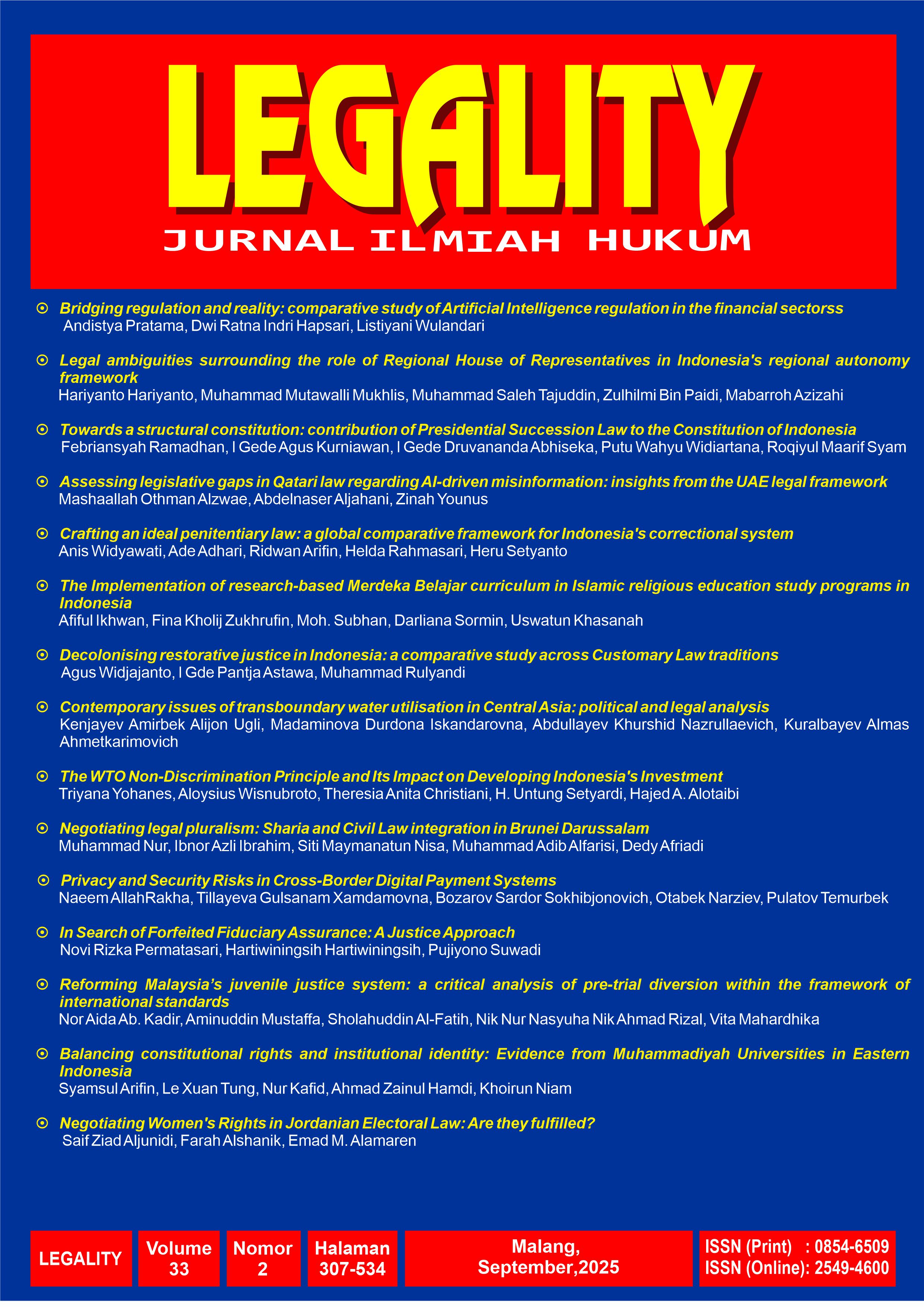
Balancing constitutional rights and institutional identity: Evidence from Muhammadiyah Universities in Eastern Indonesia
DOI:
https://doi.org/10.22219/ljih.v33i2.42108Keywords:
Constitutional Rights, Religious Freedom, Muhammadiyah Universities, Islamic Religious Education (IRE), Christian-Majority StudentsAbstract
This study examines the relationship between constitutional rights and institutional religious identity through Islamic Religious Education (IRE) at Muhammadiyah universities in Eastern Indonesia, in which the majority of students are Christian. Although the law guarantees students’ rights to receive religious education in accordance with their beliefs, some Islamic higher education institutions pay insufficient attention to this provision. Through interviews, document analysis, and classroom observations, this study investigates how religious education at Muhammadiyah universities is managed to balance Muhammadiyah’s institutional educational identity with the legal requirements related to students’ constitutional rights to obtain religious education that corresponds to their respective religions. The findings show Muhammadiyah’s commitment to providing religious education that accommodates students' religious diversity through an instructional approach known as Multicultural AIK. Nevertheless, more inclusive steps remain necessary, including facilitating religious education that explicitly indicates that the instruction students receive aligns with the religion they adhere to.
Downloads
References
Al-Fatih, S. (2024). Muhammadiyah's Untold Story; A Welfare State Vision Through Higher Education System. Jurnal Muhammadiyah Studies, 9(2), 120-129. https://doi.org/10.22219/jms.v9i2.38507
Bachtiar, H. (2020). Dār al-‘Ahd wa al-Shahādah: Muhammadiyah’s Position and Thoughts on Negara Pancasila. Studia Islamika, 27(3), 485–513. https://doi.org/10.36712/sdi.v27i3.11325
Bagir, Z. A. (2016). Religious Education in Indonesia: Contrasting Dynamics in Local and National Settings. Religious Education in a Global-Local World, 91–92.
Braun, V., & Clarke, V. (2006). Using thematic analysis in psychology. Qualitative Research in Psychology, 3(2), 77–101. https://doi.org/10.1191/1478088706qp063oa
Bruner, J. S. (1960a). The process of education. Harvard university press.
Bruner, J. S. (1960b). The process of education. The Physics Teacher, 3(8), 369–370.
Byrne, C. (2014). Religion in secular education: What, in heaven’s name, are we teaching our children? (Vol. 21). Brill.
Candy, P. C. (2002). Lifelong learning and information literacy. Retrieved October, 20(2004), 6.
Colbran, N. (2010). Realities and challenges in realising freedom of religion or belief in Indonesia. The International Journal of Human Rights, 14(5), 678–704. https://doi.org/10.1080/13642980903155166
Creswell, J. W. (2014). Research design: qualitative, quantitative, and mixed methods approaches.
Durham, W. C., & Scharffs, B. G. (2010). Law and religion: National, international, and comparative perspectives. Aspen Publishers.
Effendy, B. (2003). Islam and the State in Indonesia (Vol. 109). Institute of Southeast Asian Studies.
Engebretson, K. (2006). Learning About and Learning from Religion. The Pedagogical Theory of Michael Grimmitt BT - International Handbook of the Religious, Moral and Spiritual Dimensions in Education (M. de Souza, G. Durka, K. Engebretson, R. Jackson, & A. McGrady (eds.); pp. 667–678). Springer Netherlands. https://doi.org/10.1007/1-4020-5246-4_47
Fiddes, P. S. (2012). The Root of Religious Freedom: Interpreting Some Muslim and Christian Sacred Texts. Oxford Journal of Law and Religion, 1(1), 169–184. https://doi.org/10.1093/ojlr/rwr016
Fowler, J. W. (1988). Stages of faith: The psychology of human development and the quest for meaning. Harper & Row.
Fuller, L. L. (1969). The Morality of Law New Haven, CT. Yale Univ. Press, Rev. ed.
Hidayatullah. (2023). Ormas Islam Jatim Serempak Dukung RUU Sisdiknas. Hidayatullah.Com. https://hidayatullah.com/berita/nasional/2003/06/08/458/ormas-islam-jatim-serempak-dukung-ruu-sisdiknas.html
Indrayana, D. (2010). In Search for a Democratic Constitution: Indonesian Constitutional Reform 1999-2002. Jurnal Media Hukum, 17(1). https://doi.org/10.18196/jmh.v17i1.372
Jackson, R. (1997). Religious education: An interpretive approach. London: Hodder & Stoughton.
Jarvis, P. (2009). Lifelong learning: A social ambiguity. In The Routledge international handbook of lifelong learning (pp. 9–18). Routledge.
Khasanah, N. (2024). The Implementation of Religious Education for Muslim Students in SMP Negeri 2 Bandar Jaya. Progressive Journal of Educational Studies, 2(1), 33–42.
Kohlberg, L., & Power, C. (1981). Moral Development, Religious Thinking, and The Question of A Seventh Stage. Zygon: Journal of Religion and Science, 16(3). https://doi.org/10.1111/j.1467-9744.1981.tb00417.x
Kurzman, C., & Naqvi, S. I. H. (2010). Who are the Islamists? Rethinking Islamic Studies.
Majelis Pendidikan Tinggi, Penelitian, dan P. P. P. M. (2025). Pedoman Pengembangan Kurikulum Pendidikan Al-Islam dan Kemuhammadiyahan (AIK) pada Perguruan Tinggi Muhammadiyah dan ’Aisyiyah (PTMA) Program Sarjana, Profesi, Magister, dan Doktor. Yogyakarta: Majelis Diktilitbang PP Muhammadiyah.
Merriam, S. B., & Tisdell, E. J. (2016). Qualitative Research: A Guide to Design and Implementation. NIDA, 147.
Miles, M. B., Huberman, A. M., & Saldana, J. (2014). Qualitative data analysis: A methods sourcebook. (No Title).
Nugroho, A. R. H. (2021). Pendidikan Agama Islam dan Budi Pekerti. Islamic Religious Education and Character Education.
Parker, L. (2010). Teaching religious tolerance. Inside Indonesia, Edition 101 (July–September 2010), 102.
Parker, L. (2014). Religious Education for Peaceful Coexistence in Indonesia? South East Asia Research, 22(4), 487–504. https://doi.org/10.5367/sear.2014.0231
Patton, M. Q. (2015). Qualitative research & evaluation methods: Integrating theory and practice. (No Title).
Peace, S. I. for D. and. (2024). Regression Amidst Transition: The State of Freedom of Religion and Belief in Indonesia in 2024. Setara Institute.
Piaget, J. (2005). The psychology of intelligence. New York: International Universities Press.
Raihani, R. (2016). Minority Right to Attend Religious Education in Indonesia. Al-Jami’ah: Journal of Islamic Studies, 53(1), 1. https://doi.org/10.14421/ajis.2015.531.1-26
Roberts, K. A., & Yamane, D. (2016). Religion in sociological perspective. Sage Publications, 103.
Satrio, A. (2023). Restoring Indonesia’s (Un)Constitutional Constitution: Soepomo’s Authoritarian Constitution. German Law Journal, 24(2), 402–416. https://doi.org/10.1017/glj.2023.16
Shafar, I. (2018). Implementasi Pasal 12 Ayat (1) Huruf a Undang-Undang Nomor 20 Tahun 2003 Tentang Sistem Pendidikan Nasional di SMP Xaverius 1 Palembang. Universitas Muhammadiyah Palembang.
Stake, R. E. (1995). The art of case study research. Sage.
Sterkens, C., & Yusuf, M. (2015). Preferences for Religious Education and Inter-Group Attitudes among Indonesian Students. Journal of Empirical Theology, 28(1), 49–89. https://doi.org/10.1163/15709256-12341324
Subekti, V. S. (2008). Menyusun konstitusi transisi: pergulatan kepentingan dan pemikiran dalam proses perubahan UUD 1945. Jakarta: PT RajaGrafindo Persada.
Syafi’i. (2020). Politics of Religious Education in Schools: A Study of the Polemic of Religious Education in Law No. 20 of 2003 concerning the National Education System. South Tangerang: Young Progressive Muslim, 285–287.
Tibaka, L., & Rosdian, R. (2018). The Protection of Human Rights in Indonesian Constitutional Law after the Amendment of the 1945 Constitution of the Republic of Indonesia. FIAT JUSTISIA:Jurnal Ilmu Hukum, 11(3), 266. https://doi.org/10.25041/fiatjustisia.v11no3.1141
Tiopan, D., Kurniawan, S., Rabbani, K. A., Setiawan, A., Tjoneng, A., & Narwastuty, D. (2023). The House of Representatives Legislative Authority in Indonesia’s Amended 1945 Constitution. Croatian International Relations Review, 29(93), 254–272.
Vygotsky, L. S. (1978). Mind in society: The development of higher psychological processes (Vol. 86). Harvard university press.
Wahyudi, D. (2024). Implementasi Pendidikan Agama: Pembelajaran Pendidikan Agama Bagi Peserta Didik Beda Agama. Indonesian Research Journal on Education, 4(2), 289–294. https://doi.org/10.31004/irje.v4i2.562
Yin, R. K. (2018). Case study research and applications (Vol. 6). Sage Thousand Oaks, CA.
Yumitro, G., & Abhiyoga, N. (2022). Multiculturalism Education as the Social Approach for Deradicalization Program in Indonesia. Technium Social Sciences Journal, 38, 124–134. https://doi.org/10.47577/tssj.v38i1.7763
Downloads
Published
How to Cite
Issue
Section
License
Copyright (c) 2025 Syamsul Arifin, Le Xuan Tung, Nur Kafid, Ahmad Zainul Hamdi, Khoirun Niam

This work is licensed under a Creative Commons Attribution-ShareAlike 4.0 International License.