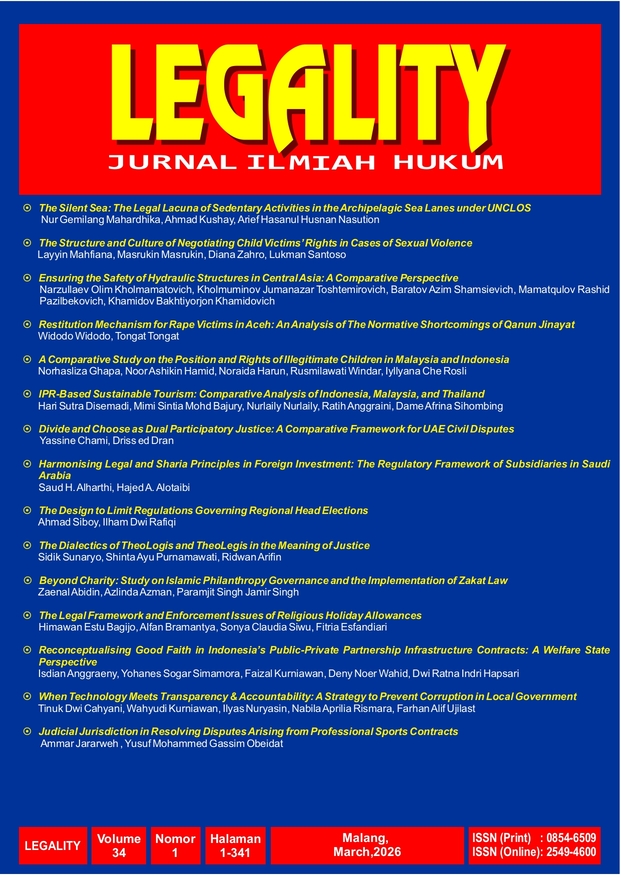
Harmonising Legal and Sharia Principles in Foreign Investment: The Regulatory Framework of Subsidiaries in Saudi Arabia
DOI:
https://doi.org/10.22219/ljih.v34i1.42145Keywords:
Foreign investment, Sharia, Subsidiaries, Investment, Saudi ArabiaAbstract
This paper examines how Saudi Arabia’s updated investment regime (2024-2025) and Sharia principles jointly shape the legal and economic environment for establishing subsidiaries. Using a mixed-methods research design, the study combines doctrinal analysis of primary legal sources: the investment laws of 2024 and the implementing regulations of 2025 the 2022 Companies Law. We also considered relevant macroeconomic determinants that inform the foreign direct investments and empirical assessments that adopted the time series data for the period 1960 to 2023. As a finding, this research found that the new Investment Law guarantees equal treatment for domestic and foreign investors and shifts most activities from a licensing model to a streamlined, registration-based entry system, while maintaining approval requirements for sensitive sectors. The 2022 Companies Law enhances structural flexibility by permitting single-member LLCs, modernising governance rules, and removing earlier constraints on shareholder numbers. These changes collectively support holding-company and subsidiary formation.
Downloads
References
Ahmed, A. M. E. T. (2010). Islamic banking: How to manage risk and improve profitability. John Wiley & Sons.
Alanazi, K., & Basir, S.M. (2021). Legal treatment of foreign direct investment in Saudi Arabia. Journal of Legal, Ethical and Regulatory Issues, 24(7), 1-15. https://www.abacademies.org/articles/legal-treatment-of-foreign-direct-investment-in-saudi-arabia-12055.html?utm_source=chatgpt.com
Alasmari, A. A. A., & Alotaibi, H. A. (2025). Modernizing commercial agency regulations in Saudi Arabia: Legal reforms and comparative insights. F1000Research, 14, 912.
Al-Fahad, A. (2005). Ornamental constitutionalism: The Saudi Basic Law of Governance. Yale Journal of International Law, 30(2), 375-408.
Al-Fatih, S. (2023). Perkembangan metode penelitian hukum di Indonesia. UMMPress.
Alhagas, W. K., & Alhenaki, M. A., (2023). The Implementation of Foreign Investment law in Saudi Arabia. Pakistan Journal of Law, Analysis and Wisdom, 2(1), 1-26. https://pjlaw.com.pk/index.php/Journal/article/view/17
Alkahtani, F., (2010), Legal protection of foreign direct investment in Saudi Arabia, PhD Thesis Newcastle University, http://hdl.handle.net/10443/2254
Alotaibi, H. A. (2021). Identifying Islamic objectives’ frameworks for ecology system in Saudi Arabia. Islamic Quarterly, 65(1), 45-62.
Alotaibi, H. A. (2025). Islamic legal perspectives on non-fungible tokens (NFTs): Exploring the permissibility of NFTs as digital assets under Islamic law. Journal of Law and Political Sciences, 46(3), 243-261. Aalborg Academy of Sciences.
Amidu, M., Coffie, W., & Acquah, P. (2019). Transfer pricing, earnings management and tax avoidance of firms in Ghana. Journal of Financial Crime, 26(1), 235-259. https://doi.org/10.1108/JFC-11-2017-0110
Aziz, H. A., Abd Ghadas, Z. A., & Ossofo, A. B. (2023). Corporate social responsibility under the Maqasid Syariah concept in Malaysia: Why does it matter? Jurnal Media Hukum, 30(1), 53-65.
Azmi, N. A., Abd Sata, F. H., Zakaria, N. B., & Sanusi, Z. M. (2020). Political connection and firm’s performance among Malaysian firms. International Journal of Financial Research, 11(1), 146-154.
Beblawi, H. (1987). The rentier state in the Arab world. In H. Beblawi & G. Luciani (Eds.), The rentier state (pp. 49-62). Croom Helm.
Bendix, R. (1977). Nation-building and citizenship. University of California Press.
Boateng, F. D., Pryce, D. K., & Alotaibi, H. A. (2025). Procedural justice, obligation to obey, and cooperation with police in a sample of Saudi Arabian citizens. Policing: An International Journal, 48(5), 1135-1154. https://www.emerald.com/pijpsm/article-abstract/48/5/1135/1271684
Bowen, J. R. (2003). Islam, law, and equality in Indonesia: An anthropology of public reasoning. Cambridge University Press.
Buettner, T., Overesch, M., & Wamser, G. (2016). Restricted interest deductibility and multinationals’ use of internal debt finance. International Tax and Public Finance, 23(5), 785-797. https://doi.org/10.1007/s10797-015-9361-1
Comincioli, N., Panteghini, P., & Vergalli, S. (2020). Debt shifting and transfer pricing in a volatile world. SSRN Electronic Journal. https://doi.org/10.2139/ssrn.3735229
Commins, D. (2015). The Wahhabi mission and Saudi Arabia (2nd ed.). I.B. Tauris.
Conermann, S. (2004). State formation and Sharia courts in Arabia. Middle Eastern Studies, 40(3), 45-67.
Crystal, J. (1990). Oil and politics in the Gulf. Cambridge University Press.
Darmawan, A., & Angelina, S. (2021). The impact of tax planning on firm value. Journal of Applied Accounting and Taxation, 6(2), 196-204.
Davies, R. B., Martin, J., Parenti, M., & Toubal, F. (2018). Knocking on tax havens’ door: Multinational firms and transfer pricing. Review of Economics and Statistics, 100(1), 120-134.
Devi, B., & Efendi, S. (2018). Financial derivatives in corporate tax aggressiveness. The Indonesian Journal of Accounting Research, 21(3).
Dharmapala, D., & Riedel, N. (2013). Earnings shocks and tax-motivated income-shifting: Evidence from European multinationals. Journal of Public Economics, 97, 95-107.
Donohoe, M. P. (2015). The economic effects of financial derivatives on corporate tax avoidance. Journal of Accounting and Economics, 59(1), 1-24.
Eickelman, D. F., & Piscatori, J. (1996). Muslim politics. Princeton University Press.
El Fadl, K. A. (2014). Reasoning with God: Reclaiming Shari‘ah in the modern age. Rowman & Littlefield.
Facchini, F. (2018). Codification and legal change in the Muslim world. Journal of Legal Pluralism, 50(1), 89-112.
Gause, F. G. (1994). Saudi-Yemeni relations. Columbia University Press.
Goyal, L. (2020). Stakeholder theory: Revisiting the origins. Journal of Public Affairs, 22(4), e2559.
Graham, J. R., Hanlon, M., Shevlin, T., & Shroff, N. (2014). Incentives for tax planning and avoidance: Evidence from the field. The Accounting Review, 89(3), 991-1023.
Gujarati, D. N. (2021). Essentials of econometrics (6th ed.). Sage Publications.
Halid, S., Mahmud, R., Zakaria, N. B., & Rahman, R. A. (2021). Does board monitoring affect integrated reporting disclosure for transparency? Universal Journal of Accounting and Finance, 9(5), 1049-1057.
Hanifah, F., Widiastuti, E., & Najmudin, N. (2024). The effect of tax avoidance, profitability, and leverage on dividend policy. Marginal Journal of Management Accounting, 3, 376-387.
Hanlon, M., Hoopes, J. L., & Shroff, N. (2014). The effect of tax authority monitoring and enforcement on financial reporting quality. Journal of the American Taxation Association, 36(2), 137-170.
Hatmaka, M. H. (2024). Pajak dan pendapatan asli daerah: Evaluasi kesesuaian dengan prinsip maqasid syariah. Journal of Ecotourism and Rural Planning, 1(1), 1-11.
Herb, M. (1999). All in the family: Absolutism, revolution, and democracy in the Middle Eastern monarchies. SUNY Press.
Isnaini, U., Salma, F. S., & Sujianto, A. E. (2024). Preparation of administrative cost budgeting with Maqasid Syariah approach. Formosa Journal of Multidisciplinary Research, 3(1), 67-80.
Kalash, I. (2021). Financial leverage and performance in Turkey: The role of distress and currency crisis. EuroMed Journal of Business, 18(1), 1-20.
Kamaruddin, A. M., Adawiyah, R., Tsalis, K. N., & Abbas, A. (2024). Implementation of Maqasid al-Shariah in zakah community development. Jurnal Ilmiah Mahasiswa Raushan Fikr, 13, 174-185.
Kaya, I. (2017). Accounting choices and positive accounting theory. In Accounting and corporate reporting (pp. 129-140). Intech.
Koivisto, A., Musoke, N., Nakyambadde, D., & Schimanski, C. (2021). Taxing multinational corporations in Uganda. WIDER Working Paper 2021/51.
Kovermann, J., & Velte, P. (2019). The impact of corporate governance on tax avoidance. Journal of International Accounting, Auditing and Taxation, 36, 100270.
Lacroix, S. (2011). Awakening Islam: The politics of religious dissent in contemporary Saudi Arabia. Harvard University Press.
Lau, C. K. (2016). Corporate derivatives and firm performance. Pacific-Basin Finance Journal, 40, 102-114.
Lohse, T., & Riedel, N. (2013). Do transfer pricing laws limit income shifting? https://papers.ssrn.com/sol3/papers.cfm?abstract_id=2334651
Ministry of Justice (Saudi Arabia). (2022). Judicial transformation and digital justice: Annual report.
Mouline, N. (2014). The clerics of Islam: Religious authority and political power in Saudi Arabia. Yale University Press.
OECD. (2019). Model Tax Convention on Income and on Capital.
Payne, D. M., & Raiborn, C. A. (2018). Aggressive tax avoidance: A conundrum. Journal of Business Ethics, 147(2), 469-487.
Peters, R. (2005). Crime and punishment in Islamic law. Cambridge University Press.
Phua, L. K., Lok, C. L., Chua, Y. X., & Lim, T. C. (2021). Earnings volatility, derivatives and earnings management. Malaysian Journal of Economic Studies, 58(1), 1-20.
Posner, R. A. (1998). The problematics of moral and legal theory. Harvard University Press.
Putri, V., Zakaria, N. B., & Said, J. (2022). Tax avoidance: Transfer pricing and financial factors. Asia-Pacific Management and Accounting Association.
Putri, V., Zakaria, N. B., Said, J., & Azis, M. A. A. (2023). Corporate social responsibility and tax avoidance. Indian Journal of Corporate Governance, 16(2), 218-239.
Putri, V., Zakaria, N. B., Said, J., Ghapar, F., & Anita, R. (2024). Tax tightrope: Transfer pricing in Indonesian banking. Journal of Risk and Financial Management, 17(1), 26.
Rahman, R. A., Zakaria, N. B., Masrom, S., & Nurdin, E. (2021). Predicting earnings manipulation using machine learning. International Journal of Emerging Technology and Advanced Engineering, 11(3), 111-120.
Rhetha, S. A., Karisha, Y., Kiyani, N., Zain, T. N., & Abadi, M. T. (2024). Maslahah in Islamic mutual funds. Jurnal Ilmiah Research and Development Student, 2(1), 116-125.
Rodriguez, A. (2016). Codifying Sharia in the Gulf. Arab Law Quarterly, 30(4), 289-314.
Sari, M. P., Raharja, S., Budiarto, A., Utaminingsih, N. S., & Budiantoro, R. (2022). Transfer pricing determinants in Indonesia. Investment Management and Financial Innovations, 19(3), 267-277.
Saunders, M., Lewis, P., & Thornhill, A. (2012). Research methods for business students (6th ed.). Pearson.
Schroeder, R. G., Clark, M. W., & Cathey, J. M. (2019). Financial accounting theory and analysis: Text and cases. John Wiley & Sons.
Sikka, P., & Willmott, H. (2010). The dark side of transfer pricing. Critical Perspectives on Accounting, 21(4), 342-356.
Vania, A. S., Nugraha, E., & Nugroho, L. (2018). Does earnings management happen in Islamic banks? International Journal of Commerce and Finance, 4(1), 47-59.
Vogel, F. E. (2000). Islamic law and legal system: Studies of Saudi Arabia. Brill.
Wang, L. (2019). Creativity as a pragmatic moral tool. Journal of Business Research, 96, 1-13.
Weber, M. (1978). Economy and society. University of California Press.
Wiktorowicz, Q. (2004). Islamic activism: A social movement theory approach. Indiana University Press.
Yamani, M. (2004). Cradle of Islam: The Hijaz and the quest for an Arabian identity. I.B. Tauris.
Yohanes, T., Christiani, T. A., Setyardi, H. U., & Alotaibi, H. A. (2025). WTO non-discrimination principle and its impact on Indonesia’s investment. Legality: Jurnal Ilmiah Hukum, 33(2), 513-534.
Zainon, S., Md Nawi, S., Ismail, R. F., Misman, F. N., Shaf, R. M., & Zakaria, N. B. (2020). ESG disclosures and financial performance. Asian-Pacific Management Accounting Journal, 15(1), 87-107.
Zang, A. Y. (2012). Evidence on the trade-off between real and accrual earnings management. The Accounting Review, 87(3), 675-703.
Zubaida, S. (2003). Law and power in the Islamic world. I.B. Tauris.
Zulfiqar, S. (2019). Shari‘a and state authority in contemporary Muslim politics. Third World Quarterly, 40(7), 1321-1339.
Downloads
Published
How to Cite
Issue
Section
License
Copyright (c) 2026 Saud H. Alharthi, Hajed A. Alotaibi

This work is licensed under a Creative Commons Attribution-ShareAlike 4.0 International License.