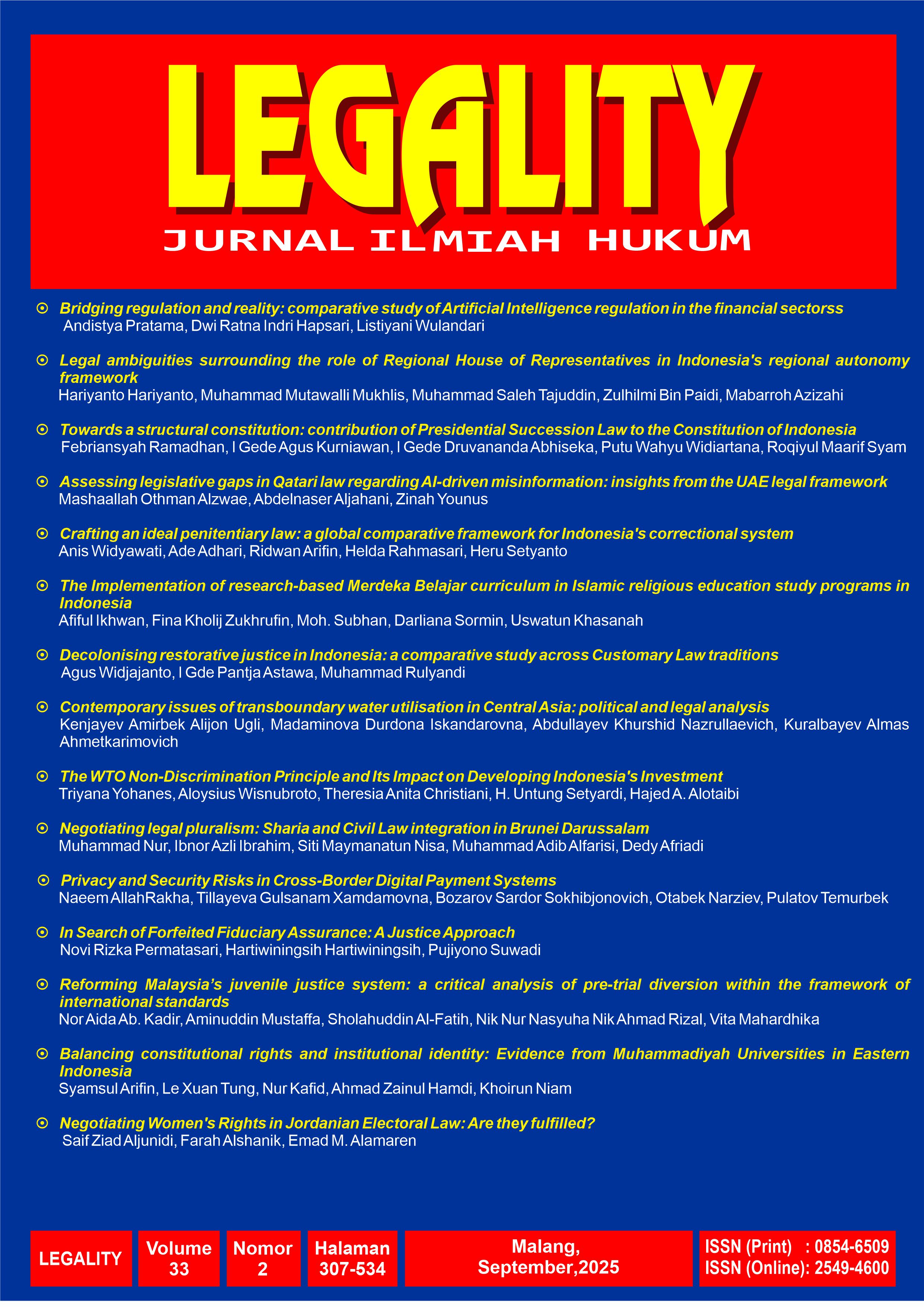
Reforming Malaysia’s juvenile justice system: a critical analysis of pre-trial diversion within the framework of international standards
DOI:
https://doi.org/10.22219/ljih.v33i2.42392Keywords:
Juvenile Justice System, Pre-trial Diversion, International StandardsAbstract
This paper aims to scrutinise the Malaysian juvenile justice system and the negative consequences of the lack of pre-trial alternative measures in dealing with children. Juvenile delinquency is a social problem that has attracted numerous discussions from different quarters. One of the primary issues in this area is how to respond to complex, multifaceted problems involving children in conflict with the law. Through doctrinal analysis and comparative frameworks with international standards and legal practice in England and New Zealand, this study highlights the positive impact of diversionary approaches on recidivism, rehabilitation, and restorative justice. Malaysia’s heavy reliance on formal adjudication is inconsistent with several international standards. This paper advocates amending the Child Act 2001 and the Criminal Procedure Code to implement pre-trial diversion, with police and prosecutorial discretion to encourage restorative justice alternatives in minor and non-violent cases. This change would align Malaysia’s system with international norms, improve children's rights, and advance the justice system toward greater rehabilitation and restoration.
Downloads
References
Aizer, A., & Doyle, J. J. (2015). Juvenile incarceration, human capital, and future crime: Evidence from randomly assigned judges. Quarterly Journal of Economics, 130(2). https://doi.org/10.1093/qje/qjv003
Barrett, J. G., Flores, M., Lee, E., Mullin, B., Greenbaum, C., Pruett, E. A., & Cook, B. L. (2021). Diversion as a Pathway to Improving Service Utilization Among At-Risk Youth. Psychology, Public Policy, and Law : An Official Law Review of the University of Arizona College of Law and the University of Miami School of Law, 28(2), 179. https://doi.org/10.1037/LAW0000325
Cleland, A., & Quince, K. (2014). Youth justice in Aotearoa New Zealand : law, policy and critique. 283.
Craig, J. M., Trulson, C. R., DeLisi, M., & Caudill, J. W. (2020). Toward an Understanding of the Impact of Adverse Childhood Experiences on the Recidivism of Serious Juvenile Offenders. American Journal of Criminal Justice, 45, 1024-1039.
Department of Social Welfare. (2016) Statistic Report 2016. https://www.jkm.gov.my/
Department of Social Welfare. (2016) Statistic Report 2019. https://www.jkm.gov.my/
Department of Social Welfare. (2016) Statistic Report 2020. https://www.jkm.gov.my/
Department of Social Welfare. (2016) Statistic Report 2022. https://www.jkm.gov.my/
Department of Social Welfare. (2016) Statistic Report 2024. https://www.jkm.gov.my/
Dmitrieva, J., Monahan, K. C., Cauffman, E., & Steinberg, L. (2012). Arrested development: the effects of incarceration on the development of psychosocial maturity. Development and Psychopathology, 24(3), 1073–1090. https://doi.org/10.1017/S0954579412000545
Dmitrieva, J., Monahan, K. C., Cauffman, E., & Steinberg, L. (2012). Arrested development: the effects of incarceration on the development of psychosocial maturity. Development and Psychopathology, 24(3), 1073–1090. https://doi.org/10.1017/S0954579412000545
Dünkel, F. (2009). Diversion: A Meaningful and Successful Alternative to Punishment in European Juvenile Justice Systems. In: Junger-Tas, J., Dünkel, F. (eds) Reforming Juvenile Justice. Springer, New York, NY. https://doi.org/10.1007/978-0-387-89295-5_9
Cauffman, E., & Steinberg, L. (2000). (Im)maturity of judgment in adolescence: Why adolescents may be less culpable than adults. Behavioral Sciences and the Law, 18(6), 741–760. https://doi.org/10.1002/bsl.416
Dmitrieva, J., Monahan, K. C., Cauffman, E., & Steinberg, L. (2012). Arrested development: the effects of incarceration on the development of psychosocial maturity. Development and Psychopathology, 24(3), 1073–1090. https://doi.org/10.1017/S0954579412000545
Gennaro, G. di, & Gennaro, G. di. (2020). Juvenile Delinquency between Probation and Criminal Careers. Criminology and Post-Mortem Studies - Analyzing Criminal Behaviour and Making Medical Decisions. https://doi.org/10.5772/INTECHOPEN.94339
Goldson, B. (2009). What ‘justice’ for children in conflict with the law? Some reflections and thoughts. Criminal Justice Matters, 76(1), 19–21. https://doi.org/10.1080/09627250902895551
Goldson, B. (2020). Excavating Youth Justice Reform: Historical Mapping and Speculative Prospects. The Howard Journal of Crime and Justice, 59(3), 317–334. https://doi.org/10.1111/HOJO.12379
Goldson, B., & Kilkelly, U. (2013). International Human Rights Standards and Child Imprisonment : Potentialities and Limitations. International Journal of Children’s Rights, 21, 345–371.
Goldson, B., & Muncie, J. (2012). Towards a global ‘child-friendly’ juvenile justice? International Journal of Law, Crime and Justice, 40(1), 47–64. https://doi.org/10.1016/j.ijlcj.2011.09.004
Green, R., Gray, R. M., Bryant, J., Rance, J., & MacLean, S. (2020). Police decision-making with young offenders: Examining barriers to the use of diversion options. Australian & New Zealand Journal of Criminology, 53(1), 137–154. https://doi.org/10.1177/0004865819879736
Lambie, I., & Randell, I. (2013). The impact of incarceration on juvenile offenders. Clinical Psychology Review, 33(3), 448–459. https://doi.org/10.1016/J.CPR.2013.01.007
Lipsey, M. W. (2009). The Primary Factors that Characterize Effective Interventions with Juvenile Offenders: A Meta-Analytic Overview. Victims & Offenders, 4(2), 124–147. https://doi.org/10.1080/15564880802612573
Mustaffa, A. (2016). Diversion Under Malaysian Juvenile Justice System: A Case of Too Little Too Late? Asian Journal of Criminology, 1–19. https://doi.org/10.1007/s11417-015-9228-8
Mustaffa, A., & Kamaliah, S. (2010). Evidence by Child in Criminal Proceedings in Malaysian Courts: A Study on Post Ratification of Convention of Rights of Child. Malaysian Current Law Journal, 6 CLJ.
Polglase, L., & Lambie, I. (2024). A sharp decline in youth crime: reviewing trends in New Zealand’s youth offending rates between 1998 and 2019. Current Issues in Criminal Justice, 36(1). https://doi.org/10.1080/10345329.2023.2236730
Syahr, Z. H. A., Hutapea, T. P. D., Farida, U., Syaifullah, D. H., & Buyamin, B. (2023). The Role of Indigenous Peoples, Social Workers, and the Syar’iyah Court in Diversion of Children Perpetrators of Jinayah. In Al-Manahij. Jurnal Kajian Hukum Islam. 17(1), 113. https://doi.org/10.24090/mnh.v17i1.
Steiner, B. (2009). The Effects of Juvenile Transfer to Criminal Court on Incarceration Decisions. Justice Quarterly, 26, 77–106. https://doi.org/10.1080/07418820802119943
Sidhu, B.S.(2022). Criminal Litigation Process (4th ed), Sweet Maxwell, Kuala Lumpur.
Singer, S. I. (2003). Incarcerating Juveniles into Adulthood: Organizational Fields of Knowledge and the Back End of Waiver. Youth Violence and Juvenile Justice, 1(2), 115–127. https://doi.org/10.1177/1541204002250871
Siti Balqis Mohd Azam, Siti Hajar Abu Bakar, Jal Zabdi Mohd Yusoff, & Syarifah Maisarah Syed Alwi. (2025). Alternative Approaches In Handling Child Offenders: A Case Study Of Community-Based Diversion Programmes In Malaysia. UUM Journal of Legal Studies, 16(2), 162–193. https://doi.org/10.32890/uumjls2025.16.2.10
Schlesinger, T. (2018). Decriminalizing racialized youth through juvenile diversion. Future of Children, 28(1), 59–81. https://doi.org/10.1353/FOC.2018.0003
Smith, R. (2021). Diversion, Rights and Social Justice. Youth Justice, 21(1), 18–32. https://doi.org/10.1177/1473225420902845
Wiley, S. A., & Esbensen, F. A. (2016). The Effect of Police Contact. Crime & Delinquency, 62(3), 283–307. https://doi.org/10.1177/0011128713492496
Wilson, H. a, & Hoge, R. D. (2013). Diverting Our Attention to What Works: Evaluating the Effectiveness of a Youth Diversion Program. Youth Violence & Juvenile Justice, 11(4), 313–331. https://doi.org/10.1177/1541204012473132
Wilson, H. a., & Hoge, R. D. (2013b). The Effect of Youth Diversion Programs on Recidivism: A Meta-Analytic Review. Criminal Justice and Behavior, 40(5), 497–518. https://doi.org/10.1177/0093854812451089
Wilson, D. B., Brennan, I., & Olaghere, A. (2018). Police‐initiated diversion for youth to prevent future delinquent behavior: a systematic review. Campbell Systematic Reviews, 14(1), 1–88. https://doi.org/10.4073/CSR.2018.5
Youth Justice Board.(2021) ‘Youth Justice Statistics 2023/2024 England and Wales. https://www.gov.uk/government/collections/youth-justice-statistics.
Zane, S. N., Welsh, B. C., & Mears, D. P. (2016). Juvenile Transfer and the Specific Deterrence Hypothesis: Systematic Review and Meta-Analysis. Criminology and Public Policy, 15(3), 901–925. https://doi.org/10.1111/1745-9133.12222
Downloads
Published
How to Cite
Issue
Section
License
Copyright (c) 2025 Nor Aida Ab. Kadir, Aminuddin Mustaffa, Sholahuddin Al-Fatih, Nik Nur Nasuha Nik Ahmad Rizal, Vita Mahardhika

This work is licensed under a Creative Commons Attribution-ShareAlike 4.0 International License.