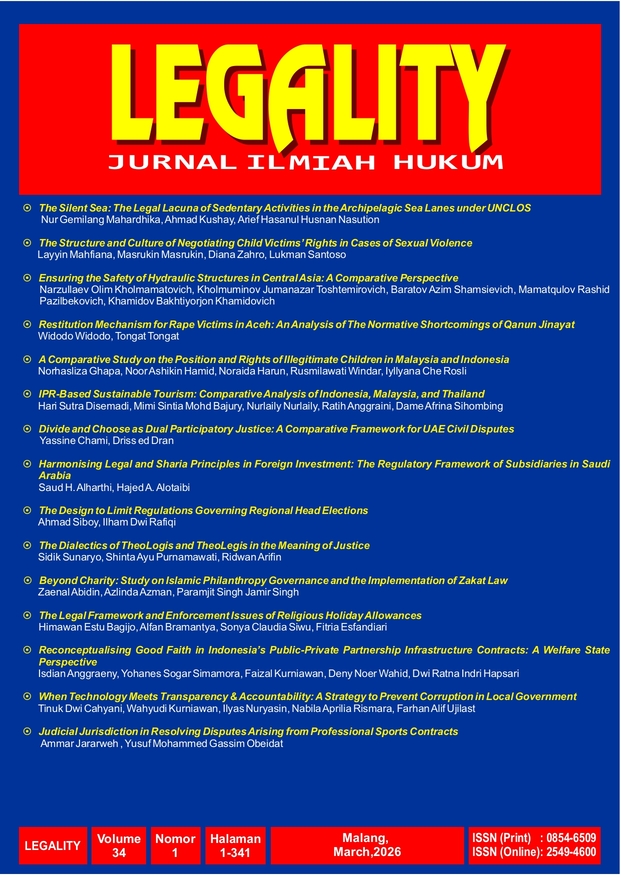
When Technology Meets Transparency & Accountability: A Strategy to Prevent Corruption in Local Government
DOI:
https://doi.org/10.22219/ljih.v34i1.42538Keywords:
Regional Autonomy, Accountability, Transparency, Anti-CorruptionAbstract
This study aims to develop an information technology–based transparency and accountability model to support corruption prevention in local government procurement in Batu City, East Java, Indonesia. Adopting a qualitative approach, this study combines a literature review with data collected through Focus Group Discussions (FGDs) involving Batu City Government’s officials and village leaders. Data were analysed using NVivo 12 Plus to identify recurring patterns and key themes related to governance, technology, and integrity. The findings reveal that although Batu City has promoted digitalisation through agency-specific applications, the absence of an integrated cross-agency procurement system creates oversight gaps and accountability risks. The study highlights that effective IT-based procurement systems require not only data integration and open budget information but also reliable human resource integrity and ethical commitment. Advanced digital systems alone are insufficient without a robust anti-corruption culture. This study proposes an integrated information-technology model for goods and services procurement to help enhance budget transparency, accelerate anomaly detection, improve procurement traceability, and strengthen digital evidence for law enforcement. The proposed model serves as a strategic and sustainable oversight instrument, thereby reinforcing regional anti-corruption enforcement frameworks.
Downloads
References
Adam, I., & Fazekas, M. (2021). Are emerging technologies helping win the fight against corruption? A review of the state of evidence. Information Economics and Policy, 57, 100950. https://doi.org/10.1016/j.infoecopol.2021.100950
Afzali, M., Ҫolak, G., & Fu, M. (2021). Economic uncertainty and corruption: Evidence from public and private firms. Journal of Financial Stability, 57(March). https://doi.org/10.1016/j.jfs.2021.100936
Agustine, O. V, Sinaga, E. M., & Yulistyaputri, R. (2019). Politik Hukum Penguatan Kewenangan Komisi Pemberantasan Korupsi dalam Sistem Ketatanegaraan Legal Politics of the Strengthening of Authority in the Constitutional System. Konstitusi, 16(2), 314–338.
Agustino, Leo., Fitriani, Indah., Wicaksana, H. H. dkk. (2022). Corruption Eradication in Indonesia : The Experience of The Corruption Eradication Commission ( KPK ). Journal of Governance, 6(2). https://doi.org/10.31506/jog.v6i2.12126
Ahmad, M. (2014). Fiqih Anti-Korupsi Mazhab Negara: Memadu Hukum Islam dan Hukum Nasional. Jurnal Hukum Islam, 12(1), 25–48. https://doi.org/10.28918/jhi.v12i1.526
Aji, Y. I. T., & Qibthiyyah, R. M. (2023). Dana Desa dan Perkembangan Status Desa: Studi Kasus Kabupaten/Kota di Indonesia. Jurnal Ekonomi Dan Pembangunan Indonesia, 23(1), 30–54. https://doi.org/10.21002/jepi.2023.03
Akbar, S., Sudewo, F., & Hamzani, A. (2022). Practice of Criminal Actions in Criminal Acts of Corruption. https://doi.org/10.4108/eai.28-5-2022.2320545
Alam, S., Fajrin, Y. A., Al-Fatih, S., & Borsa, M. O. (2022). Islamic Criminal Law Study on The Seizure of Corruptor Assets as an Indonesian's Criminal Sanction in The Future. JURIS (Jurnal Ilmiah Syariah), 21(2), 143-156. https://doi.org/10.31958/juris.v21i2.6722
Asrinaldi, Yusoff, M. A., & Karim, dan Z. A. (2022). Oligarchy in the Jokowi government and its influence on the implementation of legislative function in Indonesia. Asian Journal of Comparative Politics, 7(2), 189–203. https://doi.org/10.1177/2057891121995564
Benuf, K., Mahmudah, S., & Priyono, E. A. (2019). Metodologi Penelitian Hukum Sebagai Instrumen Mengurangi Permasalahan Hukum. Refleksi Hukum: Jurnal Ilmu Hukum, 3(2), 145–160.
Cahyani, T. D., Said, M. H. M., & Hassan, M. S. (2023). Comparative Analysis of The Effectiveness of Punishment Over Corruption in Indonesia and Hong Kong. Journal of Educational and Social Research, 13(5), 328–339. https://doi.org/10.36941/jesr-2023-0140
Cahyani, T. D., & Salmah, H. K. (2024). Legal Construction of Asset Recovery for Crime of Corruption in Indonesia. KnE Social Sciences, 985–996.
Chowdhury, F., & Audretsch, D. B. (2021). Do corruption and regulations matter for home country nascent international entrepreneurship? Journal of Technology Transfer, 46(3), 720–759. https://doi.org/10.1007/s10961-020-09797-3
Clune, C., & O’Dwyer, B. (2020). Organizing dissonance through institutional work: The embedding of social and environmental accountability in an investment field. Accounting, Organizations and Society. https://doi.org/10.1016/j.aos.2020.101130
Dobrovolska, O., & Rozhkova, M. (2024). The Impact of Digital Transformation on the Anti-Corruption and Cyber-Fraud System. Business Ethics and Leadership, 8(3), 231–252. https://doi.org/10.52340/bal/2024.02.05
Hall, O., Journal, L., Editors, G., Atkey, R., Beare, M. E., Wiilliams, C., & Sandage, J. (2015). Keynote Speech : Global Corruption and the Universal Approach of the United Nations Convention against Corruption Keynote Speech : Global Corruption and the Universal Approach of the. 53(1), 7–30.
Hanif, S. F. (2022). The Authority of The Corruption Criminal Act Courts in Order to Eradicate Corruption , Colusion and Nepotism. Pandecta Broaden, 17(1), 58–69.
Hartati, Hafrida, Erwin, Arizyanto, R., & Saputra, B. (2024). Authority for Calculating State Economic Losses in Criminal Acts of Corruption in Indonesia. Jurnal IUS Kajian Hukum Dan Keadilan, 12(3), 530–541. https://doi.org/10.29303/ius.v12i3.1480
Hassan, N. (2021). Rasuah Dalam Penguatkuasaan Undang-Undang Di Asia Tenggara : Satu Tinjauan Skop. Rasuah Dalam Penguatkuasaan Undang-Undang Di Asia Tenggara : Satu Tinjauan Skop, 18(8), 2021.
Korompot, M. I. S., Al-Fatih, S., & Pradhan, D. (2021). The Principle of Equality Before the Law in Indonesian Corruption Case: Is It Relevant?. Journal of Human Rights, Culture and Legal System, 1(3). https://doi.org/10.53955/jhcls.v1i3.13
Montes, G. C., & Luna, P. H. (2021). Fiscal transparency, legal system and perception of the control on corruption: empirical evidence from panel data. In Empirical Economics (Vol. 60, Issue 4). https://doi.org/10.1007/s00181-020-01849-9
Najih, M., & Wiryani, F. (2020). Learning the social impact of corruption: A study of legal policy and corruption prevention in indonesia and malaysia. Journal of Social Studies Education Research, 11(4), 175–189.
Ng, Y. P., Pheh, K. S., Panirselvam, R. R., Chan, W. L., Lim, J. B. Y., Lim, J. T. Y., Leong, K. K., Bartlett, S., Tay, K. W., & Chan, L. F. (2021). Malaysian Stakeholder Perspectives on Suicide-Related Reporting: Findings From Focus Group Discussions. Frontiers in Psychology, 12(May), 1–13. https://doi.org/10.3389/fpsyg.2021.673287
Nurhayati, Y., Ifrani, & Said, M. Y. (2021). Metodologi Normatif dan Empiris dalam Perspektif Ilmu Hukum. Jurnal Penegakan Hukum Indonesia, 2(1), 1–20.
Perez Torres, G. (2020). The effectiveness of the international anti-corruption legal framework in the context and practice of Colombia. Journal of Financial Crime, 27(2), 437–476. https://doi.org/10.1108/JFC-09-2019-0126
Purwaningsih, T., & Widodo, B. E. C. (2020). The interplay of incumbency, political dinasty and corruption in indonesia: Are political dynasties the cause of corruption in Indonesia? Revista UNISCI, 2020(53), 157–176. https://doi.org/10.31439/UNISCI-89
Sahroni, A., & Arumbinang, M. H. (2024). Reformulate Supervisory Mechanism of The Indonesian Corruption Eradication Commission; Challenges to Realize Justice. Jurnal IUS Kajian Hukum Dan Keadilan, 12(3), 558–571. https://doi.org/10.29303/ius.v12i3.1558
Salahudin, S., Nurmandi, A., Loilatu, M. J., Karinda, K., & Cahyani, T. D. (2022). Rent-seeking Practices in the Budget Policymaking Processes at Local Government: Case Studies in Indonesia. Journal of Government and Civil Society, 6(1), 138. https://doi.org/10.31000/jgcs.v6i1.5849
Sam, C. Y. (2005). Singapore’s experience in curbing corruption and the growth of the underground economy. Sojourn, 20(1), 39–66. https://doi.org/10.1355/sj20-1c
Sancin, V. (2021). Corruption as a Serious Inhibitor to Human Rights Realisation: A Response from the UN Human Rights Committee. Zbornik Pravnog Fakulteta u Zagrebu, 71(1), 23–49. https://doi.org/10.3935/zpfz.71.1.02
Suardi, I., Rossieta, H., Djakman, C., & Diyanty, V. (2024). Procurement Governance in Reducing Corruption in the Indonesian Public Sector: a Mixed Method Approach. Cogent Business and Management, 11(1). https://doi.org/https://doi.org/10.1080/23311975.2024.2393744
Sukmawan, Y. A., & Damayanti, D. (2025). Metode Penelitian Hukum Normatif dan Empiris sebagai Strategi Penguatan Perspektif Kajian Ilmu Hukum. NoLaJ, 4(1), 114–128.
Sunaryo, S., & Al-Fatih, S. (2022). How Corruptor Should Be Punished? A Comparative Study Between Criminal Law, Islamic Law, and Customary Law. International Journal of Criminal Justice Sciences, 17(2), 91-100. https://ijcjs.com/menu-script/index.php/ijcjs/article/view/514
Vian, T. (2020). Anti-corruption, transparency and accountability in health: concepts, frameworks, and approaches. Global Health Action, 13(sup1), 1–12. https://doi.org/10.1080/16549716.2019.1694744
Vuković, V. (2020). Corruption and re-election: how much can politicians steal before getting punished?: Corruption and re-election. Journal of Comparative Economics, 48(1), 124–143. https://doi.org/10.1016/j.jce.2019.09.002
Wang, S. J. (2020). Tackling suspect wealth: towards an accountable and transparent future? Journal of Money Laundering Control, 24(2), 244–254. https://doi.org/10.1108/JMLC-08-2020-0091
Wiraguna, S. A. (2024). Metode Normatif dan Empiris dalam Penelitian Hukum: Studi Eksploratif di Indonesia. Public Sphere: Jurnal Sosial Politik, Pemerintahan Dan Hukum, 3(3). https://doi.org/10.59818/jps.v3i3.1390
Zainuddin, M., & Karina, A. D. (2023). Use of Normative Juridical Methods in Proving the Truth in Legal Research. Smart Law Journal, 2(2), 114–123. http://stikesyahoedsmg.ac.id/ojs/index.php/slj%0ASLJ
Downloads
Published
How to Cite
Issue
Section
License
Copyright (c) 2026 Tinuk Dwi Cahyani, Wahyudi Kurniawan, Ilyas Nuryasin, Nabila Aprilia Rismara, Farhan Alif Ujilast

This work is licensed under a Creative Commons Attribution-ShareAlike 4.0 International License.