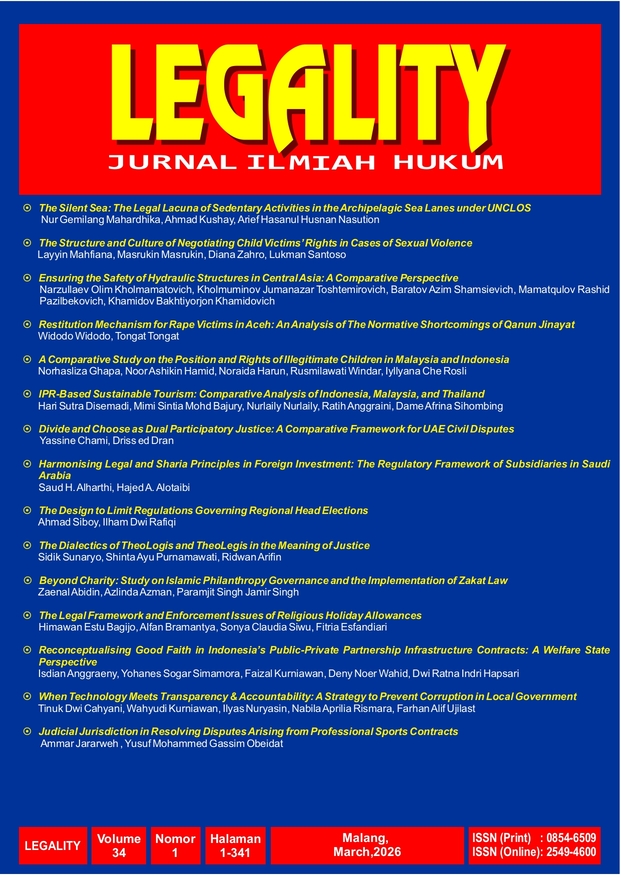
IPR-Based Sustainable Tourism: Comparative Analysis of Indonesia, Malaysia, and Thailand
DOI:
https://doi.org/10.22219/ljih.v34i1.43454Keywords:
Intellectual Property Rights, Sustainable Tourism, Sociological Jurisprudence, Legal ImplicationsAbstract
This article discusses the potential of IPR-based sustainable tourism in Indonesia, Malaysia, and Thailand, three Southeast Asian countries with immense cultural resources that can further develop the tourism industry. This analysis primarily assesses the adequacy of the relevant regulatory frameworks in bridging sustainability and tourism, particularly by utilising the relevant IPR regimes. Employing the normative legal research method, this study finds that all three countries are for the most part, normatively inadequate to adopt an IPR-based sustainable tourism system, due to the lack of emphasis on ‘social interests’ with regards to community development and its connection with the bigger and more urgent objective of environmental sustainability. However, the study also notes that Indonesia stands out as the country with the most comprehensive and locally sensitive IPR frameworks. These frameworks potentially facilitate a harmonious connection between the three domains through the perspective of Roscoe Pound’s Sociological Jurisprudence, specifically how law is viewed as an instrument for social engineering, which serves the objective of moving the tourism sector and its stakeholders towards a more sustainable approach.
Downloads
References
Abdoreza, F., & Somayyeh, A. (2016). The Environmental Impacts of Tourism on Community People’s Quality of Life in Maun, Botswana. In African Journal of Hospitality, Tourism and Leisure (Vol. 5, Issue 4, pp. 1–14). https://datacatalog.ihsn.org/citations/70148
Abramovich, N., & Vasiliu, A. (2023). Sustainability as fairness: A Rawlsian framework linking intergenerational equity and the sustainable development goals (SDGs) with business practices. Sustainable Development, 31(3), 1328–1342. https://doi.org/https://doi.org/10.1002/sd.2451
Adomako, S., & Tran, M. D. (2025). Intellectual property rights protection and sustainable innovation performance: The mediating role of technology spillover. Sustainable Development, 33(2), 1879–1891. https://doi.org/https://doi.org/10.1002/sd.3220
Agustianto, A., Disemadi, H. S., Hariyanto, O. I. B., & Sihombing, D. A. (2024). Special Intellectual Property Protection for Traditional Cultural Expressions: Rectifying Broad Legal Approaches. Nurani: Jurnal Kajian Syari’ah Dan Masyarakat, 24(1), 37–46. https://doi.org/10.19109/nurani.v24i1.21807
Agustianto, A., Disemadi, H. S., Rusdiana, S., & Tan, W. (2025). Perlindungan Lingkungan Berbasis Indikasi Geografis: Tantangan Hukum dan Implementasi Sustainable Development Goals di Indonesia. LITIGASI, 26(1), 448–476. https://doi.org/10.23969/litigasi.v26i1.19149
Ahmad, F., Draz, M. U., Su, L., & Rauf, A. (2019). Taking the bad with the good: The nexus between tourism and environmental degradation in the lower middle-income Southeast Asian economies. Journal of Cleaner Production, 233, 1240–1249. https://doi.org/https://doi.org/10.1016/j.jclepro.2019.06.138
Alam, M. S., & Paramati, S. R. (2016). The impact of tourism on income inequality in developing economies: Does Kuznets curve hypothesis exist? Annals of Tourism Research, 61, 111–126. https://doi.org/https://doi.org/10.1016/j.annals.2016.09.008
Alsabhan, T. H., Tahir, M., Burki, U., Abuhulaibah, T. F., Alnahedh, Z. K., & Jaboob, M. (2025). International Tourism and Economic Growth: Exploring the Unexplored for the ASEAN Region. Economies, 13(10), 1–16. https://doi.org/10.3390/economies13100291
Anwar, M., Zatika, D. A., & Lilyana, B. (2024). Harmonization of Sustainable Tourism Development Policy in the Regional Autonomy Era. Journal of Law, Politic and Humanities, 5(1), 417–429. https://doi.org/10.38035/jlph.v5i1.835
Arindra, R., & Novarlia, I. (2025). Dampak Green Hotel Standards Terhadap Preferensi Menginap Wisatawan (Studi Kasus Pulau Macan Eco Lodge). Jurnal Pendidikan Indonesia, 6(8), 3479–3490. https://doi.org/10.59141/japendi.v6i8.8536
Azenabor, I. I., Keshi, F. O., & Obakhedo, N. O. (2022). Pound’s Sociological Theory of Law and Its Implications for National Development: The Nigerian Experience. Niger Delta Journal of Gender, Peace & Conflict Studies, 2(3), 277–296. https://nigerdeltajournal.org/wp-content/uploads/2023/07/21.-Pounds-Sociological-Theory-of-Law-and-Its-Implications-for-National-Development-The-Nigerian-Experience-1.pdf
Chen, T., Liu, G., Sui, X., & Solangi, Y. A. (2025). Influencing consumer perceptions in green tourism: criteria and strategies for effective destination branding. PLOS ONE, 20(2), 1–25. https://doi.org/10.1371/journal.pone.0319254
Chiarolla, C. (2019). Intellectual Property from a Global Environmental Law Perspective: Lessons from Patent Disclosure Requirements for Genetic Resources and Traditional Knowledge. Transnational Environmental Law, 8(3), 503–521. https://doi.org/DOI: 10.1017/S2047102519000165
Chon, M. (2019). Recasting Intellectual Property in Light of the U.N. Sustainable Development Goals: Toward Global Knowledge Governance. American University International Law Review, 34(4), 763–785. https://digitalcommons.wcl.american.edu/auilr/vol34/iss4/3/
Cisco, G., & Gatto, A. (2021). Climate Justice in an Intergenerational Sustainability Framework: A Stochastic OLG Model. Economies, 9(2), 1–13. https://doi.org/10.3390/economies9020047
Crescenzi, R., De Filippis, F., Giua, M., & Vaquero-Piñeiro, C. (2022). Geographical Indications and local development: the strength of territorial embeddedness. Regional Studies, 56(3), 381–393. https://doi.org/10.1080/00343404.2021.1946499
Dela Cruz, M. G., Alsamaraie, M., & Tantong, K. (2022). Examining The Impact of The Covid-19 Pandemic on The Economic Performance of The Tourism Industry in Southeast Asia: A Review of The Literature. Research and Development Journal Suan Sunandha Rajabhat University, 14(1), 130–144. https://doi.org/10.53848/irdssru.v14i1.253655
Disemadi, H. S. (2022). Lenses of Legal Research: A Descriptive Essay on Legal Research Methodologies. Journal of Judicial Review, 24(2), 289–304. https://doi.org/10.37253/jjr.v24i2.7280
Disemadi, H. S., & Silviani, N. Z. (2025). Konsepsi Hak Moral atas Karya di Era Artificial Intelligence: Dialektika Hukum dalam Perspektif Paradigma Konstruktivisme. Jurnal Magister Hukum Udayana, 14(1), 109–129. https://doi.org/10.24843/JMHU.2025.v14.i01.p06
Djabbar, A., Machmud, M., & Rahayu, M. (2025). Tourist’ Behavior and Its Impacts to The Sustainability of Tours and Travel Operation: Evidence from Indonesia. E-Journal of Tourism, 12(2), 353–369. https://doi.org/10.24922/eot.v12i2.2190
Dosso, M., & Vezzani, A. (2020). Firm market valuation and intellectual property assets. Industry and Innovation, 27(7), 705–729. https://doi.org/10.1080/13662716.2019.1685374
Dubiansky, J. E. (2017). The Licensing Function of Patent Intermediaries. Duke Law & Technology Review, 16(1), 269–302. http://search.ebscohost.com/login.aspx?direct=true&db=aph&AN=127588447&site=ehost-live&scope=site
Gocci, A., & Luetge, C. (2020). The Synergy of Tradition and Innovation Leading to Sustainable Geographical Indication Products: A Literature Review. Journal of Management and Sustainability, 10(1), 152–161. https://doi.org/10.5539/jms.v10n1p152
Guan, T. (2025). Coordinated Patents. Journal of Intellectual Property and Entertainment Law, 15(1), 330–388.
Hajer, M., Nilsson, M., Raworth, K., Bakker, P., Berkhout, F., De Boer, Y., Rockström, J., Ludwig, K., & Kok, M. (2015). Beyond Cockpit-ism: Four Insights to Enhance the Transformative Potential of the Sustainable Development Goals. Sustainability, 7(2), 1651–1660. https://doi.org/10.3390/su7021651
Hutauruk, R. H., Sudirman, L., Disemadi, H. S., & Tan, D. (2023). Convergence Of Consumer Protection, Investment Law, And Cybersecurity: An in-Depth Analysis of Three-Way Legal Intersections in Investment Apps. Jurisdictie: Jurnal Hukum Dan Syariah, 14(1), 127–153. https://doi.org/10.18860/j.v14i1.21180
Jaelani, A. K. ., Dian Luthviati, R., Octavia Kusumaningtyas, R. ., Al Fatih, S. ., & Siboy, A. . (2023a). Legal Protection of Balinese Traditional Law During Global Tourism Destination Development. KnE Social Sciences, 9(1). https://doi.org/10.18502/kss.v8i21.14825
Jaelani, A. K., Hayat, M. J., Luthviati, R. D., Al-Fatih, S., & Mujib, M. M. (2023b). Green Tourism Regulation on Sustainable Development: Droning from Indonesia and China. Journal of Indonesian Legal Studies, 8(2), 663-706. https://doi.org/10.15294/jils.v8i2.72210
Jaelani, A. K., Luthviati, R. D., Siboy, A., Al-Fatih, S., & Hayat, M. J. (2024). Artificial Intelligence Policy in Promoting Indonesian Tourism. Volksgeist: Jurnal Ilmu Hukurn dan Konstitusi, 7(1). 109-135. https://doi.org/10.24090/volksgeist.v7i1.10623
Ji-min, H. (2024). Influence of Intellectual Property Laws on Innovation in the Technology Sector in South Korea. International Journal of Law and Policy, 9(2), 15–27. https://doi.org/10.47604/ijlp.2704
Jumadi, J. (2025). Integrating Tourist Satisfaction and Environmental Stewardship for Sustainable Management of Cultural Destinations. Journal of Hunan University Natural Sciences, 52(8), 1–14. https://doi.org/10.55463/issn.1674-2974.52.8.1
Kappos, D. J. (2018). The Antitrust Assault on Intellectual Property. Harvard Journal of Law and Technology, 31(2), 665–686. https://jolt.law.harvard.edu/assets/articlePDFs/v31/The-Antitrust-Assault-on-Intellectual-Property-David-Kappos.pdf
Kumpiw, W., Damrongsak, D., Jaitiang, T., Wongsapai, W., Sangkakorn, K., Daroon, S., Khiaolek, K., Srichai, P., Auttarat, S., Krajangchom, S., & Chinachan, T. (2025). Performance Tracking of Sustainable Tourism Goal (STG) Criteria for Achieving Thailand’s Greenhouse Gas Mitigation Targets in the Service Sector: A Case Study of Large Thai Hotels. Sustainability, 17(4), 1–17. https://doi.org/10.3390/su17041635
Kur, A., & Calboli, I. (2023). Intellectual property in the circular economy. Journal of Intellectual Property Law & Practice, 18(5), 337–338. https://doi.org/10.1093/jiplp/jpad045
Liu, Y. (2023). Discussion on the Balance of Intellectual Property Interests under Big Data. Academic Journal of Management and Social Sciences, 2(2), 1–4. https://doi.org/10.54097/ajmss.v2i2.6813
Magomedova, N., Kozubenko, A., & Lorsanova, Z. (2023). Socio-economic and theoretical and methodological aspects of sustainable development. E3S Web of Conferences, 451, 1–4. https://doi.org/10.1051/e3sconf/202345101024
Malaguti, J. M. A., & Avrichir, I. (2025). Geographical indications and their impacts on sustainable development: literature review. SDGs Studies Review, 6, 1–2. https://doi.org/10.37497/sdgs.v6istudies.29
McCollum, D. L., Echeverri, L. G., Busch, S., Pachauri, S., Parkinson, S., Rogelj, J., Krey, V., Minx, J. C., Nilsson, M., Stevance, A.-S., & Riahi, K. (2018). Connecting the sustainable development goals by their energy inter-linkages. Environmental Research Letters, 13(3), 1–23. https://doi.org/10.1088/1748-9326/aaafe3
Nadir, N. (2025). The Law Role of Business Competition to Develop the Global and Indonesian Economy. International Journal of Law and Society, 2(3), 29–36. https://doi.org/10.62951/ijls.v2i3.598
Nasyiah, I., Ramadhita, & Hidayah, K. (2022). The Protection of Local Handicrafts Through the Geographical Indication by the Regional Government in East Java, Indonesia. Jurisdictie: Jurnal Hukum Dan Syariah, 13(2), 162–187. https://doi.org/10.18860/j.v13i2.18265
Negara, T. A. S. (2023). Normative Legal Research in Indonesia: Its Originis and Approaches. Audito Comparative Law Journal (ACLJ), 4(1), 1–9. https://doi.org/10.22219/aclj.v4i1.24855
Nurfitri, D. (2023). Komunal, Perlindungan Kekayaan Intelektual Komunal Pasca Terbitnya Peraturan Pemerintah Nomor 56 Tahun 2022 tentang Kekayaan Intelektual. Jurnal De Lege Ferenda Trisakti, 1(2), 53–61. https://doi.org/10.25105/ferenda.v1i2.18276
Nurjaya, I. N. (2022). Legal Policy of Sustainable Tourism Development: Toward Community-Based Tourism In Indonesia. Journal of Tourism Economics and Policy, 2(3), 123–132. https://doi.org/10.38142/jtep.v2i3.404
Pamukçu, H., Saraç, Ö., Aytuğar, S., & Sandıkçı, M. (2021). The Effects of Local Food and Local Products with Geographical Indication on the Development of Tourism Gastronomy. Sustainability, 13(12), 1–13. https://doi.org/10.3390/su13126692
Pihlajarinne, T., & Ballardini, R. (2020). Paving the way for the Environment: Channelling ‘Strong’ Sustainability into the European IP System. European Intellectual Proberty Review, 42(2), 239–250. https://researchportal.helsinki.fi/en/publications/paving-the-way-for-the-environment-channelling-strong-sustainabil/
Postma, A., Cavagnaro, E., & Spruyt, E. (2017). Sustainable tourism 2040. Journal of Tourism Futures, 3(1), 13–22. https://doi.org/10.1108/JTF-10-2015-0046
Purwandoko, P. H., Sulistiyono, A., & Hawin, M. (2021). The Implementation of the Traditional Cultural Expression [TCE] Protection in Indonesia Based on Article 38 Law Number 28 of 2014 regarding Copyright. Indonesian Journal of International Law, 18(4), 543–570. https://doi.org/10.17304/ijil.vol18.4.823
Putri Hendrawan, N. S., & Andersen, C. (2025). Legal Certainty and Justice in Trademark Protection: A Comparative Analysis of the First-to-File System in Indonesia and the First-to-Use System in Malaysia. Journal of World Science, 4(12), 1717–1724. https://doi.org/10.58344/jws.v4i12.1593
Putri, I. A. (2025, April 15). Sustainable tourism continues to grow. PwC Indonesia. https://www.pwc.com/id/en/media-centre/infrastructure-news/april-2025/sustainable-tourism-continues-to-grow.html
Rohmat, R., & Wei, D. C. C. (2025). The Necessity of Legal Protection for Geographical Indications within a Sui Generis Framework. Batulis Civil Law Review, 6(1), 19–32. https://doi.org/10.47268/ballrev.v6i1.2449
Ruidie, H., Matthew, N. K., Puan, C. L., Ramachandran, S., & Yacob, M. R. (2025). Local Tourists’ Willingness to Pay for Conservation Fees on Peak Season in Pulau Payar Marine Park, Langkawi, Kedah. Sage Open, 15(4), 1–15. https://doi.org/10.1177/21582440251369179
Saccatuma Garcia, F. C., & Candia Vargas, W. F. (2024). Greenwashing in the Tourism and Hospitality Sector: A Systematic Analysis of the literature. Revista Interamericana de Ambiente y Turismo, 20(2), 174–191. https://doi.org/10.4067/s0718-235x2024000200174
Sayuti, A. T., Windarto, W., Martadinata, M. R., Ridho, M. A., & Kadir, S. M. D. A. (2025). Legal Realism and the Future of Palm Oil Management in Indonesia. Jambe Law Journal, 8(1), 375–398. https://doi.org/10.22437/home.v8i1.342
Schäfer, Q. B. (2024). Reconsidering the Limits of EU Competition Law on the IP-Competition Interface. Journal of European Competition Law & Practice, 15(3), 188–196. https://doi.org/10.1093/jeclap/lpae021
Simon, D. A. (2024). Copyright, Moral Rights, and the Social Self. Yale Journal of Law & the Humanities, 35(4), 754–811. http://hdl.handle.net/20.500.13051/18495
Situmeang, A., Disemadi, H. S., & Fitri, W. (2024). Peran Kekayaan Intelektual dalam Menggerakkan Industri Kreatif Pariwisata Berkelanjutan: Indonesia vs. Filipina. Jurnal Magister Hukum Udayana, 13(2), 384–402. https://ojs.unud.ac.id/index.php/jmhu/article/view/107471
Skliaustyte, E., & Weber, M. (2023). Subsidies versus intellectual property rights when innovators operate in two markets. Plos One, 18(4), 1–20. https://doi.org/10.1371/journal.pone.0284880
Smith, P. J., & Anti, S. J. (2022). How does TRIPs compliance affect the economic growth of developing countries? Application of the Synthetic Control method. The World Economy, 45(12), 3873–3906. https://doi.org/https://doi.org/10.1111/twec.13282
Solé, L., Hearn, K. P., Witra, T., Lechner, A. M., & Fagerholm, N. (2025). Balancing landscape values and tourism choices: Integrating participatory mapping and the IPBES Values Typology. Ambio, 54(5), 818–838. https://doi.org/10.1007/s13280-024-02112-6
Spedicato, G. (2024). The Untapped Potential of Patent Law in Deterring Environmentally Unsustainable Innovation. GRUR International, 73(8), 751–762. https://doi.org/10.1093/grurint/ikae067
Stanikzai, I. U., Seerat, A. H., & Humdard, W. U. (2024). Role of Sustainable Tourism in Preserving Cultural Heritage of Afghanistan. Society & Sustainability, 5(2), 30–38. https://doi.org/10.38157/ss.v5i2.594
Sudirman, L., & Disemadi, H. S. (2023). The Role of Indonesian Online Marketplaces in Intellectual Property Rights Infringements: A Comparative Analysis. Jurnal Pembaharuan Hukum, 10(1), 90–103. https://doi.org/10.26532/jph.v10i1.30883
Sudirman, L., Disemadi, H. S., Budi, H. S., Park, J., & Silviani, N. Z. (2025). Intellectual Property Challenges for AI-Driven Creativity: A Focus on Copyright and Patents in Emerging Economies. Lex Scientia Law Review, 9(1), 1285–1312. https://doi.org/10.15294/lslr.v9i1.20611
Sudirman, L., Sohheng, N., Agustianto, Agustini, S., & Nurlaily. (2025). Legal protections against unfair competition in e-commerce: Analysis of Indonesian and Thailand framework adequacy. Jurnal Hukum Novelty, 16(1), 27–42. https://doi.org/10.26555/jhn.v16i1.29157
Sun, H. (2019). Copyright Law as an Engine of Public Interest Protection. Northwestern Journal of Technology and Intellectual Property, 16(3), 123–188. https://scholarlycommons.law.northwestern.edu/njtip/vol16/iss3/1/
Szpojankowski, A. O. (2019). Law as a Social Engineering Tool in the Legal Philosophy of Roscoe Pound. Archiwum Filozofii Prawa i Filozofii Spolecznej, 1, 94–107. https://doi.org/10.36280/AFPiFS.2019.1.94
Tamanaha, B. Z. (2020). Sociological Jurisprudence Past and Present. Law & Social Inquiry, 45(2), 493–520. https://doi.org/DOI: 10.1017/lsi.2019.26
Tan, D. (2021). Metode Penelitian Hukum: Mengupas dan Mengulas Metodologi dalam Menyelenggarakan Penelitian Hukum. NUSANTARA: Jurnal Ilmu Pengetahuan Sosial, 8(5), 2463–2478. https://jurnal.um-tapsel.ac.id/index.php/nusantara/article/view/5601
Tantimin, T., Supasiripongchai, N., Budi, H. S., Disemadi, H. S., & Agustini, S. (2025). Assessing Local Communities’ Roles in Geographical Indication Dispute Resolution: Challenges in Southeast Asia. Jurnal Media Hukum, 32(2), 359–376. https://doi.org/10.18196/jmh.v32i2.27547
Tundang, R. E. (2025). Aligning climate needs and intellectual property: an entitlement-based framework for green technology transfer. Journal of International Economic Law, 28(3), 441–459. https://doi.org/10.1093/jiel/jgaf030
Wang, S., He, Y., & Song, M. (2021). Global value chains, technological progress, and environmental pollution: Inequality towards developing countries. Journal of Environmental Management, 277, 1–14. https://doi.org/https://doi.org/10.1016/j.jenvman.2020.110999
Weiss, Edith Brown. (2024). Marshalling the Planetary Trust. Environmental Policy and Law, 54(2–3), 67–78. https://doi.org/10.3233/EPL-239021
Widawski, K., Krzemińska, A., Zaręba, A., & Dzikowska, A. (2023). A Sustainable Approach to Tourism Development in Rural Areas: The Example of Poland. Agriculture, 13(10), 1–24. https://doi.org/10.3390/agriculture13102028
Wieczorek, A. J. (2018). Sustainability transitions in developing countries: Major insights and their implications for research and policy. Environmental Science & Policy, 84, 204–216. https://doi.org/https://doi.org/10.1016/j.envsci.2017.08.008
Wulandari, F., Suparman, E., Palar, M. R. A., & Amirulloh, M. (2023). Sui generis system: GI protection for the herbal product in Indonesia as communal property right. Cogent Social Sciences, 9(1), 2176989. https://doi.org/10.1080/23311886.2023.2176989
Yan, L. (2024). A systematic review of traditional health tourism: A priori of wellness tourism. Multidisciplinary Reviews, 7(5), 1–16. https://doi.org/10.31893/multirev.2024096
Yfantidou, G., & Matarazzo, M. (2017). The Future of Sustainable Tourism in Developing Countries. Sustainable Development, 25(6), 459–466. https://doi.org/https://doi.org/10.1002/sd.1655
Yu, P. K. (2023). Three Megatrends in the International Intellectual Property Regime. Cardozo Arts and Entertainment Law Journal, 41(2), 457–484. https://cardozoaelj.com/three-megatrends-in-the-international-intellectual-property-regime/
Yulia, Y., Herinawati, H., Jannah, R., & Safina, S. (2025). Traditional Knowledge Management: Community Understanding and Government Strategic Steps to Strengthen Aceh’s Economy. Padjadjaran Jurnal Ilmu Hukum (Journal of Law), 12(1), 113–136. https://doi.org/10.22304/pjih.v12n1.a6
Zakir, M. H., Bashir, S., Zahoor, S., Ali, R. N., Shahzad, F., & Khan, S. H. (2023). The Role Of Intellectual Property Rights In Achieving Sustainable Development Goals: A Comparative Analysis Of Policy Frameworks And Their Impact. Migration Letters, 20(9), 489–501. https://migrationletters.com/index.php/ml/article/view/8893
Zhong, L., & Wang, Y. (2021). Research on intellectual property strategy to promote the development of tourism branding in China. E3S Web of Conferences, 251, 1–5. https://doi.org/10.1051/e3sconf/202125102008
Downloads
Published
How to Cite
Issue
Section
License
Copyright (c) 2026 Hari Sutra Disemadi, Mimi Sintia Mohd Bajury, Nurlaily Nurlaily, Ratih Anggraini, Dame Afrina Sihombing

This work is licensed under a Creative Commons Attribution-ShareAlike 4.0 International License.