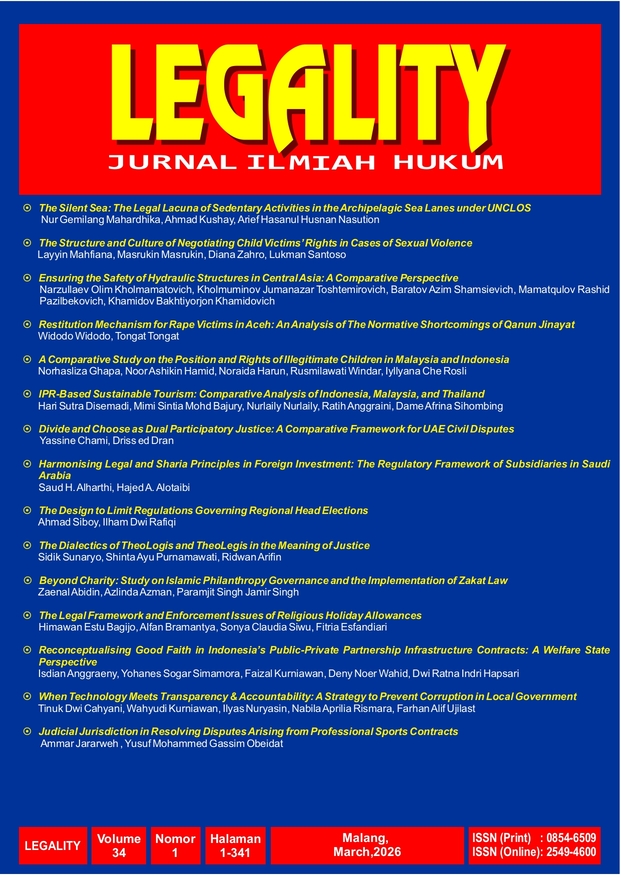
The Design to Limit Regulations Governing Regional Head Elections
DOI:
https://doi.org/10.22219/ljih.v34i1.43527Keywords:
Limitation, Regulation, Regional Head Election, Implementing RegulationAbstract
This research seeks to elaborate on the urgency and the design offered to limit regulations governing regional head elections (Pilkada). The main problem identified is the distribution of regional election norms across various types of regulations, which causes anomalies, conflicting norms, and dualism of interpretation by judicial institutions, such as differences in decisions between the Supreme Court and the Constitutional Court. Using normative-juridical research methods and statutory, conceptual, historical, and case-based approaches, this research reveals that the limitation in question serves as the initial milestone in constructing fair, effective, and efficient legal frameworks to regulate Pilkada with legal certainty. Philosophically, limiting the proliferation of norms is necessary to maintain the integrity of the local democratic system through the dimensions of ontology, epistemology, and axiology. The results of the study indicate that the most ideal design for limiting regional election regulations consists of three levels: the 1945 Constitution of the Republic of Indonesia as the constitutional basis, the Law as the primary regulation, and the Regulation of the Election Organising Institution (especially the General Elections Commission) as the technical delegation regulation. This model is considered the most appropriate, as it covers everything from abstract norms to concrete technicalities, guarantees legal certainty, and minimizes the influence of elite political interests in shaping regulations. The implementation of this design is expected to realise a more democratic, accountable, and equitable regional election governance.
Downloads
References
Aermadepa, A., Apriyanto, A., Mulyeni, Y., Judijanto, L., Lawra, R. D., & Nizwana, Y. (2024). Penegakan Hukum Pemilu dalam Pemilihan Kepala Daerah Serentak Indonesia Tahun 2024. PT. Sonpedia Publishing Indonesia.
Ahmad, A. (2024). Penegakan Hukum Pemilu di Indonesia (Tantangan dan Prospek Keberlanjutan Demokrasi).
Al-Fatih, S., & Nur, A. I. (2023). Does the Constitutional Court on Local Election Responsive Decisions?. Journal of Human Rights, Culture and Legal System, 3(3), 569-596. https://doi.org/10.53955/jhcls.v3i3.74
Ali, Z. (2021). Metode penelitian hukum. Sinar Grafika.
Arifin, F. (2024). Mengintegrasikan Hukum Pemilu: Harmonisasi Peraturan KPU dengan Putusan Mahkamah Konstitusi dalam Penyelenggaraan Pemilihan Kepala Daerah. Rio Law Jurnal, 6(1), 194–204. https://doi.org/10.36355/rlj.v6i1.1528
Arifin, F., Maarif, I., Bunyamin, B., Bahri, R. A., & Murbani, A. W. (2025). Reforming Indonesia’s Electoral System: Legal and Policy Considerations. Jambe Law Journal, 8(1), 61–99. https://doi.org/https://doi.org/10.22437/home.v8i1.501
Asnawi, E. (2021). Legal Politics of Legislation of Regional Regulations in Indonesia. Legal Politics of Legislation of Regional Regulations in Indonesia, 3(2), 1–7.
Astariyani, N. L. G., Hattori, M., & Hanum, W. N. (2024). The Validity of Sanctions Arrangements in Regional Regulations. Journal of Human Rights, Culture and Legal System, 4(3), 682–705. https://doi.org/https://doi.org/10.53955/jhcls.v4i3.313
Chandra, R. L. (2023). Local Governments’ Head Election in Indonesia: A Proposal for Asymmetric Model. Jurnal Kajian Pembaruan Hukum, 3(1), 27. https://doi.org/https://doi.org/10.19184/jkph.v3i1.31190
Denny Prabowo, Ismaidar, & Tamaulina Br. Sembiring. (2024). Dynamics and Legal Political Challenges of Simultaneous Regional Elections in Indonesia Towards Efficiency and Stability. Nternational Journal of Synergy in Law, 1(2), 320–326. https://doi.org/https://doi.org/10.70321/ijslcj.v1i2.65
Fatkhurohman, F., Sirajuddin, S., & Al Fatih, S. (2025). Facing Digital Age: Should the Regional Regulation Be Made Digitally?. Jambura Law Review, 7(1), 1-29. https://ejurnal.ung.ac.id/index.php/jalrev/article/view/27111
Firdaus Arifin, Ihsanul Maarif, Cece Suryana, Taty Sugiarti, & Anastasia Wahyu Murbani. (2025). Institutional Configuration and Competence of the Special Judiciary for Regional Election Disputes: A Comparative Study and Prospects for Implementation. Jambura Law Review, 7(2), 493–520. https://doi.org/https://doi.org/10.33756/jlr.v7i2.30949
Firdaus, M. A. N., & Sumardiana, B. (2025). Kesenjangan Hukum dalam Pengaturan Sidang In Absentia antara UU Pemilu dan UU Pilkada: Implikasi terhadap Kepastian Hukum dalam Penanganan Tindak Pidana Pemilihan. Bookchapter Hukum Dan Lingkungan, 2, 587–607.
Francisco, A. M. (2024). Development of an IoT-Based Air Quality Monitoring System for Environmental Improvement of the City of Manila. Journal of Law and Humanity Studies, 1(1), 1–4. https://doi.org/10.59613/m1bv1v26
Gunawan, M. S., & Nurul Mujahidah. (2024). Dinamika Pemilihan Kepala Daerah: Menilik Putusan Mahkamah Agung, Mahkamah Konstitusi dan Peraturan KPU RI. AL-MUTSLA, 6(2), 358–387. https://doi.org/10.46870/jstain.v6i2.1240
Hanuring Ayu AP, Lahmuddin Zuhri, & Putu Sekarwangi Saraswati. (2025). Analisis Putusan MA dan PutusaN MK Tentang Persyaratan Calon Kepala Daerah Dalam Pilkada 2024. Jurnal Verstek, 13(2), 211–229. https://doi.org/https://doi.org/10.20961/jv.v13i2.98316
Hasudungan Hutagalung, H., Sugianto, & Sanusi, A. (2024). Challenges and Solutions For Democratic Stability in Indonesia After the Cancellation of Election Regulations. Hukum Responsif, 15(2), 318–322. https://doi.org/https://doi.org/10.33603/responsif.v15i2.9532
Herlina, M. (2024). Konsep Penyusunan Norma Penjelasan Peraturan Perundang-Undangan Guna Mencegah Multitafsir Dalam Penegakan Hukum Di Indonesia. Jurnal Penelitian Hukum Galunggung, 1(3). https://doi.org/10.1234/jphgalunggung.v1i3.35
Ismaidar Ismaidar, Tamaulina Br. Sembiring, & Yulia Christy Shintara Aruan. (2024). Analysis of Legal Political Dynamics in the Regulation of Simultaneous Regional Elections in Indonesia: Between Effectiveness and Local Democracy. International Journal of Law and Society, 2(1), 64–82. https://doi.org/https://doi.org/10.62951/ijls.v2i1.288
Jubaidi, D., & Khoirunnisa, K. (2025). Optimizing Democracy: The Political Law of Digitization Policy for the Prevention of Election Disputes in Indonesia. SSRN Electronic Journal. https://doi.org/10.2139/ssrn.5068491
Khairi, H. (2020). Local Elections (Pilkada): Money Politics and Cukong Democracy. Jurnal Bina Praja, 12(2), 249–260. https://doi.org/10.21787/jbp.12.2020.249-260
Kosti, N., Levi-Faur, D., & Mor, G. (2019). Legislation and regulation: three analytical distinctions. The Theory and Practice of Legislation, 7(3), 169–178. https://doi.org/https://doi.org/10.1080/20508840.2019.1736369
Mahkamah Konstitusi RI. (2025). MK Registrasi 309 Perkara Sengketa Pilkada 2024. https://www.mkri.id/berita/mk-registrasi-309-perkara-sengketa-pilkada-2024-22028
Maulana, M. R. A. (2024). Analisis Tantangan Konstitusional Dan Problematika Hukum Tata Negara Dalam Pelaksanaan Pilkada 2024. Constitution Journal, 3(2), 211–232. https://doi.org/10.35719/constitution.v3i2.114
Maurisya, F., & Satoto, S. (2024). Special Chamber Mahkamah Konstitusi dalam Penyelesaian Sengketa Pemilu. Milthree Law Journal, 1(3), 319–360. https://doi.org/10.70565/mlj.v1i3.56
Mery Herlina. (2024). Analisis Dampak Implementasi Norma Penjelasan Dalam Peraturan Perundang-Undangan Terhadap Kepastian dan Efektivitas Penegakan Hukum di Indonesia. Jurnal Mahalisan, 1(1), 46–58. https://doi.org/10.70837/4n41x506
Muhtamar, S., & Bachmid, F. (2022). Constitutionality and Ideology in the Electoral System: Pancasila’s Moral Interpretation on the Proportional Representation System. SIGn Jurnal Hukum, 3(2), 201–220. https://doi.org/https://doi.org/10.37276/sjh.v3i2.227
Negara, T. A. S. (2023). Normative Legal Research in Indonesia: Its Originis and Approaches. Audito Comparative Law Journal (ACLJ), 4(1), 1–9. https://doi.org/https://doi.org/10.22219/aclj.v4i1.24855
Neundorf, A., Dahlum, S., Skaaning Frederiksen, K. V., & Öztürk, A. (2026). Elections Without Constraints? The Appeal of Electoral Autocracy Across the World. British Journal of Political Science, 56, e1. https://doi.org/https://doi.org/10.1017/S0007123425101129
Nir’Adlan;, M. N. M. S., Bimantara;, F. A., Daffa Naufal Athalah;, M. Rayhan Ariya Putra;, & Khanafi. (2025). Pembuktian Dalam Hukum Acara Mahkamah Konstitusi: Mengkaji Putusan Pengujian Formil suatu Undang-undang. Veteran Society Journal, 5(1), 1–32. https://doi.org/10.33005/vsj.v5i1.184
Oktari, T. (2023). Development of Regulations on Voting Rights People With Mental Disorders Post-Constitutional Court Ruling Applied. Awang Long Law Review, 6(1), 53–61. https://doi.org/https://doi.org/10.56301/awl.v6i1.982
Perbawa, K. S. L. P. (2023). Open Justice Policy in Constitutional Court Decision and Law in Indonesia. International Journal of Criminal Justice Sciences, 18(2), 89–101.
Purba, A. R. (2023). Tinjauan Yuridis Pelaksanaan Pemilihan Kepala Daerah (Pilkada) Serentak. Jurnal Ilmiah METADATA, 5(3), 47–64. https://doi.org/10.47652/metadata.v5i3.393
Putri, F. D., & Purwanti, A. (2018). Legal Politics in the Amendment of Regional Head Electoral Law. Diponegoro Law Review; Vol 3, No 1 (2018): Diponegoro Law Review April 2018DO - 10.14710/Dilrev.3.1.2018.122-131. https://doi.org/10.14710/dilrev.3.1.2018.122-131
Raden, S. (2024). The Theory of Fairness with Integrity in Indonesia’s Electoral Justice System. Fiat Justisia: Jurnal Ilmu Hukum, 18(2), 185–202. https://doi.org/10.25041/fiatjustisia.v18no2.3432
Rajab, A. A., Mas, M., & Hamid, Abd. H. (2023). Implikasi Kewenangan Komisi Pemilihan Umum Kepala Daerah Pasca Putusan Mahkamah Konstitusi Nomor 97/PUU-XI/2013. Indonesian Journal of Legality of Law, 5(2), 384–392. https://doi.org/10.35965/ijlf.v5i2.2613
Ramadhanti, N. A., Laila, N. N., Luthfiana, N., Savitri, A., & Harmoko. (2025). Rekonstruksi Pemilihan Kepala Daerah dalam Sistem Hukum di Indonesia. Indonesian Journal of Public Administration Review, 2(4), 16. https://doi.org/https://doi.org/10.47134/par.v2i4.4542
Santoso, H., Syahpandang, S. M., Nur, D. N. A., Aisy, R. N. H. R., & Aini, N. (2024). Konsep Constitutional Injury Sebagai Syarat Pengajuan Permohonan Pengujian Undang-Undang Terhadap Undang-Undang Dasar. Veteran Society Journal, 5(1), 33–52.
Sarjiyati, S., Taufiq Yuli Purnama, Anik Tri Haryani, Endang Murti, Izyan Farhana Zulkarnain, & Vivi Frita Trisnani. (2025). Age Limit for Regional Head Candidates and Legal Considerations from the Supreme Court Decision No. 23 P/HUM/2024 and Constitutional Court Decision No. 70/PUU-XXII/2024. Jurnal Jurisprudence, 100–120. https://doi.org/https://doi.org/10.23917/jurisprudence.v15i2.10187
Siboy, A. (2024). Implikasi Distribusi Pengaturan Pemilihan Kepala Daerah Dalam Berbagai Jenis Peraturan Perundang-Undangan. Konferensi Nasional Asosiasi Pengajar Hukum Tata Negara Dan Hukum Administrasi Negara, 2(1), 61–96. https://doi.org/10.55292/2gs1vv83
Siboy, A., & AlFatih, S. (2025). The Design of Preventive Control on Local Delegated Legislation: A Case Study of Regional Head Regulations. Volksgeist: Jurnal Ilmu Hukurn dan Konstitusi, 8(1). 111-126. https://doi.org/10.24090/volksgeist.v8i1.12862
Siboy, A., & Sholahuddin Al-Fatih. (2025). Indonesian Presidential Election on Presidential Threshold Policy: Evidence from Various Countries. Journal of Human Rights, Culture and Legal System, 5(3), 949–981. https://doi.org/https://doi.org/10.53955/jhcls.v5i3.639
Sipma, T., Spierings, N., Jacobs, K., Lubbers, M., & van der Meer, T. (2024). Introduction: extremes and divides in electoral politics, the Dutch 2021 elections in particular. Acta Politica, 59(3), 483–497. https://doi.org/https://doi.org/10.1057/s41269-024-00346-6
Sirajuddin, Febriansyah Ramadhan, & Ilham Dwi Rafiqi. (2021). Urgensi Pemisahan Penyelenggaraan Pemilihan Umum Serentak Nasional dan Lokal. Volksgeist: Jurnal Ilmu Hukum Dan Konstitusi, 4(2), 223. https://doi.org/https://doi.org/10.24090/volksgeist.v4i2.5224
Vliegenthart, R., Van Ham, C., Kruikemeier, S., & Jacobs, K. (2024). A Matter of Misunderstanding? Explaining (Mis)Perceptions of Electoral Integrity across 25 Different Nations. Public Opinion Quarterly, 88(SI), 495–515. https://doi.org/https://doi.org/10.1093/poq/nfae021
Xiong, D. (2025). On the Limitations of Electoral Systems in Expressing the Will of the People. Lecture Notes in Education Psychology and Public Media, 85(1), 36–42. https://doi.org/https://doi.org/10.54254/2753-7048/2025.20911
Yeung, T. Y.-C. (2017). Political philosophy, executive constraint and electoral rules. Journal of Comparative Economics, 45(1), 67–88. https://doi.org/https://doi.org/10.1016/j.jce.2016.10.006
Zainal Arifin Mochtar. (2025). Guarding Democracy: Judicial Activism in the Indonesian Constitutional Court Decisions in Regional Head Electoral Disputes. Constitutional Review, 11(11), 36–62. https://doi.org/https://doi.org/10.31078/consrev1112
Zainuddin, A., Safa’at, M. A., Negara, T. A. S., Susmayanti, R., & Al-Fatih, S. (2025). Dispute Resolution Model for Village Head Election Results: Examining the Authority of Regents/Mayors from the Perspectives of the Principles of Justice and Independence. Indonesia Law Reform Journal, 5(2), 228–260. https://doi.org/10.22219/ilrej.v5i2.41087
Zuhri, L., Ayu, H., & Atta, A. (2025). Persyarat Calon Kepada Daerah dalam Pilkada 2024, Tarik Menarik Putusan Mahkamah Agung Dengan Putusan Mahkamah Konstitusi. Jurnal Litbang Provinsi Jawa Tengah, 22(2). https://doi.org/10.36762/jurnaljateng.v22i2.1251
Downloads
Published
How to Cite
Issue
Section
License
Copyright (c) 2026 Ahmad Siboy, Ilham Dwi Rafiqi

This work is licensed under a Creative Commons Attribution-ShareAlike 4.0 International License.