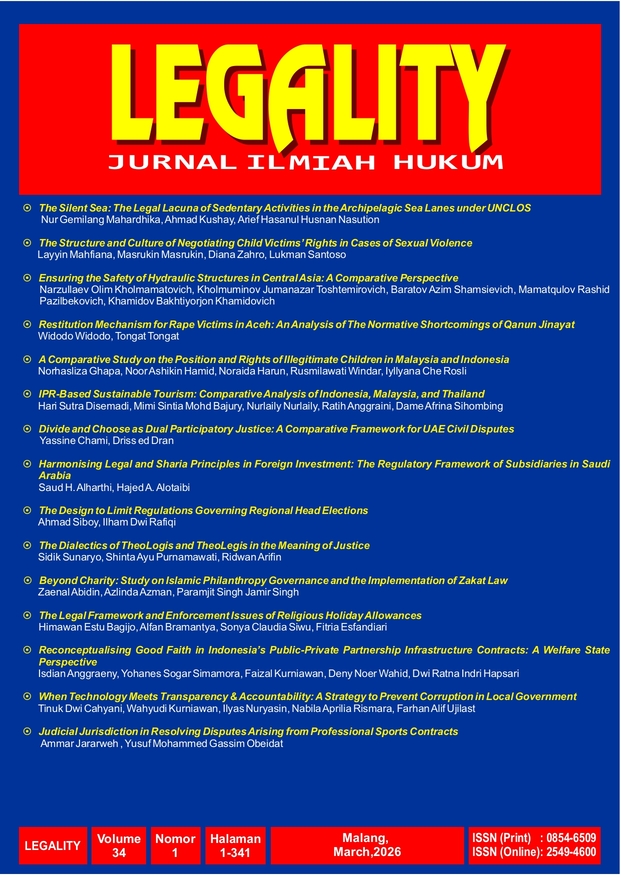
Beyond Charity: Study on Islamic Philanthropy Governance and the Implementation of Zakat Law
DOI:
https://doi.org/10.22219/ljih.v34i1.43623Keywords:
Philanthropy, Community Empowerment, SDGs, Zakat LawAbstract
This study focuses on the implementation of Zakat Law No. 23 of 2011 in Indonesia, particularly by the Lazismu Representative Office of East Java Province. Through an empirical legal approach, this study intends to evaluate the governance and compliance of the Lazismu Representative Office of East Java Province with the provisions of applicable laws, as well as its contribution to the SDGs based on community empowerment as a policy framework. This case study obtained data through interviews, observations, and data analysis to assess the compliance of the Lazismu Representative Office of East Java Province with relevant zakat regulations and the utilisation of zakat funds. This study has found a disparity between the explicit normative expectations of the Zakat Law No. 23 of 2011 and its implementation, particularly in the aspects of distributing zakat, infaq, and shodaqoh for community empowerment whose impact is sustainable. More than 70% of the programs implemented and initiated by Lazismu have been in line with the achievement of the SDGs, especially SDG 1 (No Poverty) and SDG 4 (Quality Education). However, this study also shows that 80% of the zakat, infaq, and shodaqoh of Lazismu utilisation programs remain charitable in nature but do not adequately promote participatory and inclusive community empowerment. As highlighted in this study, in the policy framework of the Zakat Law No. 23 of 2011 and its derivative regulations, there have not been many operational standards for the implementation of zakat utilisation guided by the principles of community empowerment with a participatory, accountable, and substantive governance approach in the management of zakat.
Downloads
References
Abidin, Z. (2017). Lembaga Filantropi Islam : Tinjauan Konsep Dan Praktik (1st ed.). Intelegensia Media dan DPD IPSPI Jawa Timur.
Abu, R., Rafie, S. K. M., and Sha’ari, H. (2023). Empowering Rural Public Library Users Towards Sustainable Community Development Goals. Proceedings of the European Conference on Knowledge Management, ECKM, 1(17), 18–23. https://doi.org/10.34190/eckm.24.1.1366
Ahmed Shaikh, S., and Ghafar Ismail, A. (2017). Role of Zakat in Sustainable Development Goals. International Journal of Zakat, 2(2), 1–9. https://doi.org/10.37706/ijaz.v2i2.21
Akinlabi, H. A., and Habeebullah, A. A. (2022). Implementation of Zakat Collection and Distribution System in Ibadan Metropolis Using WordPress Core Architecture and Architectonics. Fountain Journal of Natural and Applied Sciences, 11(1), 22–28. https://doi.org/10.53704/fujnas.v11i1.444
Al-Fatih, S. (2020). Strengthening BAZNAS As The Society’s Trusted Zakat Agency to Increase The Welfare of Ummah. Jurisdictie: Jurnal Hukum dan Syariah, 11(1), 106-124. https://doi.org/10.18860/j.v11i1.7841
Al-Fatih, S. (2023). Perkembangan metode penelitian hukum di Indonesia. UMMPress.
Al-Salih, A. N. (2020). The Role of Zakat in Establishing Social Welfare and Economic Sustainability: The Case of Saudi Arabia. International Journal of Financial Research, 11(6), 196. https://doi.org/10.5430/ijfr.v11n6p196
Babbie, E. (2008). The Basics of Social Research, Fourth Edition. Thomson Wadsworth.
Bahari, A. (2013). Bekerja dengan komuniti. Pustaka Qarya.
Bourdieu, P., Muzir, I. R., and Santosa, Y. (2010). Arena Produksi Kultural : Sebuah kajian sosiologi budaya (The field of cultural production) (I. R. Muzir (Ed.); Bahasa Ind). Kreasi Wacana.
Charities Aid Foundation. (2023). World Giving Index 2023: Laporan Global tentang Kedermawanan. cafonline.org
Chotib, M., Faiz, M. F., and Abdullah, I. (2023). Journal of Islamic Economics Perspectives , Volume 5 . Issue 2 ( 2023 ) Establishing a Zakat Culture based on Good Zakat Governance and Good Zakat Empowerment in Indonesia Journal of Islamic Economics Perspectives , Volume 5 . Issue 2 ( 2023 ). 5(2), 1–11.
Cresswell, J. W. (2009). Qualitative, Quantitative, and Mixed-Methods Research. In SAGE publications Inc (3rd ed.). SAGE Publications Inc.
Denzin, N. K., and Lincoln, Y. S. (2009). Handbook Of Qualitative Research (B. S. Fata, Abi, and J. Rinaldi (Eds.); Bahasa Ind). Pustaka Pelajar.
Dirie, K. A., Alam, M. M., and Maamor, S. (2023). Islamic social finance for achieving sustainable development goals: a systematic literature review and future research agenda. International Journal of Ethics and Systems, 40(4), 676–698. https://doi.org/https://doi.org/10.1108/ijoes-12-2022-0317
Gallien, M., Javed, U., and Boogaard, V. van den. (2023). Zakat, Non-State Welfare Provision and Redistribution in Times of Crisis: Evidence from the Covid-19 Pandemic. http://dx.doi.org/10.19088/ictd.2023.037
Hakim, R. N., and Rastika, I. (2019). Kemendagri: 420.381 Ormas Terdaftar di Indonesia. Kompas.Com. https://nasional.kompas.com/read/2019/08/01/18223501/kemendagri-420381-ormas-terdaftar-di-indonesia
Harker, R., Mahar, C., and Wilkes, Chris Rahmana, S. (Eds.). (2005). (Habitus x modal) + ranah = praktik : pengantar paling komprehensif kepada pemikiran Pierre Bordieu (Bahasa Ind). Jala Sutra.
Haryatmoko. (2003). Landasan Teoritis Gerakan Sosial Menurut Pierre Bourdieu: Menyingkap Kepalsuan Budaya Penguasa. Majalah Basis.11-12.
Huraerah, A. (2011). Pengorganisasian dan Pengembangan Masyarakat, Model, Strategi Pembangunan Masyarakat Berbasis Kerakyatan. Humaniora.
Hussain, S. (2020). Participation and Development Buzzwords. International Journal of Global Sustainability, 4(1), 55. https://doi.org/10.5296/ijgs.v4i1.17021
Ife, J. (1995). Community Development Creating Community Alternatives Visions, Analysis and Practice. Longman Australian.
Ife, J., and Tesoriero, F. (2008). Community development : alternatif pengembangan masyarakat di era globalisasi (S. Manurung, N. Yakin, M. Nursyahid, and S. Z. Qudsy (Eds.); Bahasa Ind). Pustaka Pelajar.
Indonesia Philanthropy Forum. (2021). Meningkatnya Partisipasi Masyarakat dalam Kegiatan Filantropi di Indonesia Saat Pandemi COVID-19. Indonesia Philanthropy Forum.
Kementerian Sosial Republik Indonesia. (2022). Statistik Organisasi Sosial dan Kemanusiaan di Indonesia. kemensos.go.id
Laksana, B. A. (2017, August). Mendagri: Ada 344 Ribu Ormas yang Terdaftar tapi Tak Berbadan Hukum. Detik News. https://news.detik.com/berita/d-3621869/mendagri-ada-344-ribu-ormas-yang-terdaftar-tapi-tak-berbadan-hukum
Ledwith, M. (2005). Community Development: A Critical Approach. The Policy Press.
Lembaga Penelitian dan Pengabdian Masyarakat Universitas Indonesia. (2023). Pengelolaan Dana Organisasi Sosial di Indonesia: Sebuah Kajian Transparansi dan Akuntabilitas. Universitas Indonesia.
Lidiawati, Maksum, A., Daulay, H., and Sukmana, O. (2023). Construction Of Islamic Philanthropy Based On Local Culture (Study On Wonorejo Digital Village, Poncokusumo District, Malang Regency). Proceeding of International Conference on Islamic Philantrophy, 1, 92–100. https://doi.org/10.24090/icip.v1i1.306
Mevlyutov, A. S., and Gamzatov, A. A. (2023). The problem of social responsibility in Islam. Minbar. Islamic Studies, 16(1), 117–125. https://doi.org/10.31162/2618-9569-2023-16-1-117-125
Mukhlishin, Dimyati, K., Absori, Ramadhan, J., and Sulthani, D. A. (2022). The Effect of Indonesia Philanthropy’s Regulation Towards the Welfare State. Bestuur, 10(2), 123–136. https://doi.org/10.20961/bestuur.v10i2.63527
Neuman, W. L. (2007). Basics of Social Research: Qualitative and Quantitative Appoaches. http://link.springer.com/10.1007/978-3-319-59379-1%0Ahttp://dx.doi.org/10.1016/B978-0-12-420070-8.00002-7%0Ahttp://dx.doi.org/10.1016/j.ab.2015.03.024%0Ahttps://doi.org/10.1080/07352689.2018.1441103%0Ahttp://www.chile.bmw-motorrad.cl/sync/showroom/lam/es/
Neuman, W. L. (2014). Social Research Methods: Qualitative and Quantitative Approaches (Seventh Ed). Pearson Education Limited. https://doi.org/10.2307/3211488
Notolegowo, H. K., Alamsyah, I. F., Saraswati, N., Jalil, B. A., and Bt Isahak Merican, F. M. (2023). Relationship between Islamic Social Finance and Sustainable Development Goals: A Conceptual Framework. KnE Social Sciences, 2023, 197. https://doi.org/10.18502/kss.v8i18.14245
Nurwulan, R. L. (2022). Pemberdayaan Masyarakat Program Corporate Social Responsibility (Csr) Bidang Lingkungan. Jurnal Ilmu Kesejahteraan Sosial HUMANITAS, 4(I), 1–20. https://doi.org/10.23969/humanitas.v4ii.5218
Pemerintah RI. (2011). Undang-Undang Nomor 23 tahun 2011 tentang Pengelolaan Zakat.
Polpum.kemendagri. (2018). Mendagri: Ada 394.250 Ormas di Indonesia. Kemendagri. https://polpum.kemendagri.go.id/mendagri-ada-394-250-ormas-di-indonesia/
Prassetyo, E. D., and Aulia, L. (2022). Kajian Filantropi di Indonesia: Studi Undang-Undang Pengumpulan Uang Atau Barang dan Undang-Undang Zakat. Al-Mazaahib: Jurnal Perbandingan Hukum, 10(2), 223. https://doi.org/10.14421/al-mazaahib.v10i2.2771
Rahayu, Y. S. and Garside, A. K. (2022). Model pengembangan pemberdayaan masyarakat di sekitar kawasan hutan di kabupaten lamongan. In Seminar Keinsinyuran Program Studi Program Profesi Insinyur (Vol. 2, Issue 1). https://doi.org/https://doi.org/10.22219/skpsppi.v3i1.5015
Setiana, L. (2005). Teknik penyuluhan dan pemberdayaan masyarakat (R. F. Sikumbank (Ed.)). Ghalia Indonesia.
Setyo Putra, T., and Rahaju, T. (2022). Pemberdayaan Masyarakat Wilayah Pesisir Di Desa Kupang, Kecamatan Jabon, Kabupaten Sidoarjo. Policy and Maritime Review, 23–34. https://doi.org/10.30649/pmr.v1i2.31
Syafruddin, S., and Hasan, N. (2021). An Ethnographic Review on the Reception of Sangir Community in Solok Selatan to Giving Alms. Mashdar: Jurnal Studi Al-Qur’an Dan Hadis, 3(1), 145–166. https://doi.org/10.15548/mashdar.v3i1.2860
Syamsuri, S., Arif, S., and Roficoh, L. (2019). Empowering economic independence of ummah based on the sustainability of zakat. Journal of International Conference Proceedings, 2(3), 122–128. https://doi.org/https://doi.org/10.32535/jicp.v2i3.653
Undang-Undang RI. (1945). Peraturan Pemerintah Pengganti Undang-Undang Nomor 2 Tahun 2017 Tentang Perubahan Atas Undang-Undang Nomor 17 Tahun 2013 Tentang Organisasi Kemasyarakatan Terhadap Undang-Undang Dasar 1945. Semarang Law Review …. http://journals.usm.ac.id/index.php/slr/article/view/2351
University, G. (2024). Dampak Digitalisasi Terhadap Kedermawanan: Studi Kasus di Indonesia. Griffith University.
Walczak, D., and Krupa, D. (2020). Exchange Transactions and Socioeconomic Determinants of Solidarity: The Case of Post-Solidarity Poland. European Research Studies Journal, XXIII(Issue 3), 364–377. https://doi.org/10.35808/ersj/1643
Yasni, R., and Erlanda, A. R. R. (2020). Challenges of Zakat Integration as Source of State Revenue. International Journal of Islamic Economics and Finance (IJIEF), 3(3), 175–204. https://doi.org/10.18196/ijief.3238
Yin, R. K. (2018). Case study research and applications: Design and methods (Sixth). SAGE Publications Inc.
Zunaidi, A., Maghfiroh, F. L., and Setiawan, F. (2024). Empowering Local Communities Through Zakat to Achieve Sustainable Development Goals. Iqtishoduna, 20(1), 52–73. https://doi.org/10.18860/iq.v20i1.23771
Downloads
Published
How to Cite
Issue
Section
License
Copyright (c) 2026 Zaenal Abidin, Azlinda Azman, Paramjit Singh Jamir Singh

This work is licensed under a Creative Commons Attribution-ShareAlike 4.0 International License.