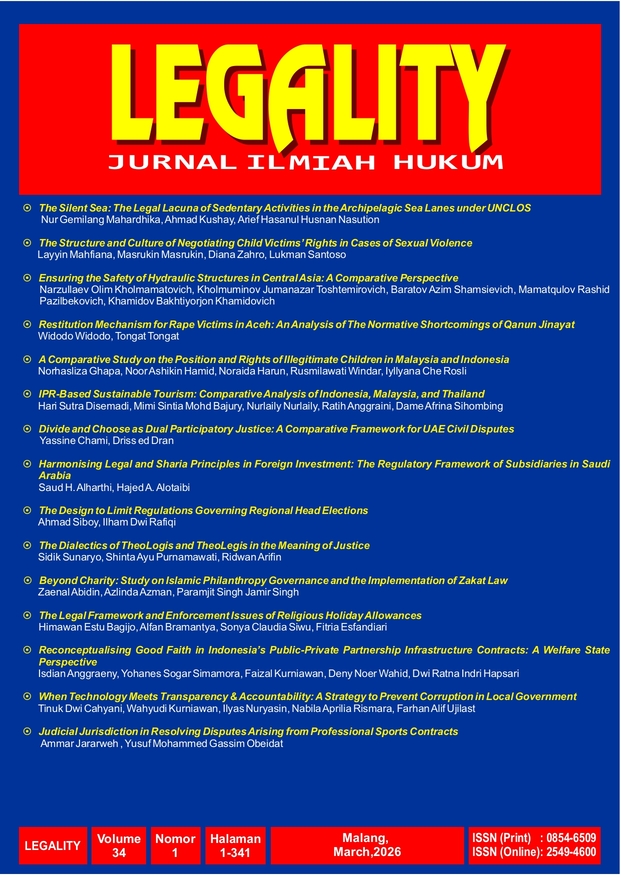
The Dialectics of TheoLogis and TheoLegis in the Meaning of Justice
DOI:
https://doi.org/10.22219/ljih.v34i1.44016Keywords:
Theologis Justice, Theolegis Justice, Legal Philosophy, Legal Theology, PancasilaAbstract
This article examines the meaning of justice through the dialectical relationship between TheoLogis justice and TheoLegis justice as two epistemological horizons in shaping and enforcing law. The study seeks to clarify the interaction between transcendental moral values and comprehensive understanding of justice through legal reasoning within contemporary legal systems. TheoLogis justice is conceptualised as a value orientation grounded in divine revelation and moral theology, providing law with a transcendental ethical foundation. However, when detached from epistemic humility, TheoLogis justice may risk formalisation and authoritarian domination. By contrast, TheoLegis justice situates legal rationality, social experience, and human values as mediating instruments through which divine values are translated into rational, contextual, and publicly accountable legal norms. Using a legal philosophy and legal theology approach, this study demonstrates that justice does not emerge as a fixed or singular concept but as a dialectical process between text and context, between the universality of values and the plurality of social realities. Within the Indonesian context, TheoLegis synthesis acquires constitutional significance through Pancasila, which integrates divine values, humanity, and social justice without reducing law to either secular positivism or normative theocracy. The main contribution of this article is the formulation of the TheoLogis-TheoLegis framework as an alternative conceptual approach for interpreting justice in pluralistic legal systems. In this framework, TheoLegis justice functions as an epistemological bridge that translates transcendental values into rational legal reasoning, enabling law to operate not merely as a coercive instrument but as a form of practical wisdom oriented toward human dignity, social balance, and substantive justice.
Downloads
References
Anthony Duff, University of Striling. Philosophy and The Criminal Law, Principle and Critique. Cambridge University Press 2008.
Alqadri, S. B., Mahmuddin, M., & Abbas, N. (2026). Divine Justice in the Perspectives of the Muʿtazilah, Ashʿariyyah, and Maturidiyyah. Socius: Jurnal Penelitian Ilmu-Ilmu Sosial, 3(6), 31-40. https://doi.org/10.5281/zenodo.18059826
Aminullah, M. (2022). Humanisme Religius Perspektif Al-Qur’an (Titik Temu Agama dan Filsafat). TAJDID: Jurnal Pemikiran Keislaman Dan Kemanusiaan, 6(2), 219-242. https://doi.org/10.52266/tadjid.v6i2.1193
An-Na’im, A. A. (2021). Religious norms and the future of justice in plural societies. Journal of Law and Religion, 36(3), 387-405.
Andrei Marmor. Interpretation and Legal Theory Second edition Oxford And Portland, Oregon 2005.
Ar, A. M., Wirda, W., Rusbandi, A. S., Zulhendra, M., Bahri, S., & Fajri, D. (2024). Peran Niat (Mens rea) dalam Pertanggungjawaban Pidana di Indonesia. Jimmi: Jurnal Ilmiah Mahasiswa Multidisiplin, 1(3), 240-252. https://doi.org/10.71153/jimmi.v1i3.140
Asshiddiqie, J. (2021). Pancasila constitutionalism and substantive justice. Indonesia Law Review, 11(3), 245-262.
Berman, P. S. (2006). Global legal pluralism. S. Cal. l. Rev., 80, 1155.
Bertrand Russell. A Critical Exposition of The Philosophy of Leibniz. Taylor and Franncis e-Library. 2005.
Duff, R. A. (2017). Moral and Criminal Responsibility: Answering and Refusing to Answer. SSRN Electronic Journal. https://doi.org/10.2139/ssrn.3055111
Duff, R. A. (2021). Criminal responsibility as moral responsibility. Oxford Journal of Legal Studies, 41(3), 615-635.
Dworkin, R. (2021). Justice, morality, and the legitimacy of law. Harvard Law Review Forum, 134.
Fudhaili, A. (2025). Living law and Islamic legal epistemology in Indonesia’s new criminal code. Journal of Humanities and Islamic Studies, 23(2), 45-66.
George Ritzer. Sociology: A Multiple Paradigm Science. Allyn and Bacon, 1980. University of California. Digitalized 2008.
Griffioen, D. (2020). Towards a Biblical Theology of Religion for This Time: Crux and Possibilities. Phronesis: Jurnal Teologi Dan Misi, 3(1), 24-46.
G.W.F. Hegel Translated by S.W Dyde Batoche Books Kitchener. Philosophy of Right. 2001.
_________The Philosophy Of History. Copyright © 2001. Blackmask Online
Habermas, J. (2006). Religion in the public sphere. European Journal of Philosophy, 14(1), 1.
Hans-Georg Gadamer. Truth And Method Second, Revised Edition Translation revised by Joel Weinsheimer and Donald G. Marshall. continuum London. New York. this edition 2004. Reprinted 2006. All rights reserved
Hallaq, W. B. (2022). Islamic law as a moral system: Beyond legal formalism. Journal of Law and Religion, 37(2), 189-210.
Hidayah, F. N. (2024). Kesadaran Hukum Dan Kepatuhan Hukum. Jurnal Hukum & Pembangunan, 7.
Humam Balya, Syukran, M. Z., & Abrar, A. (2025). Peran Mens Rea Dalam Sistem Hukum: Analisis Hubungan Dengan Prinsip Etika Dan Keadilan. As-Salam: Jurnal Studi Hukum Islam & Pendidikan, 14(1), 99-107. https://doi.org/10.51226/assalam.v14i1.713
James Bernard Murphy. The Philosophy of Positive Law Foundations of Jurisprudence. Yale University Press New Haven and London 2005
Joshua, E. B., & Adhari, A. (2021). Analisis Ketiadaan Niat (Mens Rea) Dalam Pemidanaan Pada Putusan Pengadilan Negeri Jakarta Pusat Nomor 844/PID. B/2019/PN. JKT. PST. Jurnal Hukum Adigama, 4(2), 3930-3952. https://doi.org/10.24912/adigama.v4i2.17975
Kamali, M. H. (2022). History and Jurisprudence of the Maqāṣid. American Journal of Islam and Society, 38(3-4), 8-34. https://doi.org/10.35632/ajis.v38i3-4.3110
Kurniawan, W., & Al-Fatih, S. (2021). Philosophical Meaning for Justice Based on the One Godhead in Judge's Decision. Pena Justisia: Media Komunikasi dan Kajian Hukum, 20(2). 147-160. https://doi.org/10.31941/pj.v20i2.1733
Latif, Y. (2022). Divine morality and social justice in Pancasila philosophy. Journal of Indonesian Social Sciences, 14(1), 1-20.
Larry Alexander and Emily Sherwin. The Rule Of Rules. Morality, Rules, and the Dilemmas of Law. ©2001. Duke University Press
Lon L. Fuller. The Morality of Law. Yale University. 1969.
Manurung, K. (2021). Memaknai Ajaran Alkitab Tentang Keadilan Allah Dari Sudut Pandang Teologi Pentakosta. Danum Pambelum: Jurnal Teologi Dan Musik Gereja, 1(1), 95-109. https://doi.org/10.54170/dp.v1i1.37
Menski, W. (2010). Sanskrit Law: Excavating Vedic Legal Pluralism. SSRN Electronic Journal. https://doi.org/10.2139/ssrn.1621384
Nerantzi, E., & Sartor, G. (2024). ‘Hard AI Crime’: The Deterrence Turn. Oxford Journal of Legal Studies, 44(3), 673-701. https://econpapers.repec.org/RePEc:oup:oxjlsj:v:44:y:2024:i:3:p:673-701.
Nerantzi, E., & Sartor, G. (2025). Crimes without criminals: in search of criminal liability for harms caused by AI systems. In Research Handbook on the Law of Artificial Intelligence (pp. 329-348). Edward Elgar Publishing. https://doi.org/10.4337/9781035316496.00024
Pardede, H., Lumingkewas, M., & Simangunsong, A. (2023). Teologi Keadilan (Mishpat) Dalam Kitab Mikha Dan Relevansinya Terhadap Keadilan Sosial Bagi Orang Kristen Di Indonesia. Ekklesia: Jurnal Teologi Dan Pendidikan Kristiani, 2(1), 83-101. https://doi.org/10.63576/ekklesia.v2i1.39
Purnamawati, S. A., Aprilianda, N., Endrawati, L., & Sulistiyo, F. (2024). Child-friendly justice and children’s rights from criminal cases; Islamic Law notes. Legality : Jurnal Ilmiah Hukum, 32(1), 141-154. https://doi.org/10.22219/ljih.v32i1.31681
Purwono, U. H. (2024). Reconstructing criminal justice based on Pancasila values. Bina Mulia Law Journal, 13(2), 956-975.
Roscoe Pound. An Introduction of the Philosophy of Law. Copy Right 1922, by Yale University Press London.
Skuratov, Y. I., Yastrebova, A. I., & Dzhavakhyan, R. M. (2023). Judiciary and Civil Society in Provision of Constitutional Rule of Law in the Russian Federation. Kutafin Law Review, 9(4), 641-663. https://doi.org/10.17803/2313-5395.2022.4.22.641-663
Sunaryo, S. (2021). Formal genus of the value of justice in Indonesia. Legality : Jurnal Ilmiah Hukum, 29(2), 223-236. https://doi.org/10.22219/ljih.v29i2.16609
Sunaryo, S. (2023). The philosophy of social injustice for all Indonesian laborers set forth in Job Creation Law. Legality : Jurnal Ilmiah Hukum, 31(1), 112-123. https://doi.org/10.22219/ljih.v31i1.25330
Sunaryo, S., Purnamawati, S. A., Jihadi, M., & Al-Fatih, S. (2025). The Narrating Ontology Morality of Corruption Law in Indonesia Based on Islamic Value. Jurnal Hukum Fakultas Hukum Unissula, 4(1), 133-156. https://dx.doi.org/10.26532/jh.v41i1.37154
Surahman, S. (2025). Islamic legal philosophy and ethical legitimacy of justice. Mizani, 12(2), 155-176.
Tamanaha, B. Z. (2022). Formalism, realism, and the rule of law revisited. Current Legal Problems, 75(1), 1-28.
Timothy Williamson. The Philosophy of Philosophy. © 2007 by Timothy Williamson Blackwell publishing.
Wibowo, B., Khowarizmi, M., Maulana, H., & Badi, A. (2026). Mens Rea and Juvenile Criminal Liability in Infanticide Cases: A Comparative Analysis of Indonesian Criminal Law and Fiqh Jinayat. JKIH : Jurnal Kajian Ilmu Hukum, 5(1), 25-37. https://doi.org/10.55583/jkih.v5i1.1687
Downloads
Published
How to Cite
Issue
Section
License
Copyright (c) 2026 Sidik Sunaryo, Shinta Ayu Purnamawati, Ridwan Arifin

This work is licensed under a Creative Commons Attribution-ShareAlike 4.0 International License.