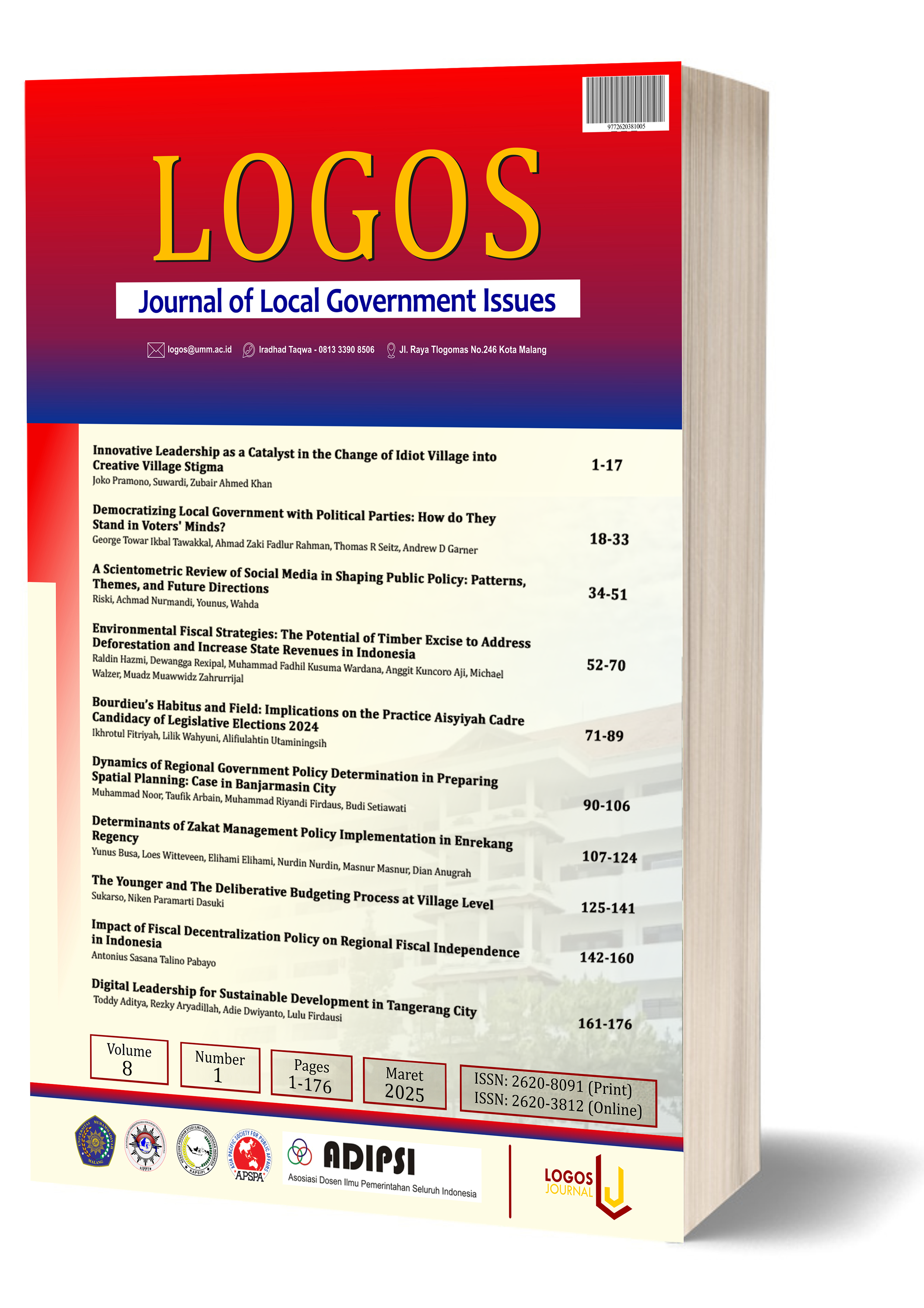
Determinants of Zakat Management Policy Implementation in Enrekang Regency
DOI:
https://doi.org/10.22219/logos.v8i1.28018Keywords:
community; engagement; determinant factors; digital transformation; policy implementation; zakat managementAbstract
This study examines the determinant factors influencing implementing zakat management policies in Enrekang Regency. Employing a descriptive qualitative method, the research adopts an explanatory phenomenological approach to explore and interpret zakat management's causal and chronological dimensions. Data were collected through interviews, field observations, and documentation analysis using instruments such as interview guides, observation sheets, and document review protocols. The NVivo 12 Plus software assisted in data organization and interpretation. This findings indicate that several key factors significantly affect zakat policy implementation: government support, public awareness and trust in zakat institutions, the professionalism of zakat managers (amil), community religiosity, understanding of zakat regulations, inclusive socialization efforts in rural areas, comprehensive zakat implementation mechanisms, adaptability of information systems, local culture of sharing, and transparency of the UPZ (zakat collecting unit). These elements interact to shape the effectiveness of zakat governance, particularly in the digital era, where zakat institutions are increasingly required to integrate digital-based systems and respond to evolving information needs. The research highlights the necessity for BAZNAS and related stakeholders to enhance digital literacy, technological adaptation, and community engagement to improve zakat services.
Downloads
References
Abas, S., Alirahman, A. D., & Mabrur, H. (2023). Humanizing STEM-Based Learning (Science, Technology, Engineering, and Mathematics) for the Transformation of Islamic Education in the 21st Century. EDUCAN: JURNAL PENDIDIKAN ISLAM, 8(1), 98–120. https://doi.org/10.21111/educan.v8i1.11429
Abbas, A., Triani, N., & Rayyani, W. O. (2023). Earnings growth, marketability and the role of Islamic financial literacy and inclusion in Indonesia. Journal of Islamic Accounting and Business Research,14(7), 1088-1105. Retrieved from https://ideas.repec.org/a/eme/jiabrp/jiabr-12-2021-0322.html
Abdullah, S & Elihami.(2018). Penerapan Pembelajaran Pendidikan Agama Islam Dalam Membentuk Karakter Pribadi Yang Islami. Edumaspul - Jurnal Pendidikan 2(1),79-96. http://dx.doi.org/10.33487/edumaspul.v2i1.17
Abubakari, M. S. (2024). The Digital Frontier within Islamic Education: Research Gaps Overview in Digital Competence. Journal of Computing Research and Innovation, 9(2), 317–331. https://doi.org/10.24191/jcrinn.v9i2.435
Adachi, M. (2018). Discourses of Institutionalization of Zakat Management System in Contemporary Indonesia: Effect of the Revitalization of Islamic Economics. International Journal of Zakat, 3(1), 25-35. https://doi.org/https://doi.org/10.37706/ijaz.v3i1.71
Adima, M. F., Syafe’i, I., & Zulaikha, S. (2024). Digital Literacy Trends in Islamic Perspective in Higher Education: A Bibliometric Review. Jurnal Penelitian Pendidikan IPA, 10(12), 1012–1026. https://doi.org/10.29303/jppipa.v10i12.9847
Adinugroho, M., Azmi, N. binti, & Zuhdi, U. (2024). Analysis of Zakat Management Efficiency Levels in Two Asean Countries (Studies in Indonesia and Malaysia). Revista De Gestão Social E Ambiental, 18(5), 1-18. https://doi.org/10.24857/rgsa.v18n5-044
Adyanti, D., Sain, Y., & Faridawati, F. (2024). Integrating Technology In English Classroom At Elementary School: Efl Pre-Service Teacher Perspective. Klasikal: Journal of Education, Language Teaching and Science, 6(3), 839-850.
Afif, M., Hidayat, A. A., Suminto, A., & Abidin, T. A. (2023). Analysis of zakat management with institutional isomorphic theorizing approach. Journal of Islamic and Finansial Studies, 4(2), 214-235. https://doi.org/10.47700/jiefes.v4i2.6333
Afifah, Z. (2021). A Systematic Literature Reviewe of Performance Management of Zakat Funds Institutions on Redistribution of Indonesian Revenue. IPTEK Journal of Proceedings Series, 1, 249-254. http://dx.doi.org/10.12962/j23546026.y2020i1.7865
Al-Ayubi, S., & Possumah, B. T. (2018). Examining the Efficiency of Zakat Management: Indonesian Zakat Institutions Experiences. International Journal of Zakat, 3(1), 37-55. https://doi.org/https://doi.org/10.37706/ijaz.v3i1.66
Al-Bawwab, R. A. (2023). Zakat: changing the framework of giving. Islamic Economic Studies, 30(2), 86–103. https://doi.org/10.1108/IES-08-2021-0026
Alfelaij, B. (2016). Why integrating technology has been unsuccessful in Kuwait? An exploratory study. E-Learning and Digital Media, 13(3-4), 126-139. https://doi.org/10.1177/2042753016672901
Alim, H. N. (2023). Analisis Makna Zakat Dalam Al-Quran: Kajian Teks dan Konteks. AKADEMIK: Jurnal Mahasiswa Humanis, 3(3), 161–169. https://doi.org/10.37481/jmh.v3i3.617
Alkhalaf, A. K. (2021). Integrating sustainable education into an ICT curriculum: A study into the role of’technology stewardship’in achieving transformative learning toward. Thesis: University of Manchester. https://research.manchester.ac.uk/en/studentTheses/integrating-sustainable-education-into-an-ict-curriculum-a-study-
Alshater, M. M., Saad, R. A. J., & Wahab, N. A. (2021). What do we know about zakat literature? A bibliometric review. Journal of Islamic Accounting and Business Research, 12(4), 544–563. https://doi.org/10.1108/JIABR-07-2020-0208
Amilahaq, F., & Ghoniyah, N. (2019). Compliance behavior model of paying zakat on income through zakat management organizations. Share: Jurnal Ekonomi Dan Keuangan Islam, 18(1), 114-141. http://dx.doi.org/10.22373/share.v8i1.3655
Andaya, L. Y. (2004). Nature of War and Peace among the Bugis–Makassar People. South East Asia Research, 12(1), 53–80. https://doi.org/10.5367/000000004773487947
Ansoriyah, F., Suharto, D. G., & Haji, W. S. N. (2025). University Zakat Management: Challenges and Opportunities for Economic Empowerment BT - Proceedings of The 8th International Conference on Social and Political Sciences (ICoSaPS 2024). 306–315. https://doi.org/10.2991/978-2-38476-368-9_29
Arlusi, N., & Fuad, A. J. (2020). Relasi Nilai Mata Kuliah Tasawuf dengan Akhlak Mahasiswa Institut Agama Islam Tribakti (IAIT) Kediri. Indonesian Journal of Islamic Education Studies (IJIES), 3(1), 96-111. https://doi.org/10.33367/ijies.v3i1.1250
Bara, A. L., & Pradesyah, R. (2019). Analysis Of The Management Of Productive Zakat At The Muhammadiyah, City Of Medan. Proceeding International Seminar Of Islamic Studies. https://doi.org/10.3059/insis.v1i1.4196.g3816
Bin-Nashwan, S. A. (2022). Toward diffusion of e-Zakat initiatives amid the COVID-19 crisis and beyond. Foresight, 24 (2),141-158. https://doi.org/10.1108/FS-08-2020-0082
Bin-Nashwan, S. A., & Abdul-Jabbar, H. (2021). Does trust in Zakat institution enhance entrepreneurs’ Zakat compliance? Journal of Islamic Accounting and Business Research, 12(5), 768-790. https://doi.org/10.1108/JIABR-09-2020-0282
Fathullah, M. N., Ulfiah, U., & Mulyanto, A. (2023). Management of Digital Literacy-Based Work Practice Training in The Boarding School Environment. Munaddhomah: Jurnal Manajemen Pendidikan Islam, 4(1), 1–11. https://doi.org/10.31538/munaddhomah.v4i1.230
Hadi, S., & Hana, K. F. (2023). The Problems Of Zakat Management In Indonesia. Indonesian Conference of Zakat - Proceedings, 106-119. https://doi.org/https://doi.org/10.37706/iconz.2023.621
Hakim, L. N., & Huda, N. (2022). Accreditation Model Zakat Management Organization (ZMO) In Indonesia. AZKA International Journal of Zakat & Social Finance, 3(2), 124-142. https://doi.org/10.51377/azjaf.vol3no2.120
Hayatika, A. H., & Suharto, S. (2021). Manajemen Pengumpulan, Pendistribusian, dan Penggunaan Dana Zakat oleh Badan Amil Zakat Nasional sebagai Upaya Peningkatan Pemberdayaan Ekonomi Umat. Jesya (Jurnal Ekonomi Dan Ekonomi Syariah), 4(2).https://doi.org/https://doi.org/10.36778/jesya.v4i2.438
Herianingrum, S., Supriani, I., & Sukmana, R. (2024). Zakat as an instrument of poverty reduction in Indonesia. Journal of Islamic Accounting and Business Research, 15(4), 643-660. https://ideas.repec.org/a/eme/jiabrp/jiabr-11-2021-0307.html
Hidayatullah, A., & Priantina, A. (2018). Toward Zakat Management Integration in Indonesia: Problems and Solution. Ahkam: Jurnal Ilmu Syariah, 18(2), 321–346. https://doi.org/10.15408/ajis.v18i2.6319
Iqbal, M., & Siswanto, I. (2024). Manajemen Pengelolaan dan Pendistribusian Dana Zakat. Al-Zayn: Jurnal Ilmu Sosial & Hukum, 2(1), 39–50. https://doi.org/10.61104/alz.v2i1.179
Judijanto, L., Rusdi, M., & Muhtadi, M. A. (2025). Global and Local Collaboration in Islamic Education Literacy Research. West Science Social and Humanities Studies, 3(01),173-183. http://dx.doi.org/10.58812/wsshs.v3i01.1646
Kidwai, A., & Zidani, M. E. M. (2020). A New Approach to Zakat Management for Unprecedented Times. International Journal of Zakat, 5(1), 45-54. https://doi.org/https://doi.org/10.37706/ijaz.v5i1.207
Latief, N. F., & Sandimula, N. S. (2022). How Accountable is Zakat Management in Indonesia? An Evidence from BAZNAS of North Sulawesi. Share: Jurnal Ekonomi Dan Keuangan Islam, 11(2), 42-60. http://dx.doi.org/10.22373/share.v11i1.11194
Mukasif, A. B., & Frieda, N. R. H. (2016). PERJALANAN HIDUP BERTASAWUF (Studi Kualitatif dengan Interpretative Phenomenological Analysis pada Pelaku Tasawuf). Jurnal EMPATI, 5(2), 362-366. https://doi.org/10.14710/empati.2016.15220
Owoyemi, M. Y. (2020). Zakat management: The crisis of confidence in zakat agencies and the legality of giving zakat directly to the poor. Journal of Islamic Accounting and Business Research, 11(2), 498-510. https://doi.org/10.1108/JIABR-07-2017-0097
Pangga, I. (2024). Model Of People’s Development In Optimizing Zakat Payments In Cendana District, Enrekang Regency: Islamic Education Perspective’. Al-Mirah: Jurnal Pendidikan Islam, 6 (1).
Rahayu, P. K. (2020). A Comparative Study on Zakat Management Law Practices between Malaysia and Indonesia. International Journal of Science and Society, 2(2), 328 - 341. https://doi.org/10.54783/ijsoc.v2i2.164
Tulab, T., Yurista, D. Y., & Rozihan, R. (2024). Strategic Management of Zakat Funds for Educational Initiatives: A Study at Amil Zakat Agency of Nurul Hayat. Ulul Albab: Jurnal Studi dan Penelitian Hukum Islam, 7(2), 212-224. http://dx.doi.org/10.30659/jua.v7i2.31088
Utami, P., Suryanto, T., Nasor, M., & Ghofur, R. A. (2020). The effect digitalization zakat payment against potential of zakat acceptance in national Amil zakat agency. Iqtishadia, 13(2), 216-239. http://dx.doi.org/10.21043/iqtishadia.v13i2.7809
Uula, M. M., & Izza, N. N. (2023). Zakat Management in Indonesia: A Qualitative Analysis using N-Vivo Analysis using N-Vivo. Management and Sustainability, 2(3). http://dx.doi.org/10.58968/ms.v2i1.321
Waldan, R. (2020). Zakat Distribution Management Of National Amil Zakat Agency Of West Kalimantan Province. Jurnal Al-Hikmah, 14(1), 37-48. https://doi.org/10.24260/jhjd.v14i1.1535.g857
Downloads
Published
How to Cite
Issue
Section
License
Copyright (c) 2025 Yunus Busa, Elihami Elihami, Nurdin Nurdin, Masnur Masnur, Dian Anugrah

This work is licensed under a Creative Commons Attribution-ShareAlike 4.0 International License.
Authors who publish with this journal agree to the following terms:
- Authors retain copyright and grant the journal right of first publication with the work simultaneously licensed under a Creative Commons Attribution-ShareAlike 4.0 International License. that allows others to share the work with an acknowledgment of the work's authorship and initial publication in this journal.
- Authors are able to enter into separate, additional contractual arrangements for the non-exclusive distribution of the journal's published version of the work (e.g., post it to an institutional repository or publish it in a book), with an acknowledgment of its initial publication in this journal.
- Authors are permitted and encouraged to post their work online (e.g., in institutional repositories or on their website) prior to and during the submission process, as it can lead to productive exchanges, as well as earlier and greater citation of published work (See The Effect of Open Access).

This work is licensed under a Creative Commons Attribution-ShareAlike 4.0 International License.