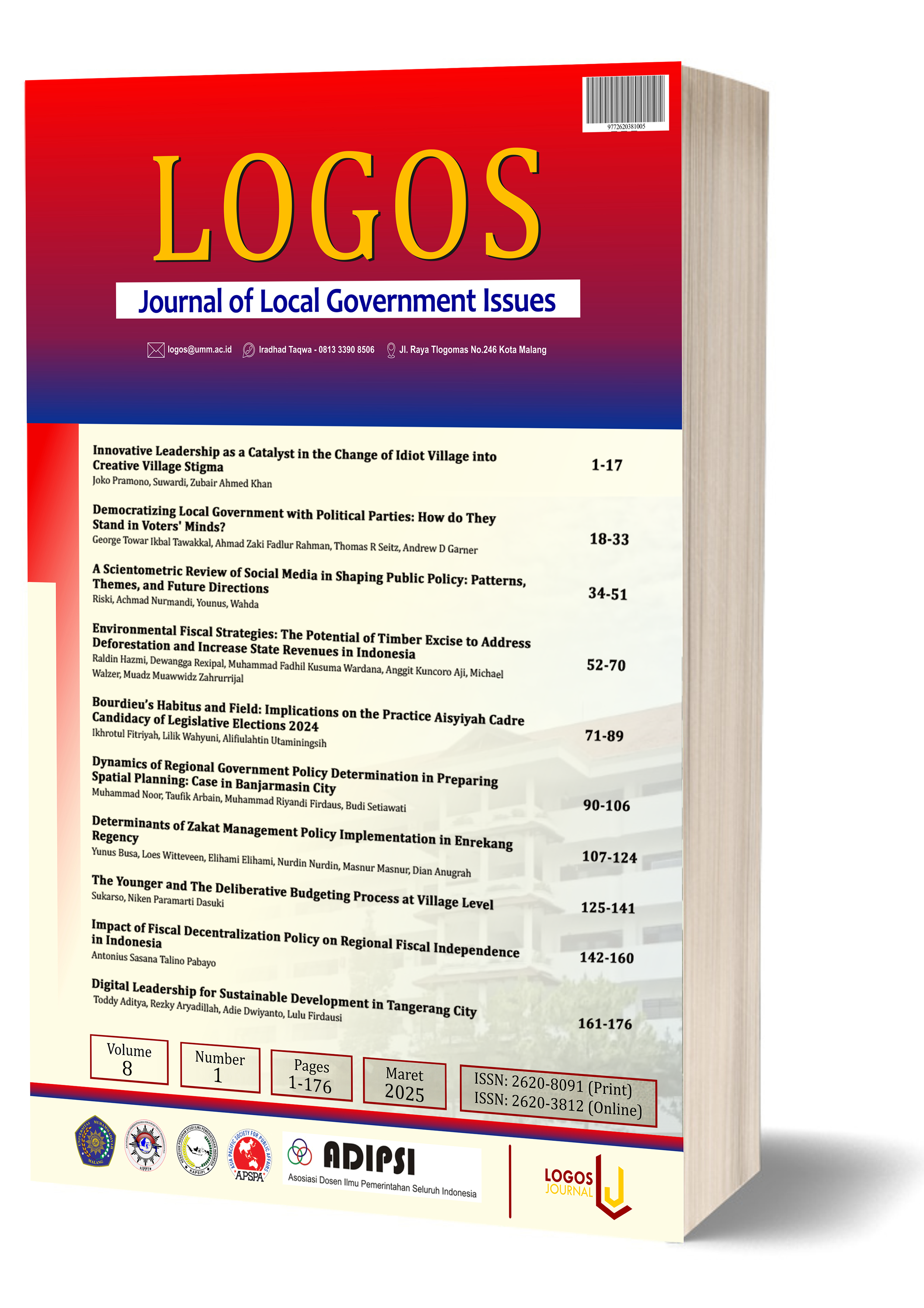
Democratizing Local Government with Political Parties: How do They Stand in Voters' Minds?
DOI:
https://doi.org/10.22219/logos.v8i1.34318Keywords:
Local election, Local government, Party, VoterAbstract
A fundamental question about local government that is rarely explored by scholars is, what do voters think about the local elections? Scholars construct clear concepts of elections, but do these concepts resonate with the thoughts of voters? The importance of elections for voters can vary and have diverse consequences on their perceptions of elections, but the issue is that voters in many countries face numerous types of elections in their country. This diversity can impact the degree of importance and their perspectives on voting, including the position of political parties in the minds of voters. For example, in Indonesia, voters engage in eight types of elections including two local elections for a local government. This article questions the degree of importance voters attach to the local elections and their consequences for the position of political parties. The article is based on survey data from two regencies in Central Java, Indonesia, during 2019 with 800 respondents, as well as in-depth interviews with over 20 voters during 2023. The results indicate that the position of parties is jeopardized by the lack of data aligning with the importance of local election for voters. It indicates that voters do not see parties as main entities on local government.
Downloads
References
Aarøe, L., Appadurai, V., Hansen, K. M., Schork, A. J., Werge, T., Mors, O., ... & Petersen, M. B. (2021). Genetic predictors of educational attainment and intelligence test performance predict voter turnout. Nature human behaviour, 5(2), 281-291. https://doi.org/10.1038/s41562-020-00952-2.
Abott, C., & Magazinnik, A. (2020). At‐Large Elections and Minority Representation in Local Government. American Journal of Political Science, 64(3), 717-733. https://doi.org/10.1111/ajps.12512.
Adamas, J., Merrill III, S., & Zur, R. (2024). How much does issue salience matter? A model with applications to the UK elections. European Journal of Political Research, 63(2), 798-809. https://doi.org/10.1111/1475-6765.12634.
Ahmad, A., Bhatti, M. I., & Yousaf, F. N. (2020). Whom to Vote? Socio-psychological Factors Influencing Voting Behavior in Rural Punjab, Pakistan. Sjesr, 3(2), 9-15. https://doi.org/10.36902/sjesr-vol3-iss2-2020(9-15).
Alemanno, A. (2020). Europe’s Democracy Challenge: Citizen Participation in and Beyond Elections. German Law Journal, 21(1), 35–40. https://doi.org/10.1017/glj.2019.92.
Almond, G. (1960). Introduction: A Functional Approach to Comparative Politics. In G. Almond, & J. Coleman (Eds.), The Politics of the Developing Areas (pp. 1-64). Princeton: Princeton University Press. https://doi.org/10.1515/9781400866977-003
Almond, G. A., & Powell, G. B. (1966). Comparative politics: A developmental approach. Little, Brown and company.
Amwaritama, M. (2018). The Distribution of Power in The Recruitment of Prospective Head Area by PDI-P in The Election Year 2015 Jember. LOGOS: Journal of Local Government Issues, 1(1), 1–19. https://doi.org/10.22219/logos.Vol1.No1.1-19.
Anzia, S. F. (2021). Party and ideology in American local government: An appraisal. Annual Review of Political Science, 24, 133-150. https://doi.org/10.1146/annurev-polisci-041719-102131.
Arianto, A. (2018). Political Transtactions and Expenxive Costs on Regional Head Election. LOGOS: Journal of Local Government Issues, 1(2), 226–243. https://doi.org/10.22219/logos.Vol1.No2.226-243.
Arkilic, A. (2021). Turkish Populist Nationalism in Transnational Space: Explaining Diaspora Voting Behaviour in Homeland Elections. Journal of Balkan and Near Eastern Studies, 23(4), 586–605. https://doi.org/10.1080/19448953.2021.1888599.
Auerbach, K. R. (2022). Accountable to whom? How strong parties subvert local democratic institutions. Party Politics, 28(5), 865-878. https://doi.org/10.1177/13540688211019720.
Bartolini, S., & Mair, P. (2001). Challenges to contemporary political parties. In L. Diamond & R. Gunther (Eds.), Political parties and democracy (pp. 327–344). Maryland: Johns Hopkins University Press.
Birch, S, 2001. Elections. In P. B. Clarke, & J. Foweraker (Eds.), Encyclopedia of Democratic Thought (pp. 239–248). Routledge. London/ New York: Routledge.
Bovenkamp, H. M. van de, & Vollaard, H. (2018). Strengthening the local representative system: the importance of electoral and non-electoral representation. Local Government Studies, 45(2), 196–218. https://doi.org/10.1080/03003930.2018.1548351.
Clark, A. (2019). The cost of democracy: The determinants of spending on the public administration of elections. International Political Science Review, 40(3), 354-369. https://doi.org/10.1177/0192512118824787.
Dalton, R., Farrell, D. & McAllister, I. (2011). The Dynamics of Political Representation. In M. Rosema, B. Denters & K. Aarts (Eds.), How Democracy Works: Political Representation and Policy Congruence in Modern Societies (pp. 21-38). Amsterdam: Amsterdam University Press. https://doi.org/10.1515/9789048513369-003
De Sio, L., & Lachat, R. (2019). Making sense of party strategy innovation: challenge to ideology and conflict-mobilisation as dimensions of party competition. West European Politics, 43(3), 688–719. https://doi.org/10.1080/01402382.2019.1655967.
Diamond, L. J., & Gunther, R. (2001). Types and Functions of Parties. In L. Diamond & R. Gunther (Eds.), Political parties and democracy (pp. 3-39). Maryland :Johns Hopkins University Press.
Dix, R. H. (1989). Cleavage Structures and Party Systems in Latin America. Comparative Politics, 22(1), 23–37. https://doi.org/10.2307/422320.
Dragu, T., & Fan, X. (2016). An Agenda-Setting Theory of Electoral Competition. The Journal of Politics, 78(4), 1170-1183. https://doi.org/10.1086/686310.
Driscoll, B. (2019). Democratization, party systems, and the endogenous roots of Ghanaian clientelism. Democratization, 27(1), 119–136. https://doi.org/10.1080/13510347.2019.1666265.
Dye, T. R., Schubert, L., & Zeigler, H. (2009). The Irony of Democracy: An Uncommon Introduction to American Politics. Cengage Learning, Wadsworth.
Easton, D. (1965). A framework for political analysis. Prentice-Hall.
Epstein, L., & Segal, J. (2000). Measuring Issue Salience. American Journal of Political Science, 44(1), 66-83. http://dx.doi.org/10.2307/2669293.
Franklin, M. N. (2001). The Dynamics Of Electoral Participation. in L. Leduc, R. Niemi, & P. Norris (Eds), Comparing Democracies 2: Elections and Voting in Global Perspective (pp. 148-168). Thousand Oaks CA: Sage.
Geertz, C. (1976). The religion of Java. Chicago: University of Chicago Press.
Harding, R. (2020). Who is democracy good for? Elections, rural bias, and health and education outcomes in sub-Saharan Africa. The Journal of Politics, 82(1), 241-254. https://doi.org/10.1086/705745.
Harrop, M., & Miller, W. L. (1987). Elections and Voters: A Comparative Introduction. Basingstoke: Macmillan.
Hazama, Y. (2006). Retrospective Voting in Turkey: Macro and Micro Perspectives. Institute of Developing Economies, Japan External Trade Organization(JETRO), IDE Discussion Papers.
Hernández, E., & Anduiza, E., & Rico, G. (2021). Affective polarization and the salience of elections. Electoral Studies, 69, 102203. https://doi.org/10.1016/j.electstud.2020.102203.
Heywood, A. (2000). Key Concepts in Politics. New York: Palgrave.
James, T. S., & Alihodzic, S. (2020). When is it democratic to postpone an election? Elections during natural disasters, COVID-19, and emergency situations. Election Law Journal: Rules, Politics, and Policy, 19(3), 344-362. https://doi.org/10.1089/elj.2020.0642.
Katz, R. S, 1997. Democracy and Elections. Oxford: Oxford University Press.
Key, V. O, 1966. The Responsible Electorate: Rationality of Presidential Voting 1936-1960. Cambridge: The Belknap Press of Harvard University Press.
Knutsen, C. H., Gerring, J., Skaaning, S. E., Teorell, J., Maguire, M., Coppedge, M., & Lindberg, S. I. (2019). Economic development and democracy: An electoral connection. European Journal of Political Research, 58(1), 292-314. https://doi.org/10.1111/1475-6765.12282.
Lee, D. S., Moretti, E., & Butler, M. J. (2004). Do Voters Affect or Elect Policies? Evidence from the US House. The Quarterly Journal of Economics, 119(3), 807–859. https://doi.org/10.1162/0033553041502153.
Loveless, M. (2021). When You Win, Nothing Hurts: The Durability of Electoral Salience on Individuals’ Satisfaction with Democracy. Political Studies, 69(3), 538–558. https://doi.org/10.1177/0032321720910356.
Medvic, S. K. (2021). Campaigns and Elections: Players and Processes (4th ed.). Routledge. https://doi.org/10.4324/9781003125099
Mozaffar, S., Scarritt, J. R., & Galaich, G. (2003). Electoral Institutions, Ethnopolitical Cleavages, and Party Systems in Africa's Emerging Democracies. American Political Science Review, 97(3), 379–390. http://doi.org/10.1017/S0003055403000753.
Ozbudun, E. (1987). Institutionalizing Competitive Elections in Developing Countries. In M. Weiner, & E. Ozbudun (Eds.), Competitive Elections in Developing Countries (pp. 393-422). Durham, NC: Duke University Press. https://www.dukeupress.edu/competitive-elections-in-developing-countires
Panebianco, A. (1988). Political parties: Organization and power. Cambridge U.P
Pradhanawati, A., Tawakkal, G. T. I., & Garner, A. D. (2019). Voting Their Conscience: Poverty, Education, Social Pressure and Vote Buying In Indonesia. Journal of East Asian Studies, 19(1), 19–38. https://doi.org/10.1017/jea.2018.27.
Posada, H. M., Burbano Valencia, E. J., & Mondragón-Mayo, A. (2024). Do Disciplinary Sanctions Affect Political Parties’ Re-election? Evidence from Colombia. Journal of Politics in Latin America, 0(0). https://doi.org/10.1177/1866802X241235676.
Richards, P. G. (2024). The reformed local government system. Taylor & Francis. https://www.taylorfrancis.com/books/mono/10.4324/9781003487197/reformed-local-government-system-peter-richards
Rose, R., & Mossawir, H. (1967). Voting and Elections: A Functional Analysis. Political Studies, 15(2), 173-201. https://doi.org/10.1111/j.1467-9248.1967.tb01843.x
Rosenstone, S. J., & Hansen, J. M. (1993). Mobilization, Participation, and Democracy in America. New York: Macmillan.
Salkin, W. (2022). Democracy within, justice without: The duties of informal political representatives 1. Noûs, 56(4), 940-971. https://doi.org/10.1111/nous.12391.
Sartori, G. (2005). Parties and party systems: A framework for analysis. ECPR Press.
Stoker, G. (1991). The politics of local government, 2nd edition. London : Macmillan.
Strikovic, E., van der Meer, T. G. L. A., van der Goot, E., Bos, L., & Vliegenthart, R. (2020). On Behalf of the People: The Use of Public Opinion and the Perception of “the People” in Political Communication Strategies of Dutch MPs. The International Journal of Press/Politics, 25(1), 135-157. https://doi.org/10.1177/1940161219864297.
Tawakkal, G. T. I., Damayanti, R., Subekti, T., Alfian, F., & Garner, A. D. (2020). Social networks and brokerage behavior in Indonesian elections: Evidence from Central Java. Asian Affairs: An American Review, 47(4), 227–244. https://doi.org/10.1080/00927678.2020.1765473.
Tawakkal, G. T. I., Ulfah, I. F., Setiawan, A., Garner, A. D., & Seitz, T. R. (2020). When Different Elections Have Different Saliencies For Voters: Most Important And Consideration (Evidence From Indonesian Voters). Humanities & Social Sciences Reviews, 8(4), 625-634. https://doi.org/10.18510/hssr.2020.8462.
Tawakkal, G. T. I., Suhardono, W., Garner, A. D., & Seitz, T. (2017). Consistency and Vote Buying: Income, Education, and Attitudes About Vote Buying In Indonesia. Journal of East Asian Studies, 17(3), 313–329. https://doi.org/10.1017/jea.2017.15.
Tawakkal, G. T. I., & Garner, A. D. (2017). Unopposed but not Uncontested: Brokers and “Vote Buying” in the 2017 Pati District Election. Contemporary Southeast Asia, 39(3), 491–510. http://www.jstor.org/stable/44684052.
Taylor, S. E., & Fiske, S. T. (1978(. Salience, Attention, and Attribution: Top of the Head Phenomena. In L. Barkowitz (Ed.), Advances in Experimental Social Psychology, Vol. 2 (pp. 249-288). New York: Academic Press.
Teti, A., Abbott, P., & Cavatorta, F. (2019). Beyond elections: perceptions of democracy in four Arab countries. Democratization, 26(4), 645-665. https://doi.org/10.1080/13510347.2019.1566903.
Eijk, C.V., Franklin, M.N., & Marsh, M. (1996). What Voters Teach Us About Europe-Wide Elections: What Europe-Wide Elections Teach Us About Voters. Electoral Studies, 15, 149-166. https://doi.org/10.1016/0261-3794(96)00009-1.
Eijk, C.V., & Franklin, M.N. (1996). Choosing Europe? The European Electorate and National Politics in the Face of Union. Ann Arbor: University of Michigan Press.
Wlezien, C. (2005). On the Salience of Political Issues: The Problem with the 'Most Important Problem. Electoral Studies, 24, 555-579. https://doi.org/10.1016/j.electstud.2005.01.009.
Wojtasik, Waldemar. (2013). Functions of Elections in Democratic Systems. Political Preferences, 4, 25-38. https://journals.us.edu.pl/index.php/PP/article/view/4181.
Wurthmann, L.C. (2023). Thematic Introduction: Issue Saliency in the 2021 Federal Election. In R. Campbell, & L. K. Davidson-Schmich (Eds), The 2021 German Federal Election. New Perspectives in German Political Studies (pp. 291-303). Cham: Palgrave Macmillan. https://doi.org/10.1007/978-3-031-38930-6_16.
Yihua, L., Xi, L., & Fangjie, Z. (2021). Collective Decision-making Power Structure and the Scale of Local Governments’ Implicit Debt: Based on the Perspective of the Standing Committee of Provincial Party Committees. Journal of Shanghai University of Finance and Economics, 23(06), 35-51. https://doi.org/10.16538/j.cnki.jsufe.2021.06.003.
Downloads
Published
How to Cite
Issue
Section
License
Copyright (c) 2025 George Towar Ikbal Tawakkal, Thomas R Seitz, Andrew D Garner, Ahmad Zaki Fadlur Rahman

This work is licensed under a Creative Commons Attribution-ShareAlike 4.0 International License.
Authors who publish with this journal agree to the following terms:
- Authors retain copyright and grant the journal right of first publication with the work simultaneously licensed under a Creative Commons Attribution-ShareAlike 4.0 International License. that allows others to share the work with an acknowledgment of the work's authorship and initial publication in this journal.
- Authors are able to enter into separate, additional contractual arrangements for the non-exclusive distribution of the journal's published version of the work (e.g., post it to an institutional repository or publish it in a book), with an acknowledgment of its initial publication in this journal.
- Authors are permitted and encouraged to post their work online (e.g., in institutional repositories or on their website) prior to and during the submission process, as it can lead to productive exchanges, as well as earlier and greater citation of published work (See The Effect of Open Access).

This work is licensed under a Creative Commons Attribution-ShareAlike 4.0 International License.