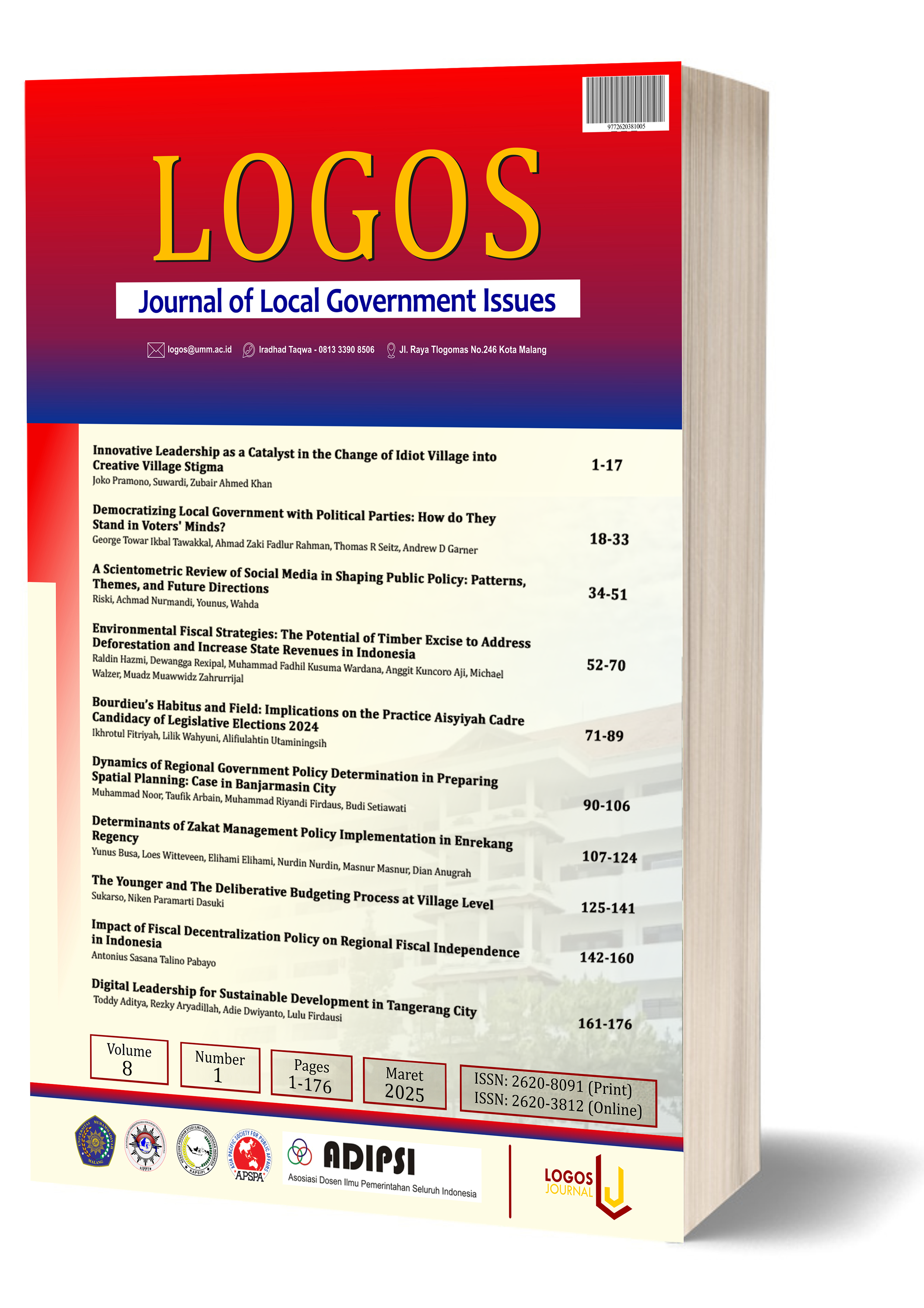
Bourdieu’s Habitus and Field: Implications on the Practice Aisyiyah Cadre Candidacy of Legislative Elections 2024
DOI:
https://doi.org/10.22219/logos.v8i1.35574Keywords:
habitus, field, candidacy, cadre Aisyiyah, Legislative elections, East JavaAbstract
This article discuss Pierre Bourdieu's concepts of habitus and field about the candidacy practices of Aisyiyah cadres running for legislative positions in East Java in the 2024 elections. Concerning the discourse of habitus formed from the socio-religious habitus formed through the experience in the Aisyiyah organization, it transformed when they entered a political structure that was patriarchal, competitive, and transactional, and not gender-neutral. The method used in this study is qualitative with a phenomenological approach, the data source used is primary data, collected through semi-structured interviews with related sources. The results of this study show that the disposition of Aisyiyah cadres in the political parties PAN, UMMAT and PDIP is based on inherent values in themselves and life journeys. In running their candidacy, they must adapt and build a strategy to navigate the contest arena by maximizing their modalities. The way is to approach party elites, local political figures, and organizational networks, take advantage of party assistance for campaigns, pengajian, and socialization with the transfer of their expertise.
Downloads
References
Adela, F. P. (2016). Proses Rekrutmen Politik Calon Legislatif Lokal di Medan Pada Pemilu 2009. Perspektif, 2(1), 1–11. https://doi.org/10.31289/perspektif.v2i1.102
Adiantoro. (2024 , Februari 14 ). Nusantaratv.com. pemilu 2024: perludem khawatirkan tak capai kuota keterwakilan perempuan minimal 30 persen. https://www.nusantaratv.com/news/pemilu-2024-perludem-khawatirkan-tak-capai-kuota-keterwakilan-perempuan-minimal-30-persen
Apriliandra, S., & Krisnani, H. (2021). Perilaku Diskriminatif Pada Perempuan Akibat Kuatnya Budaya Patriarki Di Indonesia Ditinjau Dari Perspektif Konflik. Jurnal Kolaborasi Resolusi Konflik, 3(1), 1-10. https://doi.org/10.24198/jkrk.v3i1.31968
Aspinall, E., White, S., & Savirani, A. (2021). Women’s Political Representation in Indonesia: Who Wins and How? Journal of Current Southeast Asian Affairs, 40(1), 3–27. https://doi.org/10.1177/1868103421989720
Azizah, N., ZA, I., & Maksum, A. (2022). Strategi Aisyiyah Untuk Meningkatkan Kehadiran Perempuan dalam Politik. Prosiding Seminar Nasional Program Pengabdian Masyarakat, 537–545. https://doi.org/10.18196/ppm.41.796
Blackman, A. D., & Jackson, M. (2021). Gender Stereotypes, Political Leadership, and Voting Behavior in Tunisia. Political Behavior, 43(3), 1037–1066. https://doi.org/10.1007/S11109-019-09582-5
Bochel, J & Denver, D. (1983). Candidate Selection in the Labour Party: What the Selectors Seek. British Journal of Political Science. Vol. 13, No. 1 (Jan., 1983), pp. 45-69. Https://doi.org/10.1162/003355397555136
Bourdieau, P., & L, W. (1992). An Invitations to Reflexive Sociology. Cambridge: Policy Press.
Bourdieu. (1990). The Logic Of Power. California: Stanford University Press
Bulut, A. T., & Yildirim, T. M. (2021). Elite Influence on Attitudes About Gender Egalitarianism: Evidence from a Population-Based Survey Experiment. Political Behavior, 1–20. https://doi.org/10.1007/S11109-021-09722-W
Collignon, S. (2024). Addressing Barriers to Women’s Representation in Party Candidate Selections. The Political Quarterly. https://doi.org/10.1111/1467-923x.13397
Dewi, K. H. (2024). Hybrid feminist leadership: feminist leadership on the ground – experiences of women political leaders in Indonesia. International Feminist Journal of Politics, 26(5), 1097–1118. https://doi.org/10.1080/14616742.2024.2424812
Daerah Pemilihan Provinsi Jawa Timur. dprd.jatimprov.go.id/dapil/1/jatim-i
Dewi, K. H., Ekawati, E., & Kusumaningtyas, A. N. (2018). Modal, Strategi dan Jaringan Perempuan Politisi dalam Kandidasi Pilkada Langsung: Signifikansi dan Arah Analisis. Jakarta: Yayasan Pustaka Obor Indonesia.
Dewi, Kurniawati. (2008). Perspective versus Practice: Women’s Leadership in Muhammadiyah. October 2008. Sojourn Journal of Social Issues in Southeast Asia 23(2),161-185.
Fowler, B. (2020). Pierre Bourdieu on social transformation, with particular reference to political and symbolic revolutions. Theory and Society, 49(3), 439–463. https://doi.org/10.1007/s11186-019-09375-z
Gallagher, M. & Marsh, M. (1988). Candidate Selections in Comparative Perspective: The Secret Garden of Politics. SAGE Modern Politics Series. https://doi.org/10.1007/s12288-0140499-5
Gaol, L. & Panjaitan, W. (2023). Kertas Kerja Penguatan Keterwakilan Politik Perempuan di Indonesia. Cakra Wikara Indonesia. https://cakrawikara.id/publikasi/naskah-kebijakan/kertas-kerja-penguatan-keterwakilan-politik-perempuan-di-indonesia/
Handayani, I & Rosmilawati, S. (2019). Peran Perempuan Muhammadiyah Dalam Kepemimpinan Dan Politik Di Kalimantan Tengah. October 2019. Pencerah Publik 6(2), 32-42. https://doi.org/10.33084/pencerah.v6i2.1111
Hardjaloka, L. (2012). Potret Keterwakilan Perempuan dalam Wajah Politik Indonesia Perspektif. Jurnal Konstitusi, 9(2), 404–430. https://doi.org/10.31078/jk928
Jenkins, S. (2007). A Woman’s Work Is Never Done? Fund-Raising Perception and Effort among Female State Legislative Candidates. Political Research Quarterly, 60(2), 230-239. https://doi.org/10.1177/1065912907301682
Kuswarno, E. (2009). Fenomenologi. Bandung: Widya Padjajaran.
Kusyuniardi, I. Y. (2018). Perempuan Dalam Politik: Studi Kandidasi Anggota Legislatif Perempuan Dprd Provinsi Jawa Timur Fraksi Partai Kebangkitan Bangsa. Thesis: Universitas Airlangga
Lumendek, Kudubun, & Susanti A. (2022). Peran Habitus Perempuan (Studi Sosiologis Pemberdayaan Perempuan Lewat Program Kampung Kb “Melati” Bonorejo Kelurahan Blotongan, Kota Salatiga, Jawa Tengah):Equalita: Jurnal Studi Gender dan Anak 4 (1), 59-76. http://dx.doi.org/10.24235/equalita.v4i1.10896
Mahsun, M., Elizabeth, M. Z., & Mufrikhah, S. (2021). Female Candidates, Islamic Women’s Organisations, and Clientelism in the 2019 Indonesian Elections. Journal of Current Southeast Asian Affairs, 40(1), 73–92. https://doi.org/10.1177/1868103420988729
Manik, E. N. G., & Ekayanta, F. B. (2024). Women’s Representation in Political Development in Indonesia: Examining Gender Discrimination and Patriarchal Culture. Evolutionary Studies in Imaginative Culture, 228–241. https://doi.org/10.70082/esiculture.vi.683
Maula, B. S. (2016). Indonesian Muslim Women: Between Culture, Religion, and Politics. Ijtimā’iyya: Journal of Muslim Society Research, 1(1), 113–131. https://doi.org/10.24090/ijtimaiyya.v1i1.930
Matland, R. E., & Studlar, D. T. (1996). The contagion of women candidates in single-member district and proportional representation electoral systems: Canada and Norway. Journal of Politics, 58(3), 707–733. https://doi.org/10.2307/2960439
Musarrofa, I. (2019). Pemikiran Pierre Bourdieu Tentang Dominasi Maskulin dan Sumbangannya Bagi Agenda Pengarusutamaan Gender di Indonesia. Kafa`ah: Journal of Gender Studies, 9(1), 34. https://doi.org/10.15548/jk.v9i1.227
Miles, M.B, Huberman, A.M, & Saldana, J. (2014). Qualitative Data Analysis, A Methods Sourcebook, Edition 3. USA: Sage Publications. Terjemahan Tjetjep Rohindi Rohidi, UI-Press.
Momen, W. (2023). The Bahá’í Faith and the Equality, Rights, and Advancement of Women: A Survey of Principles, Praxis, and Discourse. Religions, 14(4), 491-505. http://dx.doi.org/10.3390/rel14040491
Muhammadiyah, M. T. P. (1982). Adabul Mar’ah Fil islam. 1–65.
Norris, P & Lovenduski, J. (2009). Poitical Recruitment: Gender, Race and Class in The British Parlement. Massachusetts: Cambridge University Press.
Norris, P. (2014). Recruitment, dalam Ricard S. Katz dan Wiliam Crotty, Hand Book Partai Politik, (Edisi Terjemahan). Bandung: Nusa Media.
Nurdin, N. (2021). Keterwakilan Politik Perempuan di Parlemen Periode 2019-2024: Peran Partai Politik. PARAPOLITIKA: Journal of Politics and Democracy Studies, 2(2), 129–145. https://doi.org/10.33822/jpds.v2i2.5912
Ohmura, T., & Bailer, S. (2022). Power-seeking, networking and competition: why women do not rise in parties. West European Politics, 46(5), 897–927. https://doi.org/10.1080/01402382.2022.2097442
OSCE/ODIHR. (2014). Handbook on Promoting Women’s Participation in Political Parties. https://www.osce.org/odihr/120877
Perludem. (2024). Ketangguhan Perempuan Politik Jadi Faktor Peningkatan Keterwakilan Perempuan DPR Hasil Pemilu 2024. https://perludem.org/2024/03/29/ketangguhan-perempuan-politik-jadi-faktor-peningkatan-keterwakilan-perempuan-dpr-hasil-pemilu-2024/. Siaran Pers 29 Maret 2024
Pranawati, Rita. (2006) Women's Leadership Within The Elite Members Of Muhammadiyah Post The 45 Th National Conference.
Ramadhan, D. A. (2020). Affecting factor for Muslim women to achieve their Political Rights in Muslim Majority Country. Administrative Law and Governance Journal, 3(4),52–53.
Ramadhany, D., & Rahmawati, D. E. (2020). Modal Caleg Perempuan dan Politik Patriarkhi dalam Pemilihan Umum di Indonesia: Keterwakilan Perempuan pada Pemilu 2019 di Kabupaten Sleman. JISPO Jurnal Ilmu Sosial Dan Ilmu Politik, 10(1), 39–62. https://doi.org/10.15575/jispo.v10i1.7237
Ranney, A. (1965). Pathways to Parliament: Candidate Selection in Britain. London: Macmillan
Richard, L. F., & Lawless, J. L. (2004, March). Entering the Arena? Gender and the Decision to Run for Office. American Journal of Political Science, Volume 48(2), 264-280. https://doi.org/10.1111/j.0092-5853.2004.00069.x
Ritzer, George & Douglas J. Goodman. (2008). Teori Sosiologi Modern. Jakarta : Kencana Prenada Media Grup
Rush, M. (1969). The Selections of Parliamentary Candidates. London: Nelson
Schwindt-Bayer, L. A., & Senk, K. (2020). The Challenges of Gender Representation in Latin America. Latin American Research Review. https://doi.org/10.25222/LARR.889
Santoro, M. (2011). From Bourdieu to cultural sociology. Cultural Sociology, 5(1), 3–23. https://doi.org/10.1177/1749975510397861
Talaohu, R. A. (2021). Partisipasi Politik Kaum Perempuan Dalam Pemilu Legislatif Di Kecamatan Ambalau Kabupaten Buru Selatan. BESTERKUNDE: Jurnal Ilmiah Ilmu Pemerintahan, 1(1), 15-28.
Tampinongkol, D., Kasenda, V., & Kimbal, A. (2019). Kandidasi Partai Politik dalam Pencalonan Anggota DPRD di Kota Bitung pada Pileg 2019 (Studi Kasus di Partai PDIP Kota Bitung). Jurnal Eksekutif, 3(3), 1–9. Retrieved from https://ejournal.unsrat.ac.id/v3/index.php/jurnaleksekutif/article/view/26245
Tuasuun, G. C. (2015). Kandidasi Perempuan Caleg di Kota Surabaya dalam Pemilihan Legislatif 2014. Jurnal Politik Muda, 4(1), 31–38.
Ugwu, C. S., & Okoye, C. A. (2022). Political Parties And Women Candidacy: Gender Analysis of The 2019 General Elections in Nigeria. Afro Eurasian Studies, 9(3), 165-181. https://doi.org/10.33722/afes.1100803
Utama, A. S. (2021). Motivasi Perempuan Bergabung Dalam Partai Politik. Jurnal Dinamika, 1(2), 48–52. https://doi.org/10.54895/dinamika.v1i2.1133
Wäckerle, J. (2022). The end of the all-male party? Voter preferences for gender representation in political parties. Journal of Elections, Public Opinion & Parties, 1–20. https://doi.org/10.1080/17457289.2022.2120885
Wardani, S. B. E. (2018). Konstituensi dalam Persepsi Wakil di Tingkat Lokal Era Reformasi. Jurnal Penelitian Politik, 15(2), 215. https://doi.org/10.14203/jpp.v15i2.749
Wardani, S. B. E., & Subekti, V. S. (2021). Political Dynasties and Women Candidates in Indonesia’s 2019 Election. Journal of Current Southeast Asian Affairs, 40(1), 28–49. https://doi.org/10.1177/1868103421991144
Warren, M. R. (2009). Community organizing in britain: The political engagement of faith-based social capital. City and Community, 8(2), 99–127. https://doi.org/10.1111/j.1540-6040.2009.01276.x
Wibisono. (2022). Pencapaian Identitas Politik Perempuan di Indonesia. Jurnal Mengkaji Indonesia, 1(1), 67–80. https://doi.org/10.59066/jmi.v1i1.61
Wood, R. L., & Warren, M. R. (2002). A different face of faith-based politics: Social capital and community organizing in the public arena. In International Journal of Sociology and Social Policy,22,9–10). https://doi.org/10.1108/01443330210790148
Downloads
Published
How to Cite
Issue
Section
License
Copyright (c) 2025 Ikhrotul Fitriyah, Lilik Wahyuni, Alifulatin Utaminingsih

This work is licensed under a Creative Commons Attribution-ShareAlike 4.0 International License.
Authors who publish with this journal agree to the following terms:
- Authors retain copyright and grant the journal right of first publication with the work simultaneously licensed under a Creative Commons Attribution-ShareAlike 4.0 International License. that allows others to share the work with an acknowledgment of the work's authorship and initial publication in this journal.
- Authors are able to enter into separate, additional contractual arrangements for the non-exclusive distribution of the journal's published version of the work (e.g., post it to an institutional repository or publish it in a book), with an acknowledgment of its initial publication in this journal.
- Authors are permitted and encouraged to post their work online (e.g., in institutional repositories or on their website) prior to and during the submission process, as it can lead to productive exchanges, as well as earlier and greater citation of published work (See The Effect of Open Access).

This work is licensed under a Creative Commons Attribution-ShareAlike 4.0 International License.