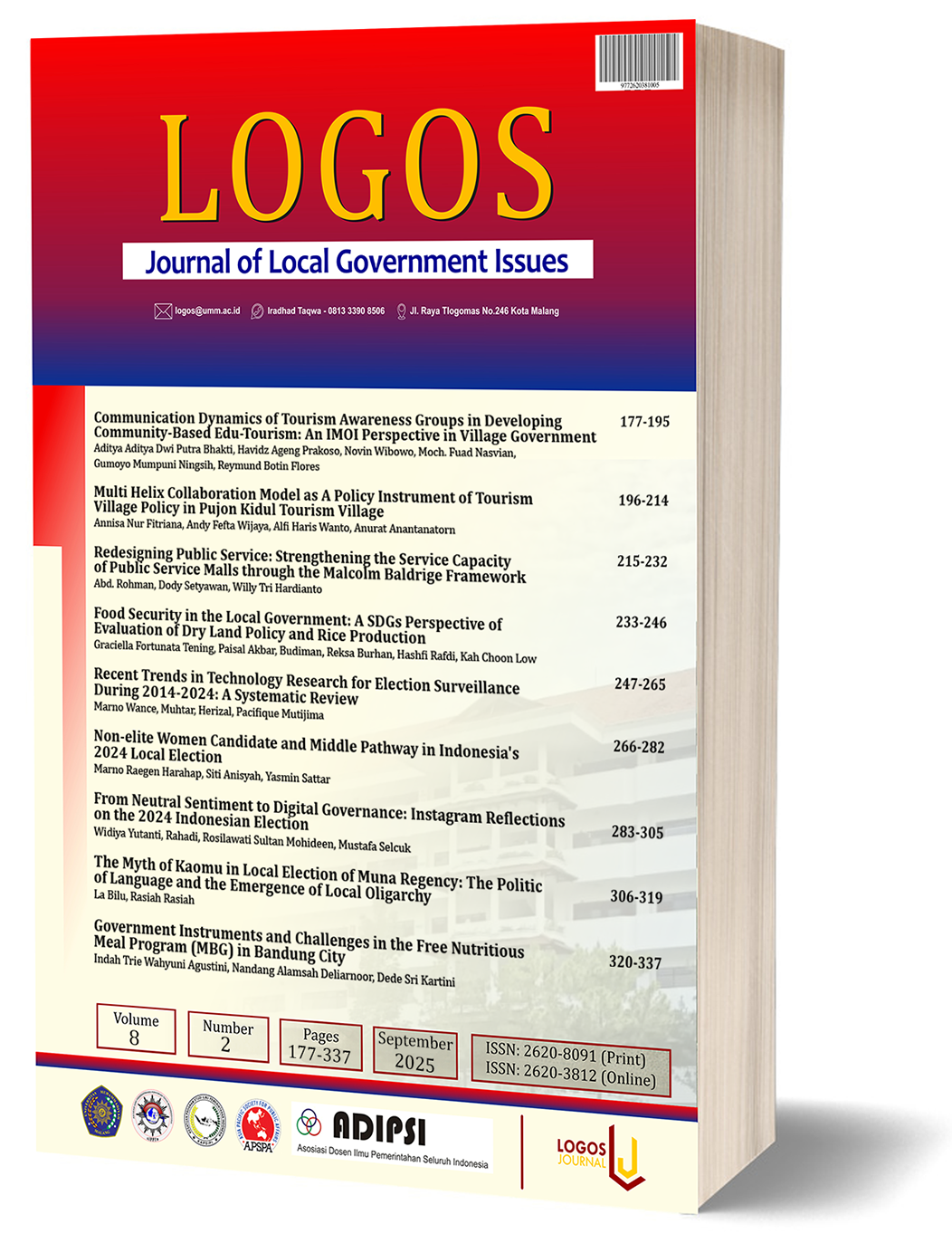
Non-elite Women Candidate and Middle Pathway in Indonesia's 2024 Local Election
DOI:
https://doi.org/10.22219/logos.v8i2.40803Keywords:
digital politics, Local election, middle pathway, non-elite women, ogan ilirAbstract
In Southeast Asia, women's political representation is often explained through dynastic ties or grassroots activism. This article examines non-elite women candidates in the 2024 Legislative Election in Ogan Ilir, Indonesia, using Choi's "middle pathway" framework. In contrast to the dynastic and grassroots paths, the middle path emphasizes the conversion of family reputation, business networks, and social capital into political legitimacy. With a qualitative case study approach, this study shows how non-elite women candidates mobilized their father's philanthropic reputation as a local entrepreneur, transformed a family multipurpose building into a community political center, and used digital strategies to gain the highest votes in their constituencies. These findings broaden the debate about the representation of non-elite women in Indonesia by asserting that electability does not only depend on political dynasties or short-term patronage, but can also be built through political entrepreneurship strategies based on family reputation, economic networks, and candidate tenacity. Thus, the middle path presents an alternative for non-elite women to negotiate political legitimacy in the context of a local democracy that is still patriarchal.
Downloads
Downloads
Published
How to Cite
Issue
Section
License
Copyright (c) 2025 Raegen Harahap, Siti Anisyah, Yasmin Sattar

This work is licensed under a Creative Commons Attribution-ShareAlike 4.0 International License.
Authors who publish with this journal agree to the following terms:
- Authors retain copyright and grant the journal right of first publication with the work simultaneously licensed under a Creative Commons Attribution-ShareAlike 4.0 International License. that allows others to share the work with an acknowledgment of the work's authorship and initial publication in this journal.
- Authors are able to enter into separate, additional contractual arrangements for the non-exclusive distribution of the journal's published version of the work (e.g., post it to an institutional repository or publish it in a book), with an acknowledgment of its initial publication in this journal.
- Authors are permitted and encouraged to post their work online (e.g., in institutional repositories or on their website) prior to and during the submission process, as it can lead to productive exchanges, as well as earlier and greater citation of published work (See The Effect of Open Access).

This work is licensed under a Creative Commons Attribution-ShareAlike 4.0 International License.