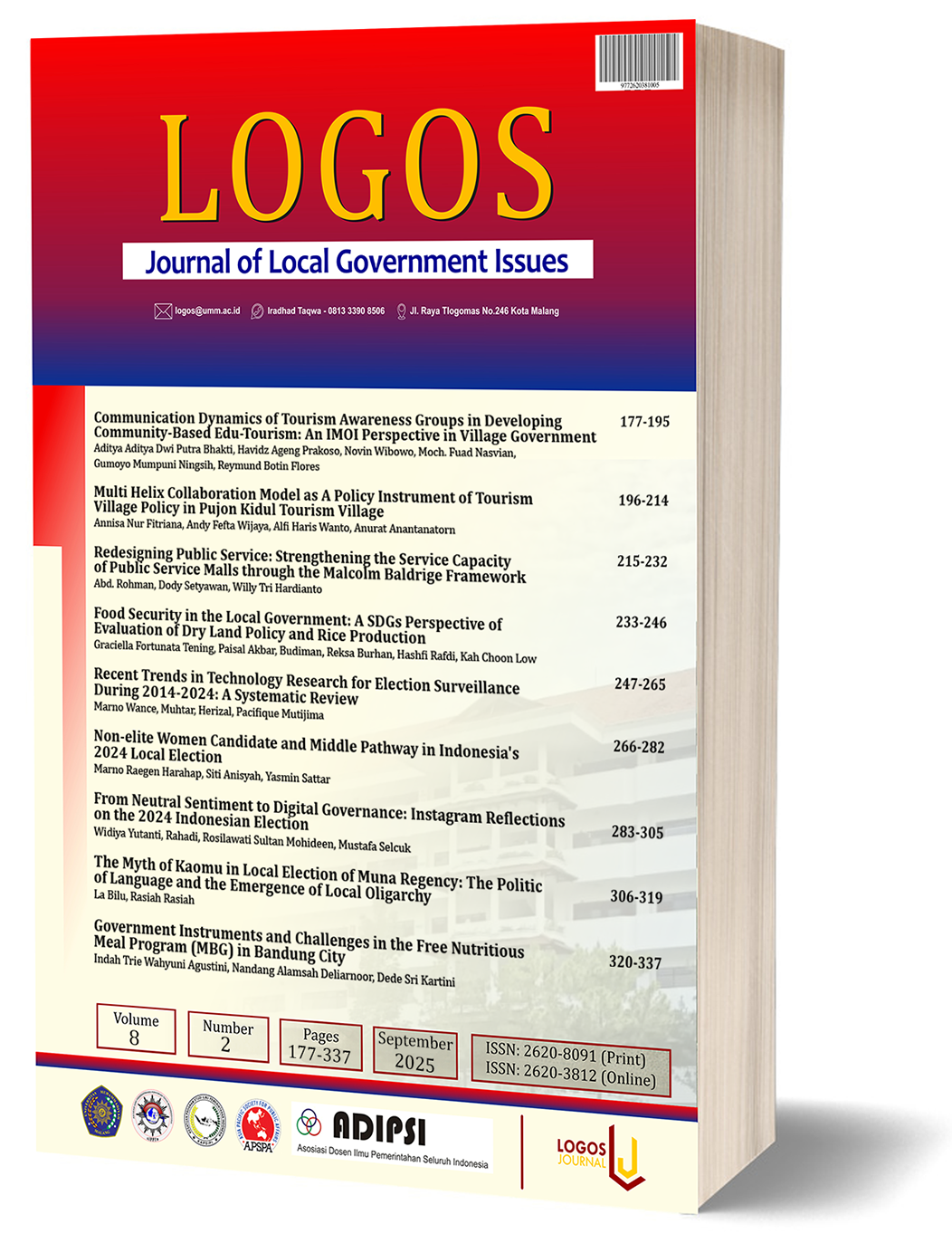
Government Instruments and Challenges in the Free Nutritious Meal Program (MBG) in Bandung City
DOI:
https://doi.org/10.22219/logos.v8i2.41554Keywords:
Bandung city, government instruments, MBG, policy implementationAbstract
This study analyzes government instruments and the challenges in implementing the Free Nutritious Meal Program (MBG) in Bandung City (2024-2025). The program faces several obstacles, including limited budgets, logistical and distribution constraints, low capacity of third-party providers, inadequate facilities and personnel, as well as weak supervision, coordination, socialization, and regulatory uniformity. Using a qualitative case study approach, data were collected through purposive sampling, observation, interviews, documentation, and triangulation, and analyzed using reduction, display, and conclusion-drawing techniques. The analysis applies Hughes’ (2012) framework of government instruments: provision, subsidy, production, and regulation. The findings show that the application of government instruments in the MBG program remains suboptimal. Among the four instruments, only subsidy functions relatively effectively, while provision, production, and regulation are still constrained. To address these challenges, the Bandung City Government is advised to strengthen budget flexibility, cross-sectoral logistics, and processing facilities in priority areas, while improving target mapping, facility audits, hygiene training, food quality monitoring, and standardized technical guidelines.
Downloads
References
Abadi, M. N. P., Basrowi, R. W., Gunawan, W. Ben, Arasy, M. P., Nurjihan, F., Sundjaya, T., Pratiwi, D., Hardinsyah, H., Taslim, N. A., & Nurkolis, F. (2025). Unraveling Future Trends in Free School Lunch and Nutrition: Global Insights for Indonesia from Bibliometric Approach and Critical Review. Nutrients, 17(17), 2777. https://doi.org/10.3390/nu17172777
Affan, I., Kurniawan, A., Serah, Y. A., Siswadi, & Riono, S. B. (2020). Public Service: The Principle of Equality, Neutrality, and Participation. 7(8), 2050–2055.
Albaburrahim, A., Putikadyanto, A. P. A., Efendi, A. N., Alatas, M. A., Romadhon, S., & Wachidah, L. R. (2025). Program Makan Bergizi Gratis: Analisis Kritis Transformasi Pendidikan Indonesia Menuju Generasi Emas 2045. Entita: Jurnal Pendidikan Ilmu Pengetahuan Sosial Dan Ilmu-Ilmu Sosial, 1(2), 767–780. https://doi.org/10.19105/ejpis.v1i.19191
Alderman, H., & Bundy, D. (2012). School Feeding Programs and Development: Are We Framing the Question Correctly? The World Bank Research Observer, 27(2), 204–221. https://doi.org/10.2307/23262830
Andin, A., Risti, D., Latifah, I., Panuntun, M., Nur, M., Selviani, R., & Saptatiningsih, R. I. (2024). Penerapan Nilai Pancasila Melalui Program Makan Bergizi Gratis. Indonesian Journal of Education and Development Research, 3(1), 370–383. https://doi.org/10.57235/ijedr.v3i1.4684
Assefa, E. A. (2025). From nutrition to education: the contributions of school feeding programs on the UN 2030 Agenda and AU 2063 goals. British Food Journal, 1–18. https://doi.org/10.1108/bfj-03-2025-0311
Bandoni, D. H., Ottoni, I. C., de Amorim, A. L. B., & Canella, D. S. (2023). It is time: free meals at schools for all. British Journal of Nutrition, 131(8), 1447–1451. https://doi.org/10.1017/s0007114523002660
Borbely, D., Gehrsitz, M., McIntyre, S., & Rossi, G. (2024). Does the provision of universal free school meals improve school attendance? Economics of Education Review, 103, 102597. https://doi.org/10.1016/j.econedurev.2024.102597
Burhanudin, A. (2025). 21 Ribu Siswa di Kota Bandung Sudah Terlayani MBG. Rri.Co.Id. https://rri.co.id/makan-bergizi-gratis/1251820/21-ribu-siswa-di-kota-bandung-sudah-terlayani-mbg
Campi, M., Dueñas, M., & Fagiolo, G. (2021). Specialization in food production affects global food security and food systems sustainability. World Development, 141, 105411. https://doi.org/10.1016/j.worlddev.2021.105411
Cohen, J. F. W., Verguet, S., Giyose, B., & Bundy, D. A. P. (2023). Universal free school meals: the future of school meal programmes? The Lancet, 9(402), 831-833 https://doi.org/10.1016/s0140-6736(23)01516-7
Fang, J., He, C., & Zhu, S. (2024). From death to birth: Do logistics parks help local renewals in logistics industry? Transport Policy, 158, 148–158. https://doi.org/10.1016/j.tranpol.2024.09.009
Gelli, A., Aurino, E., Folson, G., Arhinful, D., Adamba, C., Osei-Akoto, I., Masset, E., Watkins, K., Fernandes, M., Drake, L., & Alderman, H. (2019). A School Meals Program Implemented at Scale in Ghana Increases Height-for-Age during Midchildhood in Girls and in Children from Poor Households: A Cluster Randomized Trial. The Journal of Nutrition, 149(8), 1434–1442. https://doi.org/https://doi.org/10.1093/jn/nxz079
Grosso, G., Mateo, A., Rangelov, N., Buzeti, T., & Birt, C. (2020). Nutrition in the context of the Sustainable Development Goals. European Journal of Public Health, 30(Suppl_1), i19–i23. https://doi.org/10.1093/eurpub/ckaa034
Guan, H., Zhang, Y., Du, K., Wang, Z., & Shi, Y. (2024). Revisit the one-time subsidies and long-run adoption of health products: Quasi-experimental evidence from providing free eyeglasses in rural China. World Development. https://doi.org/10.1016/j.worlddev.2024.106627
Hegab, H., Shaban, I., Jamil, M., & Khanna, N. (2023). Toward sustainable future: Strategies, indicators, and challenges for implementing sustainable production systems. Sustainable Materials and Technologies, 36, e00617. https://doi.org/10.1016/j.susmat.2023.e00617
Huang, W. (2022). Public service provision with a limited budget: Service design, privatization and subsidies. Computers & Industrial Engineering, 172, 108374. https://doi.org/10.1016/j.cie.2022.108374
Hughes, O. (2012). Public Management & Administration. London: Bloomsbury Plc.
Jaime, P. C., & Lock, K. (2009). Do school based food and nutrition policies improve diet and reduce obesity? Preventive Medicine, 48(1), 45–53. https://doi.org/https://doi.org/10.1016/j.ypmed.2008.10.018
Kaur, R. (2021a). Estimating the impact of school feeding programs: Evidence from mid day meal scheme of India. Economics of Education Review, 84, 102171. https://doi.org/10.1016/j.econedurev.2021.102171
Kaur, R. (2021b). Estimating the impact of school feeding programs: Evidence from mid day meal scheme of India. Economics of Education Review, 84, 102171. https://doi.org/10.1016/j.econedurev.2021.102171
Komara, C. P., Pitriani, S., Sari, D. S., & Yulianti, D. (2025). Program Makan Bergizi Gratis di Tengah Krisis Food Waste. E-Sospol. Electronical Journal of Social and Political Sciences, 12(2), 379–391. https://doi.org/10.19184/e-sospol.v12i2.53789
Krishnan, S., Sytsma, T., & Wischmeyer, P. E. (2024). Addressing the Urgent Need for Clinical Nutrition Education in PostGraduate Medical Training: New Programs and Credentialing. Advances in Nutrition, 15(11), 100321. https://doi.org/10.1016/j.advnut.2024.100321
Kumar, A. (2025). Welfare and income effects of tuition subsidies and public investment in schooling. Economic Modelling, 144, 107001. https://doi.org/10.1016/j.econmod.2024.107001
Laheri, Z., Ferris, I., da Cunha, D. T., & Soon-Sinclair, J. M. (2025). 'Going dark’ or under the radar? Challenges and opportunities for local authorities and dark kitchens in ensuring food safety. Food Control, 172, 111179. https://doi.org/10.1016/j.foodcont.2025.111179
Locke, A., James, M., Jones, H., Davies, R., Williams, F., & Brophy, S. (2025). Impacts of Global School Feeding Programmes on Children’s Health and Wellbeing Outcomes: A Scoping Review. BMJ Open, 15(10), e093244. https://doi.org/10.1136/bmjopen-2024-093244
Maharani, P. A., Namira, A. R., & Chairunnisa, T. V. (2024). Peran Makan Siang Gratis Dalam Janji Kampanye Prabowo Gibran Dan Realisasinya. Journal Of Law And Social Society , 1(1 SE-Articles), 1–10. https://doi.org/10.70656/jolasos.v1i1.79
Martin, A. J., Bostwick, K. C. P., Burns, E. C., Munro-Smith, V., George, T., Kennett, R., & Pearson, J. (2024). A healthy breakfast each and every day is important for students’ motivation and achievement. Journal of School Psychology, 104, 101298. https://doi.org/10.1016/j.jsp.2024.101298
McEwan, P. J. (2013). The impact of Chile’s school feeding program on education outcomes. Economics of Education Review, 32, 122–139. https://doi.org/10.1016/j.econedurev.2012.08.006
Mehr, A. S., Abdellahi, E., Gandomani, S. J., & Ghahar, S. H. (2024). Analysis of The Effects of Government Policies on Reducing Social and Economic Inequalities. 1(2), 69–79. https://doi.org/10.63053/ijmea.13
Miles, M. B., Huberman, A. M., & Saldaña, J. (2014). Qualitative data analysis: A methods sourcebook (3rd ed.). Thousand Oaks, CA: Sage Publications.
Nurcahyo, A. T. (2025). Dukung Makan Bergizi Gratis, Pemkot Bandung Butuh 12 Dapur Lagi dan Bentuk Pokja Kawal Pelaksanaan.https://prfmnews.pikiran-rakyat.com/bandung-raya/pr-138967283/dukung-makan-bergizi-gratis-pemkot-bandung-butuh-12-dapur-lagi-dan-bentuk-pokja-kawal-pelaksanaan?page=all
Park, J., & Chung, E. (2021). Learning from past pandemic governance: Early response and Public-Private Partnerships in testing of COVID-19 in South Korea. World Development, 137, 105198. https://doi.org/10.1016/j.worlddev.2020.105198
Peters, B. G. (2000). Policy Instruments and Public Management: Bridging the Gaps. Journal of Public Administration Research and Theory, 10, 35–47. https://www.jstor.org/stable/3525810
Purwanto, E. A., & Pramusinto, A. (2018). Decentralization and functional assignment in Indonesia: the case of health and education services. Policy Studies, 39(6), 589–606. https://doi.org/10.1080/01442872.2018.1530413
Rassanjani, S., & Rahmi, I. (2025). Free School Meals Policy: Lessons Learned from Around the World for Indonesia. Jurnal Ilmu Sosial, 24(1), 1–28. https://doi.org/10.14710/jis.24.1.2025.1-28
Saptani, R. (2025). Pemerintah Salurkan Makan Bergizi Gratis (MBG), Ini Sasaran Utama Penerimanya. Mediakeuangan.Kemenkeu.Go.Id. https://mediakeuangan.kemenkeu.go.id/article/show/pemerintah-salurkan-makan-bergizi-gratis-mbg-ini-sasaran-utama-penerimanya
Silva, E. A. da, Pedrozo, E. A., & Silva, T. N. da. (2023). National School Feeding Program (PNAE): A Public Policy That Promotes a Learning Framework and a More Sustainable Food System in Rio Grande do Sul, Brazil. Foods, 12(19), 3622. https://doi.org/10.3390/foods12193622
Silva, J. M. da, Delgrossi, M. E., & Pantoja, M. J. (2023). Food quality perceptions and agreements: Case of local purchases from family farmers for school feeding program in the Federal District of Brazil. Journal of Rural Studies, 101, 103069. https://doi.org/10.1016/j.jrurstud.2023.103069
Silva, L., Malcolm, A., Cooklin Urbano, S., Couzens, L., Clark, E., & Dyakova, M. (2023). Impact of universal free school meals on health and equity: international policy scoping review. European Journal of Public Health, 33(Supplement_2). https://doi.org/10.1093/eurpub/ckad160.1085
Sukmawati, S., Hermayanti, Y., Fadlyana, E., Maulana, I., & Mediani, H. S. (2025). Health cadres’ experiences in detecting and preventing childhood stunting in Indonesia: a qualitative study. BMC Public Health, 25(1). https://doi.org/10.1186/s12889-025-24192-z
Tan, P. Y., Chan, C. L., Som, S. V., Dye, L., Moore, J. B., Caton, S. J., & Gong, Y. Y. (2024). Prevalence and key determinants of the triple burden of childhood malnutrition in Southeast Asian countries: a systematic review and meta-analysis within an adapted socio-ecological framework. Critical Reviews in Food Science and Nutrition, 1–15. https://doi.org/10.1080/10408398.2024.2419539
Taylor, C. M., Gallagher, E. A., Pollard, S. J. T., Rocks, S. A., Smith, H. M., Leinster, P., & Angus, A. J. (2019). Environmental regulation in transition: Policy officials’ views of regulatory instruments and their mapping to environmental risks. Science of The Total Environment, 646, 811–820. https://doi.org/10.1016/j.scitotenv.2018.07.217
Utami, M. M. (2023). Efektivitas Program Makan Siang Sekolah Dalam Menumbuhkan Nilai Karakter Anak di SDIT Bina Anak Sholeh (Bias) Giwangan Yogyakarta. Skripsi; Universitas Negeri Yogyakarta. https://eprints.uny.ac.id/30137/
Wang, D., Shinde, S., Young, T., & Fawzi, W. W. (2021). Impacts of school feeding on educational and health outcomes of school-age children and adolescents in low- and middle-income countries: A systematic review and meta-analysis. Journal of Global Health, 11, 4051. https://doi.org/10.7189/jogh.11.04051
Zhou, Y., Ren, J., & Zheng, X. (2024). Feeding for a brighter future: The long-term labor market consequences of school meals in rural China. Economics & Human Biology, 52, 101335. https://doi.org/10.1016/j.ehb.2023.101335
Downloads
Published
How to Cite
Issue
Section
License
Copyright (c) 2025 Indah Trie Wahyuni Agustini, Nandang Alamsah Deliarnoor, Dede Sri Kartini

This work is licensed under a Creative Commons Attribution-ShareAlike 4.0 International License.
Authors who publish with this journal agree to the following terms:
- Authors retain copyright and grant the journal right of first publication with the work simultaneously licensed under a Creative Commons Attribution-ShareAlike 4.0 International License. that allows others to share the work with an acknowledgment of the work's authorship and initial publication in this journal.
- Authors are able to enter into separate, additional contractual arrangements for the non-exclusive distribution of the journal's published version of the work (e.g., post it to an institutional repository or publish it in a book), with an acknowledgment of its initial publication in this journal.
- Authors are permitted and encouraged to post their work online (e.g., in institutional repositories or on their website) prior to and during the submission process, as it can lead to productive exchanges, as well as earlier and greater citation of published work (See The Effect of Open Access).

This work is licensed under a Creative Commons Attribution-ShareAlike 4.0 International License.