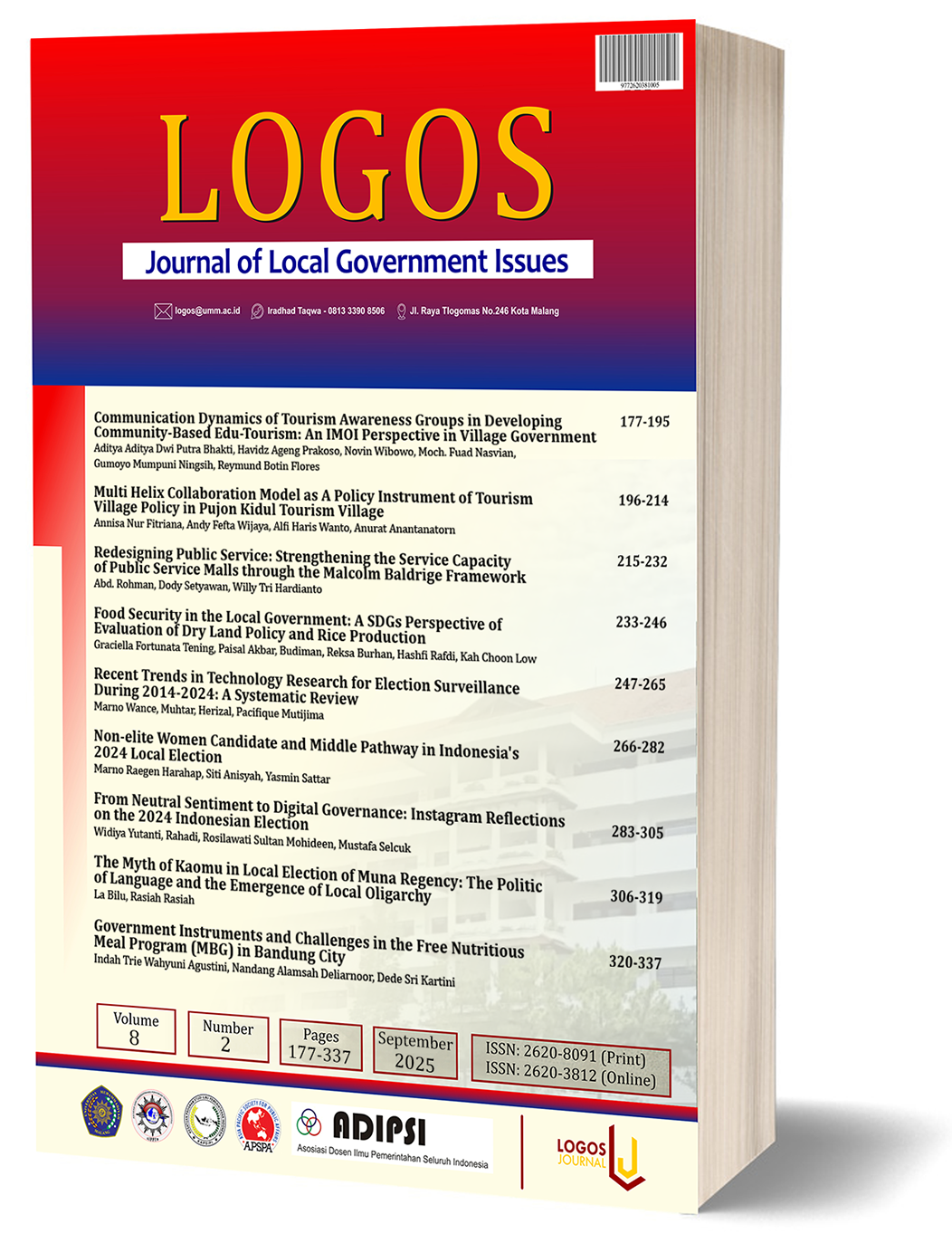
From Neutral Sentiment to Digital Governance: Instagram Reflections on the 2024 Indonesian Election
DOI:
https://doi.org/10.22219/logos.v8i2.41840Keywords:
presidential election, sentiment analysis, support vector machinesAbstract
This study aims to describe how sentiment on tempo.co Instagram after the announcement of the winner of the presidential election by the General Election Committee (KPU). Presidential and Vice-Presidential elections are one of the important moments in the political life of a country. Data was collected from Instagram posts on tempo.co from March to April 2024. This research uses a sentiment classification method using Support Vector Machines (SVM) and classifies into three categories, namely: positive, neutral and negative. The analysis was conducted by describing the phrases that appeared specifically related to the couple. The results showed that comments on the @tempodotco Instagram account related to the news about Prabowo-Gibran, Ganjar Pranowo-Mahfud MD, Anies Baswedan-Muhaimin Iskandar, neutral sentiments tend to be higher than positive and negative sentiments. This suggests that the dominance of neutral sentiments in social media comments reflects the complex dynamics of digital interaction, where audiences collectively choose a moderate tone to avoid conflict. Comments that are positive or negative often come from a particular camp of supporters, while neutral comments reflect the voices of audiences trying to take a moderate position. Neutral audiences are often the silent majority who do not engage in violent discussions but still play a role in shaping opinions collectively.
Downloads
References
Abdullah, N. A. S., & Rusli, N. I. A. (2021). Multilingual Sentiment Analysis: A Systematic Literature Review. Pertanika Journal of Science and Technology, 29(1). https://doi.org/10.47836/pjst.29.1.25
Anggara, A., Widiono, S., Tri Hidayat, A., & Sutarman, S. (2022). Analysis of Netizen Comments Sentiment on Public Official Statements on Instagram Social Media Accounts. International Journal of Advances in Data and Information Systems, 3(2), 87–97. https://doi.org/10.25008/ijadis.v3i2.1244
Barisione, M., Michailidou, A., & Airoldi, M. (2019). Understanding a digital movement of opinion: the case of #RefugeesWelcome. Information Communication and Society, 22(8). https://doi.org/10.1080/1369118X.2017.1410204
Belcastro, L., Branda, F., Cantini, R., Marozzo, F., Talia, D., & Trunfio, P. (2022). Analyzing Voter Behavior on Social Media During the 2020 US Presidential Election Campaign. Social Network Analysis and Mining, 12(1). https://doi.org/10.1007/s13278-022-00913-9
BUNTORO, G. A., ARIFIN, R., SYAIFUDDIIN, G. N., SELAMAT, A., KREJCAR, O., & FUJITA, H. (2021). Implementation of a Machine Learning Algorithm for Sentiment Analysis of Indonesia‘s 2019 Presidential Election. IIUM Engineering Journal, 22(1), 78–92. https://doi.org/10.31436/IIUMEJ.V22I1.1532
Ceron, Andrea, Curini, Luigi, Iacus, Stefano M, & Porro, Giuseppe. (2013). Every tweet counts? How sentiment analysis of social media can improve our knowledge of citizens’ political preferences with an application to Italy and France. New Media & Society, 16(2), 340–358. https://doi.org/10.1177/1461444813480466
Chai, C. P. (2022). Comparison of Text Preprocessing Methods. Natural Language Engineering, 29(3), 509–553. https://doi.org/10.1017/s1351324922000213
Danaditya, A., Ng, L. H. X., & Carley, K. M. (2022). From curious hashtags to polarized effect: profiling coordinated actions in indonesian twitter discourse. Social Network Analysis and Mining, 12, 1–13. https://doi.org/10.48550/arXiv.2207.07937
de-Lima-Santos, M.-F., Gonçalves, I., Quiles, M. G., Mesquita, L., Ceron, W., & Lorena, M. (2024). Visual political communication on Instagram: a comparative study of Brazilian presidential elections. EPJ Data Science, 13(1). https://doi.org/10.1140/epjds/s13688-024-00502-0
de Oliveira Fornasier, M., & Borges, G. S. (2022). The current influence of social media on democratic debate, political parties and electioneering. Revista de Investigações Constitucionais, 9(1), 73-91. https://doi.org/10.5380/rinc.v9i1.83460
Dommett, K., Mensah, S., Zhu, J., & Stafford, T. (2024). Understanding the communicative strategies used in online political advertising and how the public views them. The British Journal of Politics and International Relations. https://doi.org/10.1177/13691481241287177
Ennser-Jedenastik, L., Gahn, C., Gahn, C., Bodlos, A., & Haselmayer, M. (2021). Does social media enhance party responsiveness? How user engagement shapes parties’ issue attention on Facebook. Party Politics, 135406882098533. https://doi.org/10.1177/1354068820985334
Febrianto, A., & Purnamasari, D. (2023). Analysis Instagram Content In The Political Communication Strategies Of The 2024 Indonesia Presidential Candidates. Sociae Polites, 24(2), 47–65. https://doi.org/10.33541/sp.v24i2.5403
Follert, M. (2021). The Silent Majority, Populism and the Shadow Sides of Democracy. Constellations, 28(4), 455–465. https://doi.org/10.1111/1467-8675.12587
Gayatri, S., & Satwika, I. B. C. (2022). Peran Media Sosial Sebagai Media Sarana Informasi Politik. Anubhava Jurnal Ilmu Komunikasi Hindu, 2(1), 273–282. https://doi.org/10.25078/anubhava.v2i1.1050
Gherghina, S., & Țap, P. (2022). Buying Loyalty: Volatile Voters and Electoral Clientelism. Politics, 44(4), 670–687. https://doi.org/10.1177/02633957221132707
Gidron, N. (2020). Many Ways to Be Right: Cross-Pressured Voters in Western Europe. British Journal of Political Science, 52(1), 146–161. https://doi.org/10.1017/s0007123420000228
Gómez-García, S., Zamora, R., & Berrocal, S. (2023). New Frontiers for Political Communication in Times of Spectacularization. Media and Communication, 11(2), 109–112. https://doi.org/10.17645/mac.v11i2.7069
Haßler, J., Wurst, A.-K., & Pohl, K. (2023). Politicians over issues? Visual personalization in three Instagram election campaigns. Information, Communication & Society, 1–21. https://doi.org/10.1080/1369118x.2023.2227684
Hidayaturrahman, M., Purwanto, E., Sinaga, A. B., Ubaid, A. H., Wardhani, W. K., & Sugiantiningsih, A. A. P. (2024). Public Expectations Towards the Roles of the Indonesian House of Representatives. Jurnal Studi Komunikasi 8(1), 183–194. https://doi.org/10.25139/jsk.v8i1.7432
Ivanusch, C. (2024). Where do parties talk about what? Party issue salience across communication channels. West European Politics. https://doi.org/10.1080/01402382.2024.2322234
Kurniasih, E., & Setianti, Y. (2024). Strategi Personal Branding Anies Baswedan Dalam Membangun Komunikasi Politik Melalui Instagram. Ekspresi Dan Persepsi Jurnal Ilmu Komunikasi, 7(1), 123–140. https://doi.org/10.33822/jep.v7i1.6074
Kurniawan, F., & Mutiah, T. (2023). Menentukan Capres Dan Cawapres 2024 Melalui Penggunaan Media Sosial. Global Komunika Jurnal Ilmu Sosial Dan Ilmu Politik, 5(2), 65–73. https://doi.org/10.33822/gk.v5i2.5091
Majid, N. (2023). Strategi Komunikasi Politik Dalam Pemilihan Umum Di Era Digital. 1(2), 53–61. https://doi.org/10.62238/perseptifjurnalilmusosialdanhumaniora.v1i2.34
Medhat, W., Hassan, A., & Korashy, H. (2014). Sentiment analysis algorithms and applications: A survey. Ain Shams Engineering Journal, 5(4), 1093–1113. https://doi.org/10.1016/j.asej.2014.04.011
Moslehpour, M., Schafferer, C., Lewi, S., Kurniawati, D., Pham, V. K., & pour faez, S. E. (2024). The Influence of Social Media Marketing on Voting Intention in Indonesia. Journal of Political Marketing. https://doi.org/10.1080/15377857.2024.2303509
Muzahid Akbar Hayat, Sjaiful Jayadiningrat, Gunawan Wibisono, & Muhammad Iwu Iyansyah. (2021). Peran Media Sosial Dalam Komunikasi Politik. Jurnal Indonesia Sosial Teknologi, 2(1), 104–114. https://doi.org/10.36418/jist.v2i1.61
Norris, P. (2011). Democratic Deficit: Critical Citizens Revisited. Cambridge: Cambridge University Press. https://doi.org/DOI: 10.1017/CBO9780511973383
OLINDER, N., TSVETKOV, A., FEDYAKIN, K., & ZABURDAEVA, K. (2020). Using Digital Footprints in Social Research: an Interdisciplinary Approach. WISDOM, 16, 124–135. https://doi.org/10.24234/wisdom.v16i3.403
Pang, B., & Lee, L. (2008). Opinion Mining and Sentiment Analysis. Foundations and Trends® in Information Retrieval, 2(12).https://doi.org/10.1561/1500000011
Papacharissi, Z. (2014). Affective Publics: Sentiment, Technology, and Politics. Oxford University Press. https://doi.org/10.1093/acprof:oso/9780199999736.001.0001
Prihatini, E. S. (2020). Women and social media during legislative elections in Indonesia. Women’s Studies International Forum, 83. https://doi.org/10.1016/j.wsif.2020.102417
Putra, T. R., & Nurcholis, A. (2021). Pengaruh Media Sosial Terhadap Partisipasi Pemilih Pemula Pada Pemilihan Presiden 2019: Studi Pada Mahasiswa FISIPOL UGM. Jurnal Polgov, 2(1), 193–222. https://doi.org/10.22146/polgov.v2i1.1372
Putri, R. L., Amrulloh, M. C., Gunawan, A., Sunandes, A., & Yanti, D. A. W. (2023). Cyber Politic as a New Perspective for People in Surabaya in Understanding Politics in the Digital Age. Kne Social Sciences. https://doi.org/10.18502/kss.v8i9.13356
Ramadhani, R. W., Rakhman, F. R., Kuncoroyakti, Y. A., Utami, S. R., & Pertiwi, C. A. (2023). Gerakan Opini Digital pada #TolakUUCiptaKerja di Twitter dengan Pendekatan Social Network Analysis. WACANA: Jurnal Ilmiah Ilmu Komunikasi, 22(2), 190–200. https://doi.org/10.32509/wacana.v22i2.2609
Ravi, K., & Ravi, V. (2015). A survey on opinion mining and sentiment analysis: Tasks, approaches and applications. Knowledge-Based Systems, 89, 14–46. https://doi.org/10.1016/j.knosys.2015.06.015
Riski, Nurmandi, A., Younus, M., & Suardi, W. (2025). A Scientometric Review of Social Media in Shaping 2 Public Policy: Patterns, Themes, and Future Directions. Journal of Local Government Issues, 8(1), 34–51. https://doi.org/10.22219/logos.v8i1.38239
Robison, J. (2022). Valuing Politics: Explaining Citizen’s Normative Conceptions of Citizenship. Political Behavior, 45(4), 1447–1466. https://doi.org/10.1007/s11109-022-09773-7
Selvey, L., Carpenter, M., Lazarou, M., & Cullerton, K. (2022). Communicating About Energy Policy in a Resource-Rich Jurisdiction During the Climate Crisis: Lessons From the People of Brisbane, Queensland, Australia. International Journal of Environmental Research and Public Health, 19(8), 4635. https://doi.org/10.3390/ijerph19084635
Steffan, D., & Venema, N. (2020). New Medium, Old Strategies? Comparing Online and Traditional Campaign Posters for German Bundestag Elections, 2013–2017. European Journal of Communication, 35(4), 370–388. https://doi.org/10.1177/0267323120903681
Subekti, D., Yusuf, M., Saadah, M., & Wahid, M. (2025). Social media and disinformation for candidates: the evidence in the 2024 Indonesian presidential election. Frontiers in Political Science, 7. https://doi.org/10.3389/fpos.2025.1625535
Susilowati, T., Rahmanto, A. N., & Pawito, P. (2024). Digital Storytelling in Political Marketing Communication Ganjar Pranowo and Anies Baswedan on Instagram Leading Up to the 2024 Presidential Election. Formosa Journal of Social Sciences (Fjss), 3(1), 45–60. https://doi.org/10.55927/fjss.v3i1.7680
Tretyakov, E., Savić, D., Korpusenko, A., & Ionkina, K. (2022). Sentiment Analysis of Social Networks Messages, 552–560. https://doi.org/10.1007/978-3-030-96993-6_61
Tumasjan, A., Spenger, T. O., Sandner, P. G., & Welpe, I. M. (2010). Predicting Elections with Twitter: What 140 Characters Reveal about Political Sentiment Andranik. Anuario Filosofico, 4(1), 178–185. https://doi.org/10.1609/icwsm.v4i1.14009
Ulya, H., & Indainanto, Y. I. (2024). Mobilisasi Gerakan Opini Digital #TolakRUUKesehatan di Media Sosial. Jurnal Communio : Jurnal Jurusan Ilmu Komunikasi, 13(1), 146–156. https://doi.org/10.35508/jikom.v13i1.9296
Wijayanto, W., Wijayanto, W., Sastramidjaja, Y., & Ruijgrok, K. (2024). The Infrastructure of Domestic Influence Operations: Cyber Troops and Public Opinion Manipulation Through Social Media in Indonesia. The International Journal of Press/Politics. https://doi.org/10.1177/19401612241297832
Downloads
Published
How to Cite
Issue
Section
License
Copyright (c) 2025 Rahadi Rahadi, Widia Yutanti, Rosilawati Sultan Mohideen, Mustafa Selcuk

This work is licensed under a Creative Commons Attribution-ShareAlike 4.0 International License.
Authors who publish with this journal agree to the following terms:
- Authors retain copyright and grant the journal right of first publication with the work simultaneously licensed under a Creative Commons Attribution-ShareAlike 4.0 International License. that allows others to share the work with an acknowledgment of the work's authorship and initial publication in this journal.
- Authors are able to enter into separate, additional contractual arrangements for the non-exclusive distribution of the journal's published version of the work (e.g., post it to an institutional repository or publish it in a book), with an acknowledgment of its initial publication in this journal.
- Authors are permitted and encouraged to post their work online (e.g., in institutional repositories or on their website) prior to and during the submission process, as it can lead to productive exchanges, as well as earlier and greater citation of published work (See The Effect of Open Access).

This work is licensed under a Creative Commons Attribution-ShareAlike 4.0 International License.