
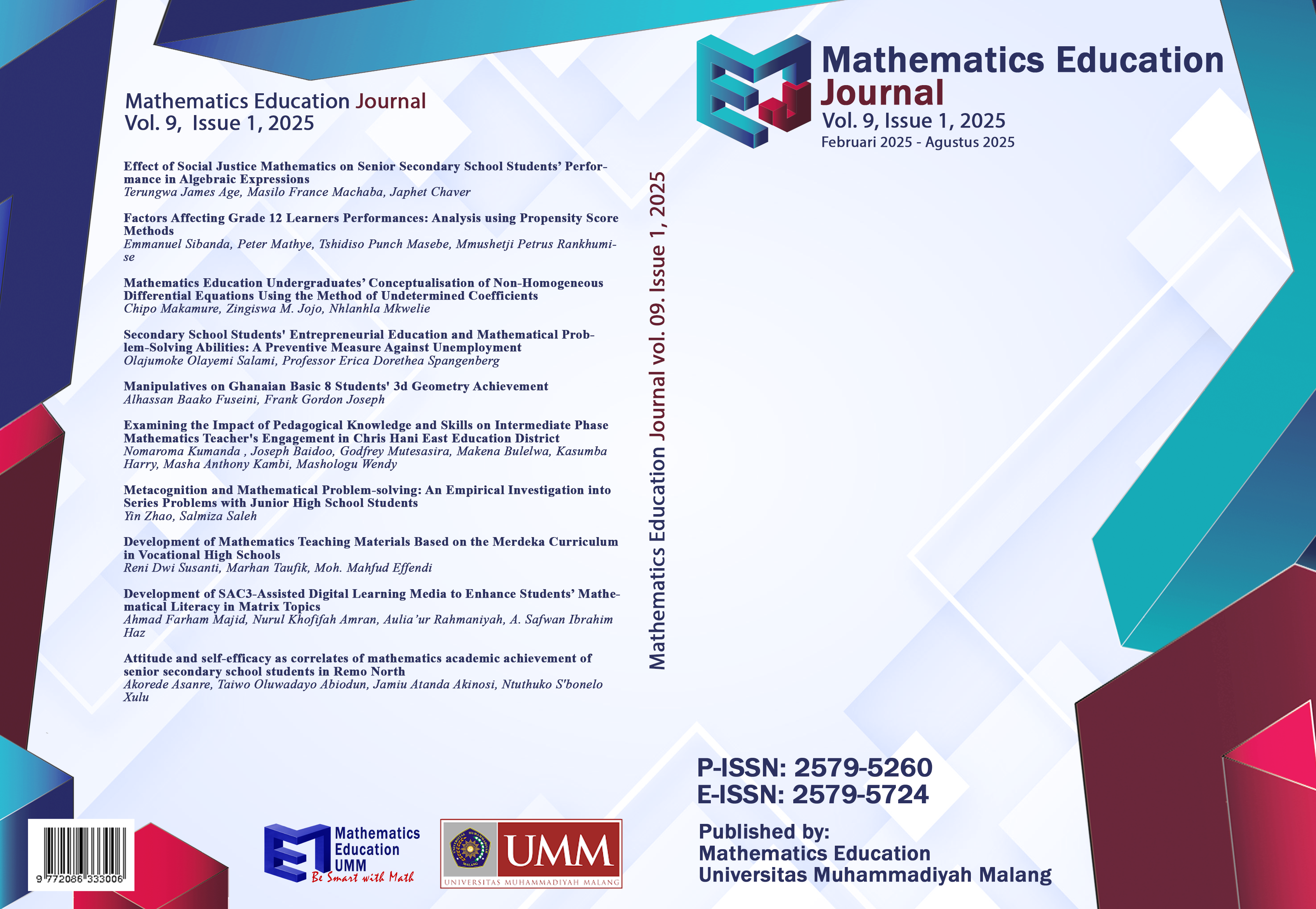
Mathematics Education Undergraduates’ Conceptualisation of Non-Homogeneous Differential Equations Using the Method of Undetermined Coefficients
DOI:
https://doi.org/10.22219/mej.v9i1.36757Abstract
The topic of ordinary differential equations (ODEs) is widely covered in higher education institutions, however, understanding non-homogeneous differential equations (NHDEs) poses challenges for students due to its complexity. Limited research in second order NHDEs points to the need for more studies on students’ conceptions and understanding of this topic and its basic concepts. This study delved into the conceptualisation of second order NHDEs and their solutions using the method of undetermined coefficients among Bachelor of Science in Education Mathematics student teachers. Employing the APOS Theory, an in-depth test on NHDE was administered to 60 participants from a university in Zimbabwe to identify their underlying challenges. The study revealed that student teachers encountered difficulties in determining general solutions for NHDEs using the method of undetermined coefficients, largely due to insufficient knowledge of basic ODEs concepts such as differentiation of exponentials, trigonometric ratios, solving quadratic equations, and algebraic skills. The findings indicated that the participants primarily utilised reasoning associated with APOS ‘action’ and less of ‘process’, hindering their engagement with higher-level concepts of solving NHDEs. Consequently, enhancing student teachers’ performance and retention in NHDEs classes therefore requires inventive approaches to instruction.
Downloads
References
Aisha, B, Zamri, S.N.S., Abedalaziz, N.A.M., Ahmad, M., Satti, U. (2017). Factors Affecting Differential Equation Problem Solving Ability Of Students At Pre-University Level: A Conceptual Model. Malaysian Online Journal of Educational Sciences, 5(4), 13-24.
Arficho, D. (2015). Method for Solving Particular Solution of Linear Second Order Ordinary Differential Equations. J Appl Computat Math 4: 210. doi:10.4172/2168-9679.1000210.
Arslan, S. (2010). Traditional instruction of differential equations and conceptual learning. Teaching Mathematics and its Applications: An International Journal of the IMA, 29(2), 94-107. https://doi.org/10.1093/teamat/hrq001.
Arslan, S. (2010). Do students really understand what an ordinary differential equation is?, International Journal of Mathematical Education in Science and Technology, 41:7, 873-888, DOI: 10.1080/0020739X.2010.486448
Boyce, W. E., & DiPrima, R. C. (2012). Elementary Differential Equations and Boundary Value Problems (10th ed). New York: John Willey & Sons.
Boyce, W.E. & Diprima, R.C. (2012). Elementary Differential Equations and Boundary Value Problems (9th edition). John Wiley & Sons, Inc, USA.
Chikwanha, P. (2021). Exploring students' understanding of first order differential equations: A case of a High School in Mudzi District. https://www.academia.edu/93301513/Exploring_students_understanding_of_first_order_differential_equations_A_case_of_a_High_School_in_Mudzi_District#:~:text=Exploring%20students%27%20understanding%20of%20first%20order%20differential%20equations%3A%20A%20case%20of%20a%20High%20School%20in%20Mudzi%20District.
Dubinsky, E. (1991). Reflective Abstraction in Advanced Mathematical Thinking. In D.O. Tall (Ed.), Advanced Mathematical Thinking (pp.95-123). Kluwer: Dordrecht
Dubinsky, E., Weller, K., McDonald, M.A. et al. (2005). Some Historical Issues and Paradoxes Regarding the Concept of Infinity: An Apos Analysis: Part 2. Educ Stud Math 60, 253–266 https://doi.org/10.1007/s10649-005-0473-0.
Dubinsky, E.D & Tall, D. (1991). Advanced Mathematical Thinking and the Computer, In Tall D. O. (ed.), Advanced Mathematical Thinking, Kluwer: Holland, 231–248 (1991). http://doi.org/10.1007/0-306-47203-1_14.
Dubinsky, E.D. (1991). Reflective Abstraction in Advanced Mathematical Thinking. In Tall D. O. (ed.), Advanced Mathematical Thinking, Kluwer: Holland. http://doi.org/10.1007/0-306-47203-1_7
Dubinsky, E.D., Mcdonald, M.A. (2001). APOS: A Constructivist Theory of Learning in Undergraduate Mathematics Education Research. In: Holton, D., Artigue, M., Kirchgräber, U., Hillel, J., Niss, M., Schoenfeld, A. (eds) The Teaching and Learning of Mathematics at University Level. New ICMI Study Series, vol 7. Springer, Dordrecht. https://doi.org/10.1007/0-306-47231-7_25.
Farlina, E., Rachmawati, T. K., Ariany, R. L., Widiastuti, T. T. A., & Sobarningsih, N. (2018). Ordinary differential equations: Students’ difficulty in solve the algorithm of the initial value problem with the integrating factor method. IOP Conference Series: Materials Science and Engineering, 434, 012010.
Holzner, S. (2008). Differential Equations For Dummies, Wiley Publishing, Canada.
Jones, K. (2002). “Issues in the teaching and learning of geometry”, In L. Haggarty (Ed.), Aspects of Teaching Secondary School Mathematics: Perspectives on Practice, pp. 121-139. London: Routledge Falmer. https://doi.org/10.1002/tl.62. Research in Education and Science (IJRES), 2(1), 125- 135.
Kreyszig, E., Kreyszig, H., & Norminton, E. J. (2011). Advanced Engineering Mathematics. USA: John Wiley & Sons.
Legutko, M. (2008). An analysis of students’ mathematical errors in the teaching-research process, In B. Czarnocha (Ed.), Handbook for mathematics teaching: Teacher experiment, A tool for research, pp. 141–152, University of Rzeszόw, Poland.
Luneta, K., & Makonye, P. J. (2010). Learner errors and misconceptions in elementary analysis: A case study of a grade 12 class in South Africa. Acta Didactica Napocensia, 3(3), 35-46.
Maat, S. M., & Zakaria, E. (2011). Exploring students’ understanding of ordinary differential equations using computer algebraic system (CAS). The Turkish Online Journal of Educational Technology, 10(3), 123-128.
Makamure, C., & Jojo, Z.M.M. (2022). An analysis of errors for pre-service teachers in first order ordinary differential equations. EURASIA Journal of Mathematics, Science and Technology Education, 18(6), 1-11. https://doi.org/10.29333/ejmste/12074
Makonye, P. J. (2016). Mathematics learner error analysis protocol. In Proceedings of the Association for Mathematics Education of South Africa (pp. 314-323).
McDonald, G.S. (2004). Differential Equations, Bernoulli Equations, A Tutorial Module for learning how to solve Bernoulli differential equations, 2004, [email protected].
Mudrikah, A. (2016). Problem-based learning associated by action-process-object-schema (APOS) D. Abrahamson, M.J. Nathan, C. Williams-Pierce, C. Walkington, E.R. Ottmar, H.
Ningsih, Y. L., & Rohana. (2018). Pemahaman Mahasiswa Terhadap Persamaan Diferensial Biasa Berdasarkan Teori APOS. JPPM, 11(1), 168-176.
Nykamp, D. Q, (2015). An introduction to ordinary differential equations. Math Insight. http://mathinsight.org/ordinary_differential_equation_introduction.
Prawoto, B., Hartono, S., & Fardah, D. (2018). Prospective teachers' difficulties in second order linear differential equation: A case of constructing methods in solving a non-homogeneous problem. IOP Conf. Series 1108, 012002, 1-5.
Rasmussen, C & Whitehead, K (2003). Learning and Teaching Ordinary Differential Equations. In A. Selden (Eds.), MAA Online Research Sampler. (http://www.maa.org/t_and_l/sampler/rs_7.html)
Russell, M. & Masters, J. (2009). Formative diagnostic assessment in algebra and geometry, American Education Research Association Conference.
Soto and M.W. Alibali, “The Future of Embodied Design for Mathematics Teaching and Learning”, Frontiers in Education, vol. 5, no. 147, 2020. https://doi.org/10.3389/feduc.2020.00147
Tsoularis, A. (2021). On Some Important Ordinary Differential Equations of Dynamic Economics. In Eds Carpentieri, B. ( ). Recent Developments in the solution of Nonlinear Equations. https://doi.org/10.5772/intechopen.97130.
Tsoularis, A. (2021). On Some Important Ordinary Differential Equations of Dynamic Economics. IntechOpen. https://doi.org/10.5772/intechopen.97130.
Zill, D.G (2013). A First Course in Differential Equations with Modeling Applications, Richard Stratton, Boston.
Zill, D.G. (2018). Advanced Engineering Mathematics (6th ed), Jones & Bartlett Learning, Burlington.
Downloads
Published
Issue
Section
License
Copyright (c) 2025 Chipo Makamure, Zingiswa M. Jojo, Nhlanhla Mkwelie

This work is licensed under a Creative Commons Attribution-ShareAlike 4.0 International License.
Authors who publish with MEJ (Mathematics Education Journal) agree to the following terms:
For all articles published in MEJ, copyright is retained by the authors. Authors give permission to the publisher to announce the work with conditions. When the manuscript is accepted for publication, the authors agree to automatic transfer of the publishing right to the publisher.
Authors retain copyright and grant the journal right of first publication with the work simultaneously licensed under a Creative Commons Attribution-ShareAlike 4.0 International License that allows others to share the work with an acknowledgment of the work's authorship and initial publication in this journal.
Authors are able to enter into separate, additional contractual arrangements for the non-exclusive distribution of the journal's published version of the work (e.g., post it to an institutional repository or publish it in a book), with an acknowledgment of its initial publication in this journal.
Authors are permitted and encouraged to post their work online (e.g., in institutional repositories or on their website) prior to and during the submission process, as it can lead to productive exchanges, as well as earlier and greater citation of published work (See The Effect of Open Access).

This work is licensed under a Creative Commons Attribution-ShareAlike 4.0 International License.


