
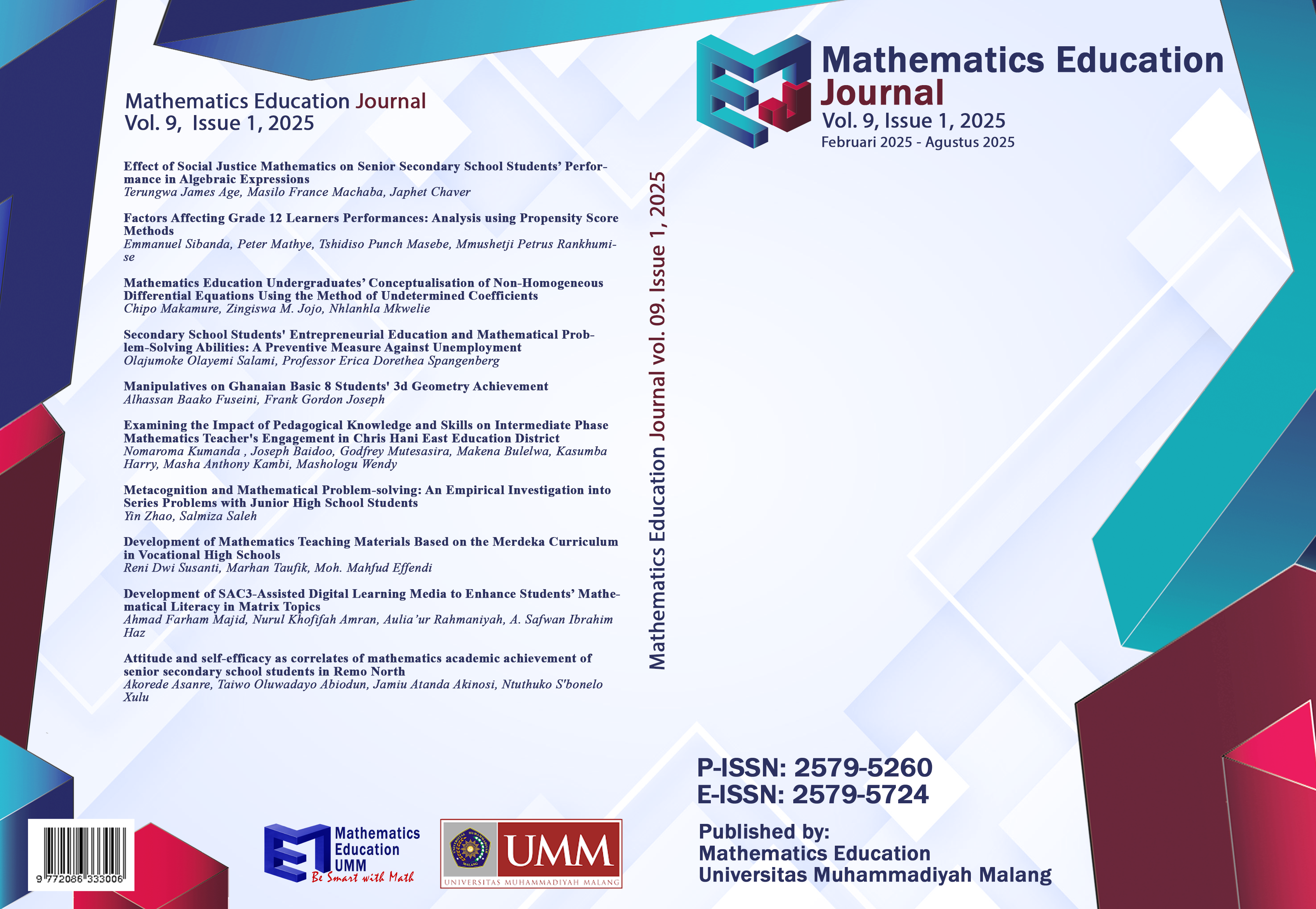
Secondary School Students' Entrepreneurial Education and Mathematical Problem-Solving Abilities: A Preventive Measure Against Unemployment
DOI:
https://doi.org/10.22219/mej.v9i1.36803Abstract
This study investigated problem solving skills and entrepreneurship education among secondary school students: an antidote for unemployment in Kwara State, Nigeria. The study was conducted in Ilorin Educational Zone of Kwara State. It was guided by three research question and one hypothesis. The survey research design was adopted. The population of the study covers mathematics students of both public and private secondary schools in the zone. 80 students (35 male and 45 female) were selected using the simple random sampling as sample for the study. One instrument tagged Opinion on Problem Solving Skills and Entrepreneurship Education Questionnaire (OPSEEQ) was used to collect data. OPSEEQ was validated and had a reliability of 0.86 when subjected to the split-half method. The research questions were answered using the mean and standard deviation score while the hypothesis was analyzed using the Pearson Product Moment Correlation (PPMC) at 0.05 level of significance. The result revealed that there was a significant relationship between problem solving skills and entrepreneurship education among students. It was concluded that problem solving skill enhances entrepreneurship education skill. Based on the findings, it was recommended that teachers should encourage students in problem solving skills and teachers of entrepreneurship education should be trained in problem solving to enhance their teaching.
Downloads
References
Ainur Rizqi, M., Sa’dijah, C., & Susiswo, S. (2023). Development of Linear Equations e-Learning Media by Integrating Geogebra in Google Sites. Jurnal Pendidikan MIPA, 24(2), 481–492.
https://doi.org/10.23960/jpmipa/v24i2.pp481-492
Becker, G. S. (1964). Human capital: A theoretical and empirical analysis, with special reference to education. University of Chicago Press.
Belbase, S., Mainali, B. R., Kasemsukpipat, W., Tairab, H., Gochoo, M., & Jarrah, A. (2022). At the dawn of science, technology, engineering, arts, and mathematics (STEAM) education: prospects, priorities, processes, and problems. International Journal of Mathematical Education in Science and Technology, 53(11), 2919–2955.
https://doi.org/10.1080/0020739X.2021.1922943
Callan, G. L., Rubenstein, L. D. V., Ridgley, L. M., Speirs Neumeister, K., & Hernández Finch, M. E. (2021). Self-regulated learning as a cyclical process and predictor of creative problem-solving. Educational Psychology, 41(9), 1139–1159. https://doi.org/10.1080/01443410.2021.1913575
Chiu, M. S., Xiong, W., & Kuan, P. Y. (2021). Graduates’ career success predicted by mathematical and affective abilities, effective higher-education learning and economic contexts: a bioecological positivity to success model. Journal of Education and Work, 34(3), 313–330.
https://doi.org/10.1080/13639080.2021.1931668
Corvino, J., Egara, F. O., Mosimege, M., Birgin, O., Topuz, F., Yohannes, A., Chen, H. L., Zeybek Simsek, Z., Sanusi, I. T., Sunday, K., Oyelere, S. S., Suhonen, J., Vartiainen, H., Tukiainen, M., Rupnow, R., Çiydem, E., Maciejewski, W., Bergthold, T., Bragelman, J., … Tramuns, E. (2024). Policies and practices for the professionalization of the teaching profession in the late Ottoman Empire (1839-1920). International Journal of Mathematical Education in Science and Technology, 00(2), 1–19. https://doi.org/10.1080/00029890.2021.1945378
Eltanahy, M., & Mansour, N. (2022). Promoting UAE entrepreneurs using E-STEM model. Journal of Educational Research, 115(5), 273–284. https://doi.org/10.1080/00220671.2022.2124218
Evens, M., Tielemans, K., Elen, J., & Depaepe, F. (2019). Pedagogical content knowledge of French as a foreign language: differences between pre-service and in-service teachers. Educational Studies, 45(4), 422–439. https://doi.org/10.1080/03055698.2018.1446339
Fülöp, É. (2021). Developing Problem-Solving Abilities by Learning Problem-Solving Strategies: An Exploration of Teaching Intervention in Authentic Mathematics Classes. Scandinavian Journal of Educational Research, 65(7), 1309–1326. https://doi.org/10.1080/00313831.2020.1869070
Iddris, F., Dogbe, C. S. K., & Kparl, E. M. (2022). Innovation education and entrepreneurial intentions among postgraduate students: The role of innovation competence and gender. Cogent Education, 9(1). https://doi.org/10.1080/2331186X.2022.2083470
Munyaruhengeri, J. P. A., Umugiraneza, O., Ndagijimana, J. B., & Hakizimana, T. (2023). Potentials and limitations of GeoGebra in teaching and learning limits and continuity of functions at selected senior four Rwandan secondary schools. Cogent Education, 10(2). https://doi.org/10.1080/2331186X.2023.2238469
Obeng, B. A., Banson, G. M., Owusu, E., & Owusu, R. (2024). Analysis of senior high school students’ errors in solving trigonometry. Cogent Education, 11(1). https://doi.org/10.1080/2331186X.2024.2385119
Obeng, B. A., Banson, G. M., Owusu, E., Owusu, R., Belbase, S., Mainali, B. R., Kasemsukpipat, W., Tairab, H., Gochoo, M., Jarrah, A., Hamer, J. M. M., Kemp, P. E. J., Wong, B., Copsey-Blake, M., van Rooij, E. C. M., Fokkens-Bruinsma, M., Goedhart, M. J., Usta, N., Yılmaz, M., … Gericke, N. (2020). Cracking the code: exploring student attitudes towards coding in secondary education. Journal of Educational Research, 115(5), 2919–2955. https://doi.org/10.1080/2331186X.2022.2083470
Olsson, J., & Granberg, C. (2022). Teacher-student interaction supporting students’ creative mathematical reasoning during problem solving using Scratch. Mathematical Thinking and Learning, 00(00), 1–28.
https://doi.org/10.1080/10986065.2022.2105567
Pedersen, I. F., & Haavold, P. Ø. (2023). Students’ mathematical beliefs and motivation in the context of inquiry-based mathematics teaching. International Journal of Mathematical Education in Science and Technology, 54(8), 1649–1663. https://doi.org/10.1080/0020739X.2023.2189171
Piaget, J. (1954). The construction of reality in the child (M. Cook, Trans.). Basic Books.
Rupnow, R. (2023). Mathematicians’ beliefs, instruction, and students’ beliefs: how related are they? International Journal of Mathematical Education in Science and Technology, 54(10), 2147–2175.
https://doi.org/10.1080/0020739X.2021.1998684
Salami, O. O., & Spangenberg, E. D. (2024). Impact of Information and Communication Technology (ICT) on Academic Achievement of Senior Secondary School Students in Mathematics. European Journal of STEM Education, 9(1), 1–8. https://doi.org/https://doi.org/10.20897/ejsteme/15700
Salami, O. O., & Spangenberg, E. D. (2024). Impact of cooperative learning on teaching mensuration to senior secondary students. Interdisciplinary Journal of Education Research, 6, 1–16. https://doi.org/10.38140/ijer-2024.vol6.18
Sund, P., & Gericke, N. (2020). Teaching contributions from secondary school subject areas to education for sustainable development–a comparative study of science, social science and language teachers. Environmental Education Research, 26(6), 772–794. https://doi.org/10.1080/13504622.2020.1754341
Usta, N., & Yılmaz, M. (2020). Impact of the KWL reading strategy on mathematical problem-solving achievement of primary school 4th graders. Journal of Educational Research, 113(5), 343–363.
https://doi.org/10.1080/00220671.2020.1830017
Van Rooij, E. C. M., Fokkens-Bruinsma, M., & Goedhart, M. J. (2020). Identifying Potential Secondary School Teachers among Science University Students: A Latent Profile Analysis. Journal of Science Teacher Education, 31(5), 556–577. https://doi.org/10.1080/1046560X.2020.1729478
Vygotsky, L. S. (1978). Mind in society: The development of higher psychological processes (M. Cole, V. John-Steiner, S. Scribner, & E. Souberman, Eds. & Trans.). Harvard University Press.
Downloads
Published
Issue
Section
License
Copyright (c) 2025 Olajumoke Olayemi Salami, Professor Erica Dorethea Spangenberg

This work is licensed under a Creative Commons Attribution-ShareAlike 4.0 International License.
Authors who publish with MEJ (Mathematics Education Journal) agree to the following terms:
For all articles published in MEJ, copyright is retained by the authors. Authors give permission to the publisher to announce the work with conditions. When the manuscript is accepted for publication, the authors agree to automatic transfer of the publishing right to the publisher.
Authors retain copyright and grant the journal right of first publication with the work simultaneously licensed under a Creative Commons Attribution-ShareAlike 4.0 International License that allows others to share the work with an acknowledgment of the work's authorship and initial publication in this journal.
Authors are able to enter into separate, additional contractual arrangements for the non-exclusive distribution of the journal's published version of the work (e.g., post it to an institutional repository or publish it in a book), with an acknowledgment of its initial publication in this journal.
Authors are permitted and encouraged to post their work online (e.g., in institutional repositories or on their website) prior to and during the submission process, as it can lead to productive exchanges, as well as earlier and greater citation of published work (See The Effect of Open Access).

This work is licensed under a Creative Commons Attribution-ShareAlike 4.0 International License.


