
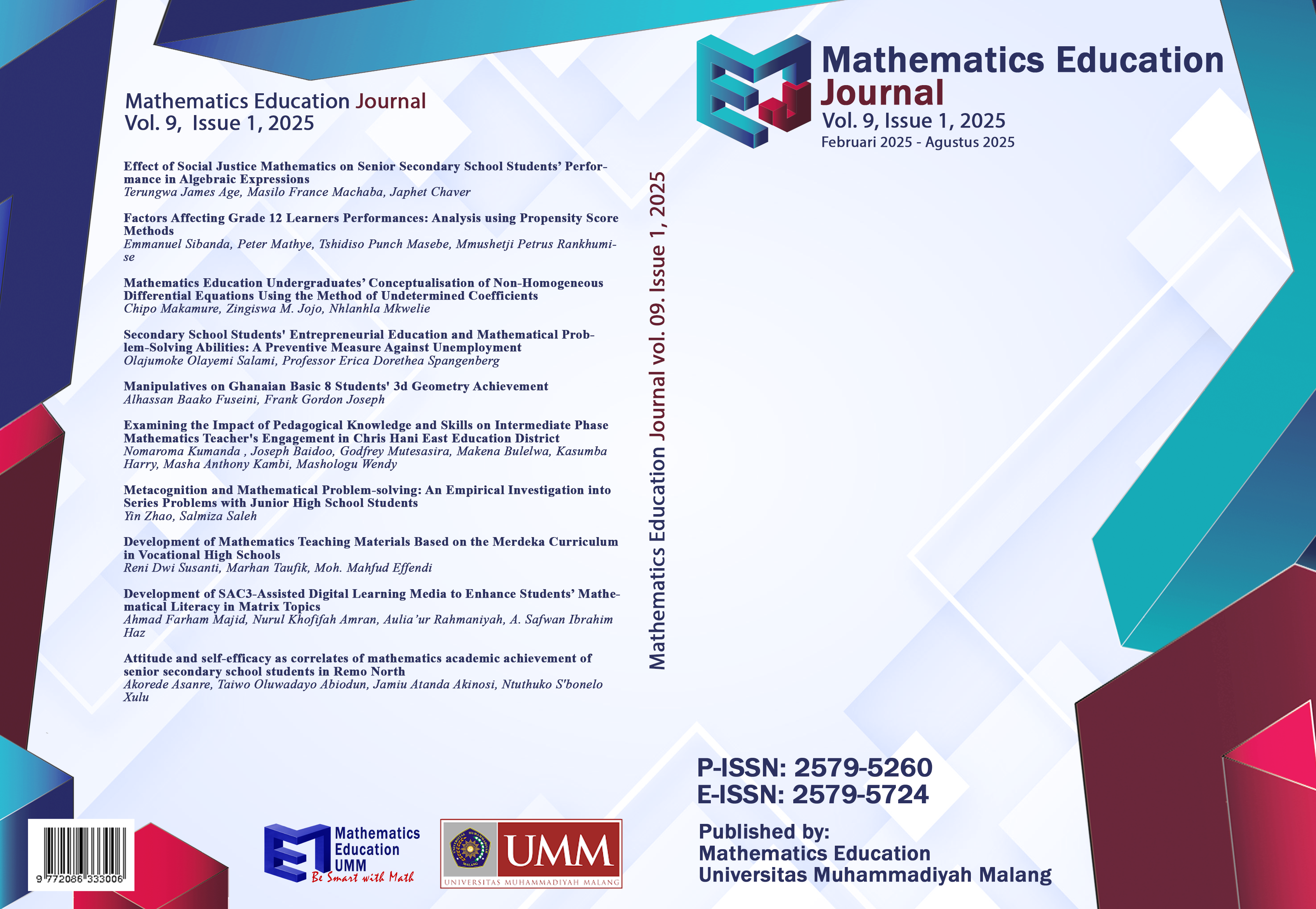
Effect of Social Justice Mathematics on Senior Secondary School Students’ Performance in Algebraic Expressions
DOI:
https://doi.org/10.22219/mej.v9i1.37244Abstract
Mathematics education plays a crucial role in developing students’ problem-solving skills and critical thinking. However, traditional teaching methods often fail to address social inequalities, which can impact students’ engagement and performance. This study investigated the effectiveness of Social Justice Mathematics (SJM) in enhancing senior secondary school students’ performance in algebraic expressions. Conducted in Benue State, Nigeria, the research employed a quasi-experimental pretest-post-test design with non-equivalent groups. The instrument used for data collection was the Social Justice Mathematics Algebraic Expression Test (SJMAET). A pilot test was conducted with 20 students, and the instrument’s reliability was established using the Kuder-Richardson Formula 21 (K-R21), yielding a reliability coefficient of 0.86. Data analysis revealed that students in the experimental group, who were taught using Social Justice Mathematics, outperformed their counterparts in the control group who were taught using conventional method. The findings suggest that integrating social justice principles into mathematics instruction enhances students’ academic achievement and promotes an inclusive learning environment. Therefore, it is recommended that Social Justice Mathematics be adopted in teaching algebraic expressions and other mathematical concepts to foster equity, justice, and fairness in the classroom.
Downloads
References
Abah, J. & Chinaka, T.W. & Ogbiji, E. O..(2024). PEffect of Kinesthetic Learning on Students’ Interest and Achievement in Mathematics. Mathematics Education Journal, 8(2), 120-136. https://doi.org/10.22219/mej.v8i2.34218
Abimbade, O. A., Olasunkanmi, I. A., Akinyemi, L. A., & Lawani, E. O. (2023). Effects of Two Modes of Digital Storytelling Instructional Strategy on Pupils' Achievement in Social Studies. TechTrends, 67(3), 498-507
Acharya, B.R. (2017). Factor affecting difficulties in learning mathematics by mathematics learners. International Journal of Elementary Education.
Age, T. J. (2024). Ubuntulisation of Mathematics Classroom for the Enhancement of Learner’s Interest and Achievement. Journal of Advanced Sciences and Mathematics Education, 4(1), 41- 50. https://doi.org/10.58524/jasme.v4i1.367
Age, T. J & Machaba, M. F. (2024). Mathematical Software; a Panacea for Improving Senior Secondary School Students’ Retention in Geometrical Constructions. Research in Educational Policy and Management, 6(1), 238-254. https://doi.org/10.46303/repam.2024.15
Age, T. J., Iji, C. O., Abakpa, B. O., Anyagh, P. I. (2021). Reinvigorating Secondary School Students’ Interest in Geome¬try Using GeoEnZo Software (GS) in Benue State, Nigeria. Journal of Global Research in Education and Social Science, 5 (6), 1–9.
Age, T. J. & Machaba, M. F. (2023). Effect of Mathematical Software on Senior Secondary School Students’ Achievement in Geometry. Eureka: Social and Humanities. 5, 82–93. doi: http://doi.org/10.21303/2504-5571.2023.003151
Al-Hanifah, J.,A.,Cholily, Y., M., & Ummah, S., K..(2023). Analysis of Students' Analytical Thinking Ability and Mathematical Communication Using Online Group Investigation Learning Model. Mathematics Education Journal, 7(1), 100-113.https://doi.org/10.22219/mej.v7i1.23342
Anyagh P.I., O’kwu E. I. Effect of formula teaching approach on students’ achievement in Algebra. Journal of Research in Curriculum and Teaching. 2010;5(1):374-379.
Bature, I. J. (2014) Productive pedagogies for reforming secondary school mathematics classroom practice in Nigeria. Unpublished Doctoral Thesis, Curtin University, Perth.
Berry, R. Q., III, Conway, B. M., Lawler, B. R., & Staley, J. W. (2020). High school mathematics lessons to explore, understand, and respond to social injustice. Corwin Press.
Boetang,F.O., Bandoh, S. O., Kwarteng, S.& Lotey, E. K.(2024). Impact of Parent Interest in Mathematics and Students Mathematics Interest on Student Mathematics Achievement. Mathematics Education Journal, 8(2), 206-220. https://doi.org/10.22219/mej.v8i2.33182
Bostic, J., Clark, Q., Vo, T., Esters, L., & Knobloch, N. (2021). A design process for developing agricultural life science focused. model eliciting activities. School Science and Mathematics Journal, 121(1), 13–24.
Cahill, J., & Bostic, J. D. (2024). Preparing preservice mathematics teachers to teach for social justice. School Science and Mathematics, 124(1), 48–59. https://doi.org/10.1111/ssm.12602
Colquitt, R. L. (2014). Social justice in mathematics education. Ph.D. dissertation, University of Tennessee.
Council on Social Work Education, (2001). Educational Policy and Accreditation Standards (Draft No. 2). Author: Alexandria, VA.
Danny, B. M. (2013) "The Impact of Identity in K-8 Mathematics: Rethinking Equity-Based Practices," published in 2013.
David, F. (2022) effective teaching practices in algebra and algebraic thinking.
Egara, F. O., Eseadi C., & Nzeadibe, A. C. (2022). Effect of computer simulation on secondary school students’ interest in algebra. Education and Information Technologies, 27, 5457-5469. https://doi.org/10.1007/s10639-021-10821-8
Eric, G., & Bob, P. (2017). Rethinking Mathematics: Teaching Social Justice by the Numbers.
Gutstein, E., & Peterson, B. (Eds.). (2013). Rethinking mathematics: Teaching social justice by the numbers (2nd ed.). Rethinking Schools. https://eric.ed.gov/?q=Steele&pg=6&id=ED521792.
Hancock, T.U., Kledaras, C.G., and Waites, C. (2012). Facing structural inequality: Students’ orientation to oppression and practice with oppressed groups. Journal of Social Work Education, 48(1), 5-25.
Harrison, L. (2015). Teaching social justice through mathematics: A self-study of bridging theory to practice. Middle Grades Review, 1(1), 5.
Hattie, J. (2016) “invisible learning and students performances”.
Hodge, L.L. (2006). An orientation on the mathematics classroom that emphasizes power and identity: Reflecting on equity research. The Urban Review, 38(5), 373-385.
Iji, C.O. (2010). Mathematics the language of the new millennium: implication for mathematics teaching in Nigerian primary schools. Benue journal of Research in Science and Education, 69, 23-30.
Iji, C.O., Abakpa, B.O. & Age, T. J. (2018). Effect of Geometer’s Sketchpad on Senior Secondary School Students’ Interest and Achievement in Geometry in Gboko Metropolis. International Journal of Research & Review, 5 (4), PP 33-39. E-ISSN: 2349-9788
James, J. K. (2015). Understanding algebraic learning and the development of algebraic thinking in students.
Jo, B. (2022) How Teachers and Parents Can Transform Mathematics Learning and Inspire Success.
Jong, K. & Jackson, C. (2016). Teaching mathematics for social justice: Examining preserves teacher conceptions. Journal of Mathematics Education, 7.
Kaur, B. (2012). Equity and social justice in teaching and teacher education. Teaching and Teacher Education, 28, 485-492.
Keddie, A. (2011). Educating for diversity and social justice. New York, NY: Routledge.
Lawler, B. R. (2010). Fabrication of knowledge: A framework for mathematical education for social justice. Proceedings of the sixth international mathematics education and society conference.
Kadt, E. (2020) Promoting social justice in teaching and learningin higher education through professional development, Teaching in Higher Education, 25:7, 872-887, DOI: 10.1080/13562517.2019.1617685
Khanal, J., & Park, S. H. (2016). Corporal punishment in private Schools: The case of Kathmandu, Nepal. Journal of Education and Practice, 7(26), 53-61.
Koomson, D., Boateng, F.O. & Lotely, E. K.(2024). Investigating the Level of Mathematics Anxiety among Junior High School Pupils. Mathematics Education Journal, 8(2), 147-158. https://doi.org/10.22219/mej.v8i2.33693
Leonard J., & Moore, C. M. (2014) Learning to enact social justice pedagogy in mathematics classrooms. Action Teach Educ 36(1):76–95. https:// doi. org/ 10. 1080/ 01626 620. 2013. 861371.
Lily, K. & Gizem, K. (2022) "Mathematics for Social Justice: Focusing on Quantitative Reasoning and Statistics.
Makonye, J. P., & Stepwell, N. (2016). Eliciting learner errors and misconceptions in simplifying rational algebraic expressions to improve teaching and learning. International Journal of Educational Sciences, 12(1), 16–28. https://doi.org/10.1080/09751122.2016.11890408
National Council of Teachers of Mathematics, (2014). Principles and standards for school mathematics. Reston, VA: NCTM.
NCTM. (2014). Access and equity in mathematics education: A position statement of the National Council of Teachers of Mathematics. Reston, VA: NCTM.
NCTM. (2021). Multicultural teacher education for the 21st century. Teacher Educator, 36(1), 1-16.
OECD, (2016) Teaching practices and their effectiveness across different countries.
OECD. (2012). Equity and quality in education: Supporting disadvantaged students and schools. OECD Publishing. http://dx.doi.org/10.1787/9789264130852-en.
Okeke, A. M., Egara, F. O., Orga, A. C., & Nzeadibe, A. C. (2023b). Effect of symbolic form model on students’ interest in logic content of the mathematics curriculum. Pedagogical Research, 8(2), em0159. https://doi.org/10.29333/pr/13077
Osakwe, I. J., Egara, F. O., Inweregbuh, O. C., Nzeadibe, A. C., & Emefo, C. N. (2023a). Interaction pattern approach: An approach for enhancing students’ retention in geometric construction. International Electronic Journal of Mathematics Education, 18(1), em0720. https://doi.org/10.29333/iejme/12596
Osei, W., & Kubi, M. K. (2022). Algebra teaching knowledge of professional and non-professional basic school mathematics `teachers. International Journal of Scientific & Research Publications, 12(1), 41–48. https://doi.org/10.29322/IJSRP.12.01.2022,p12107
Panthi, R. K., Khana, B., Kshetree, M. P., Acharya, B. R., & Belbase, S. (2021). Challenges of social justice in mathematics classrooms. SN Social Sciences, 1, 227. https://doi.org/10.1007/s43545-021-00233-3.
Putra, V.,A.,Taufik, M., & Susanti, R., D.(2023). Implementation of the Everyone Is a Teacher Here (ETH) Learning Model Based on the Mathematical Communication Ability. Mathematics Education Journal, 7(1), 114-122. https://doi.org/10.22219/mej.v7i1.23329
Putra, F. H. K.., Taufik, M. & Nadlifah, M..(2024). Development of MATLAB GUI-Based Mathematics Learning Media with ADDIE Model to Enhance Students' Mathematical Connection Ability. Mathematics Education Journal, 7(2), 102-113. https://doi.org/10.22219/mej.v8i1.28850
Ratts, M. J., Anthony, L., & Santos, K. N. (2010). The dimensions of social justice model: Transforming traditional group work into a socially just framework. The Journal for Specialists in Group Work, 35(2), 160-168. DOI 10.1080/01933921003705974.
Rousseau, C., & Tate, W.F. (2003). no time like the present: Reflecting equity in school mathematics. Theory Into Practice, 42(5), 210-216.
Singh, M. (2011). The place of social justice in higher education and social change discourses. Compare: A Journal of Comparative and International Education, 41(4), 481-494. doi: 10.1080/03057925.2011.581515.
Star, J. R., Caronongan, P., Foegen, A., Furgeson, J., Keating, B., Larson, M. R., Lyskawa, J., McCallum, W. G., Porath, J., & Zbiek, R. M. (2015). Teaching strategies for improving algebra knowledge in middle and high school students (NCEE 2014-4333). National Center for Education Evaluation and Regional Assistance (NCEE), Institute of Education Sciences, U.S. Department of Education. Retrieved from the NCEE website. http://whatworks.ed.gov
Stinson, D. W., Bidwell, C. R., & Powell, G. C. (2012). Critical pedagogy and teaching mathematics for social justice. The International Journal of Critical Pedagogy, 4(1), 76–94.
Veith, J. M., Beste, M. L., Kindervater, M., Krause, M., Straulino, M., Greinert, F., & Bitzenbauer, P. (2023, August). Mathematics education research on algebra over the last two decades: quo vadis? Frontiers Media SA. Volume 8 - 2023 | https://doi.org/10.3389/feduc.2023.1211920
Wright, P. (2017). Teaching mathematics for social justice: Transforming classroom practice. https://discovery.ucl.ac.uk/id/eprint/1536205/3 /Wright_WrightP.pdf
Xenofontos, C., Fraser, S., Priestley, A., & Priestley, M. (2020). Mathematics teachers and social justice: A systematic review of empirical studies. Oxford Review of Education, 47(2), 135-151. https://doi.org/10.1080/03054985.2020.1807314
Downloads
Published
Issue
Section
License
Copyright (c) 2025 Terungwa James Age, Masilo France Machaba, Japhet Chaver

This work is licensed under a Creative Commons Attribution-ShareAlike 4.0 International License.
Authors who publish with MEJ (Mathematics Education Journal) agree to the following terms:
For all articles published in MEJ, copyright is retained by the authors. Authors give permission to the publisher to announce the work with conditions. When the manuscript is accepted for publication, the authors agree to automatic transfer of the publishing right to the publisher.
Authors retain copyright and grant the journal right of first publication with the work simultaneously licensed under a Creative Commons Attribution-ShareAlike 4.0 International License that allows others to share the work with an acknowledgment of the work's authorship and initial publication in this journal.
Authors are able to enter into separate, additional contractual arrangements for the non-exclusive distribution of the journal's published version of the work (e.g., post it to an institutional repository or publish it in a book), with an acknowledgment of its initial publication in this journal.
Authors are permitted and encouraged to post their work online (e.g., in institutional repositories or on their website) prior to and during the submission process, as it can lead to productive exchanges, as well as earlier and greater citation of published work (See The Effect of Open Access).

This work is licensed under a Creative Commons Attribution-ShareAlike 4.0 International License.


