
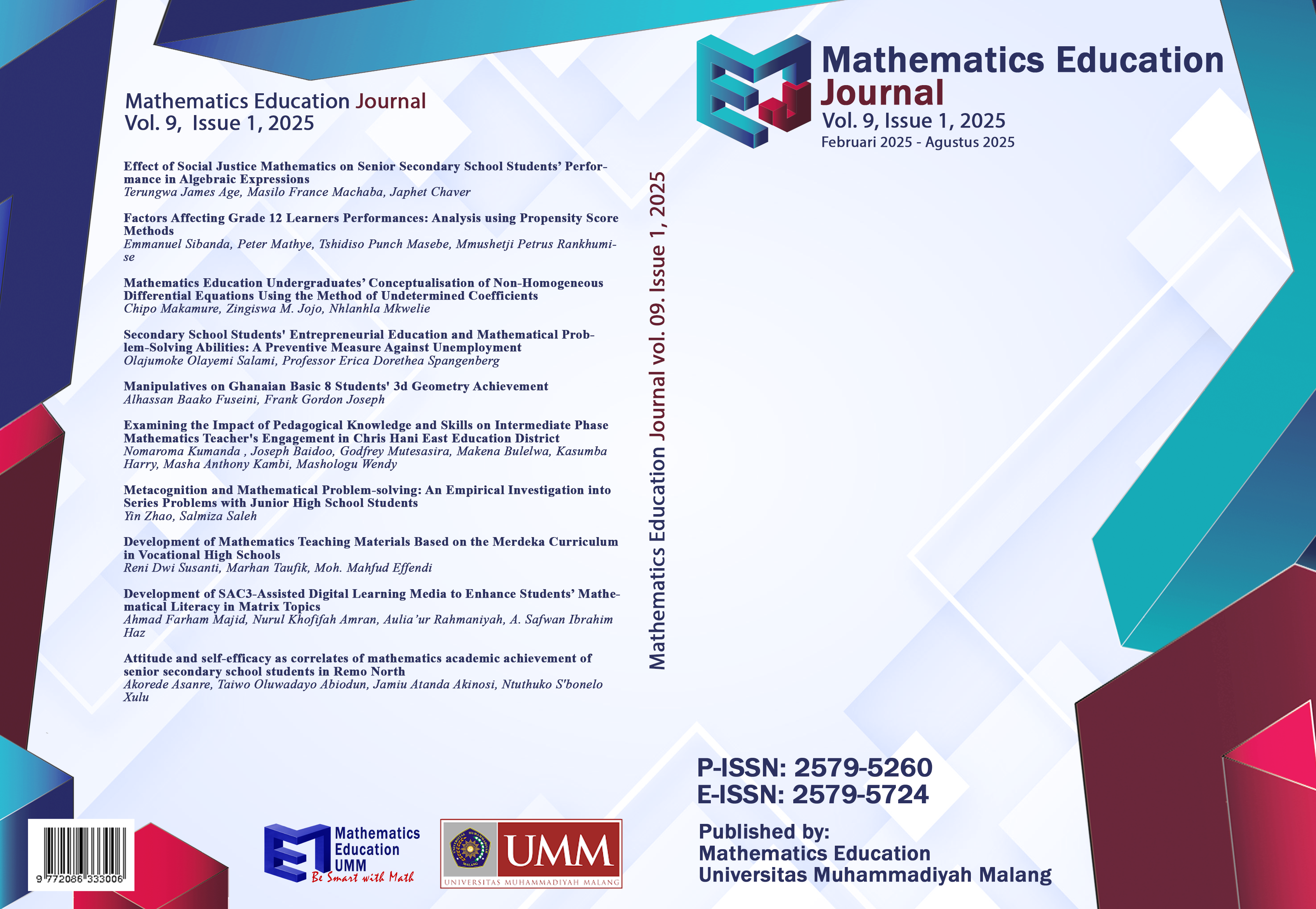
Metacognition and Mathematical Problem-solving: An Empirical Investigation into Series Problems with Junior High School Students
DOI:
https://doi.org/10.22219/mej.v9i1.39924Abstract
his empirical study examines the critical relationship between metacognitive skills and mathematical problem-solving performance through a focused case study on series summation problems. Conducted with 50 seventh-grade students, the research involved a structured online lecture covering rational number series and algebraic transformations, followed by two problem-solving tasks and a detailed metacognitive questionnaire aligned with Polya’s four-phase framework. Results demonstrated a significant disparity: while all students (100%) successfully solved the initial summation problem , only 29 students (58%) correctly solved the more complex squared summation problem . Analysis of the metacognitive questionnaire revealed pronounced differences in strategy use. Students solving both problems successfully reported significantly higher engagement in metacognitive behaviors: reading problems multiple times (72.4% vs. overall 42%), schematic representation (100% vs. 78%), strategic planning (100% vs. 78%), solution monitoring (86%), and calculation verification (100% vs. 90%). Statistical analysis confirmed strong positive correlations between these specific metacognitive strategies and successful problem-solving outcomes. The study robustly concludes that explicit metacognitive strategy deployment, particularly in problem representation, planning, and evaluation, is a decisive factor in successful mathematical problem-solving, especially for non-routine tasks. These findings underscore the imperative for systematic integration of metacognitive skill development within secondary mathematics curricula to enhance students' conceptual understanding and transfer abilities.
Downloads
References
Biryukov, P. (2004). Metacognitive Aspects of Solving Combinatorics Problems. International Journal for Mathematics Teaching and Learning. http://www.cimt.org.uk/journal/biryukov.pdf
Bloom, B. S., Engelhart, M. D., Furst, E. J., Hill, W. H., & Krathwohl, D. R. (1956). Taxonomy of Educational Objectives: The Classification of Educational Goals. Handbook 1: Cognitive Domain. New York: David McKay Company.
Desoete, A., Roeyers, H., & Buysse, A. (2001). Metacognition and Mathematical Problem Solving in Grade 3. Journal of Learning Disabilities, 34(5), 435–447.
Flavell, J. H. (1979). Metacognition and Cognitive Monitoring: A New Area of Cognitive-Developmental Inquiry. American Psychologist, 34(10), 906–911.
Fortunato, I., Hecht, D., Tittle, C. K., & Alvarez, L. (1991). Metacognition and Problem Solving. The Arithmetic Teacher, 39(4), 38–40.
Gagné, R. M. (1968). Learning Hierarchies. Educational Psychologist, 6(1), 1–9.
Jacobs, J. E., & Paris, S. G. (1987). Children’s Metacognition About Reading: Issues in Definition, Measurement, and Instruction. Educational Psychologist, 22(3 & 4), 255–278.
Lester, F. K. (1994). Musings about Mathematical Problem-Solving Research: 1970-1994. Journal for Research in Mathematics Education, 25(6), 660–675.
Mayer, R. E. (2001). Cognitive, Metacognitive, and Motivational Aspects of Problem Solving. In H. J. Hartman (Ed.), Metacognition in Learning and Instruction (pp. 87–101). Kluwer Academic Publishers.
Niss, M. (Ed.). (1988). Proceedings of the Sixth International Congress on Mathematical Education (ICME-6).
Pólya, G. (1957). How to Solve It: A New Aspect of Mathematical Method (2nd ed.). Princeton University Press.
Schneider, W., & Artelt, C. (2010). Metacognition and Mathematics Education. ZDM Mathematics Education, 42, 149–161.
Schoenfeld, A. H. (1983). The Wild, Wild, Wild, Wild, Wild World of Problem Solving (A Review of Sorts). For the Learning of Mathematics, 3(3), 40–47.
Sengul, S., & Katranci, Y. (2012). Metacognitive Aspects of Solving Function Problems. Procedia - Social and Behavioral Sciences, 46, 2178–2182.
Sternberg, R. J., & Gardner, M. K. (1983). Unities in Inductive Reasoning. Journal of Experimental Psychology: General, 112(1), 80–116.
Downloads
Published
Issue
Section
License
Copyright (c) 2025 Yin Zhao, Salmiza Saleh

This work is licensed under a Creative Commons Attribution-ShareAlike 4.0 International License.
Authors who publish with MEJ (Mathematics Education Journal) agree to the following terms:
For all articles published in MEJ, copyright is retained by the authors. Authors give permission to the publisher to announce the work with conditions. When the manuscript is accepted for publication, the authors agree to automatic transfer of the publishing right to the publisher.
Authors retain copyright and grant the journal right of first publication with the work simultaneously licensed under a Creative Commons Attribution-ShareAlike 4.0 International License that allows others to share the work with an acknowledgment of the work's authorship and initial publication in this journal.
Authors are able to enter into separate, additional contractual arrangements for the non-exclusive distribution of the journal's published version of the work (e.g., post it to an institutional repository or publish it in a book), with an acknowledgment of its initial publication in this journal.
Authors are permitted and encouraged to post their work online (e.g., in institutional repositories or on their website) prior to and during the submission process, as it can lead to productive exchanges, as well as earlier and greater citation of published work (See The Effect of Open Access).

This work is licensed under a Creative Commons Attribution-ShareAlike 4.0 International License.


