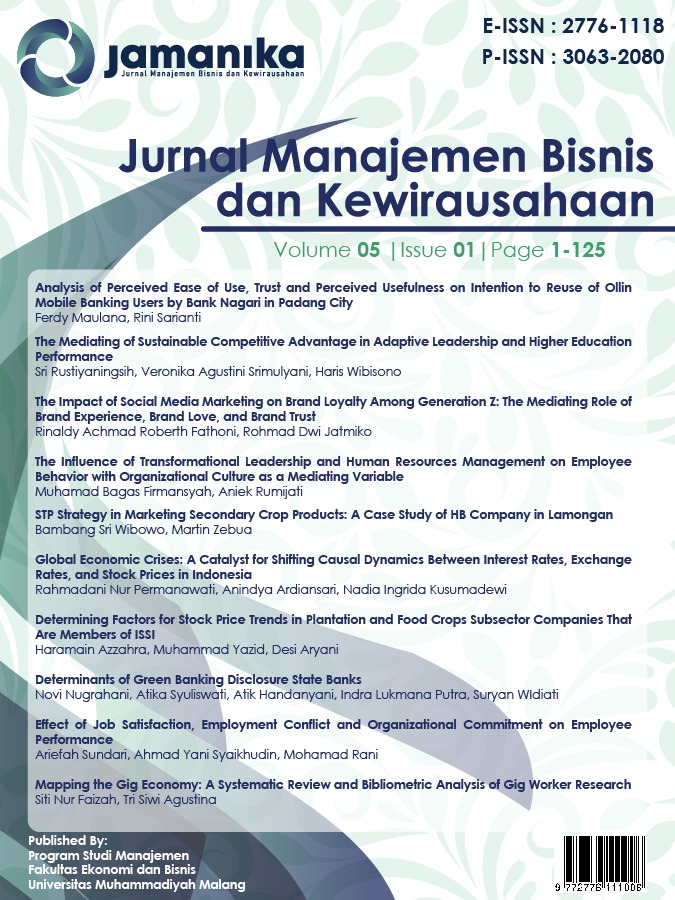
Mediating sustainable competitive advantage on adaptive leadership and higher education performance
DOI:
https://doi.org/10.22219/jamanika.v5i1.39597Keywords:
adaptive leadership, Sustainable competitive advantage, higher education performanceAbstract
Higher education competition is getting tighter due to the increasing number of universities, in addition there are also more and more universities from abroad operating in Indonesia. Higher education leaders must be adaptive to competitive challenges and very rapid environmental changes so that universities can be competitive and sustainable so that they produce good performance. The purpose of this study is to test and prove the effect of adaptive leadership on higher education performance with the mediation of sustainable competitive advantage. The sample of this study is a study program at a private university in Madiun City. The respondents of this study are the head of the study program and the secretary of the study program. Primary data was collected using a questionnaire in the form of a Google form and sent via WhatsApp to respondents, obtaining 32 data. Hypothesis testing uses path analysis and the Sobel Test. The research results prove that adaptive leadership has an influence on higher education performance. Adaptive leadership has a significant effect on sustainable competitive advantage and sustainable competitive advantage has a significant effect on higher education performance. The results of the path analysis test with SPSS and the results of the test with the Sobel test show sustainable competitive advantage as a mediation
Keywords— adaptive leadership; Sustainable competitive advantage; higher education performance.
Downloads
References
Akparep, J. Y., Jengre, E., & Mogre, A. A. (2019). The Influence of Leadership Style on Organizational Performance at TumaKavi Development Association, Tamale, Northern Region of Ghana. Open Journal of Leadership, 8, 1–22. https://doi.org/10.4236/ojl.2019.81001
Çağlıyan, V., Attar, M., & Abdul-Kareem, A. (2022). Assessing the mediating effect of sustainable competitive advantage on the relationship between organisational innovativeness and firm performance. Competitiveness Review, 32(4), 618–639. https://doi.org/10.1108/CR-10-2020-0129
Dunn, R. (2020). Adaptive Leadership: Leading Through Complexity. Journal of the Commonwealth Council for Educational Administration & Management, 48(1), 31–37.
Eko Pujianto, W., Aulia, S., Haque, ul, Wisnu Dyatmika, S., Wirawan Tedja, F., & Author, C. (2023). Adaptive leadership model: A Systematic Literature Review and Future Research. Proceeding The 2 Nd International Seminar of Multicultural Psychology (ISMP 2 Nd ) Faculty of Psychology Universitas 17 Agustus 1945 Surabaya.
Faeq, D. K. (2022). SME Competitiveness : The influence of the Qualities of Leadership on Competitive advantage. 6, 1–15. https://doi.org/10.22161/ijllc
Fitriani, M. I. (2023). Adaptive leadership: Concepts, models and their actualisation in educational institutions. 15(1), 1–14.
Haseeb, M., Hussain, H. I., Kot, S., Androniceanu, A., & Jermsittiparsert, K. (2019). Role of social and technological challenges in achieving a sustainable competitive advantage and sustainable business performance. Sustainability (Switzerland), 11(14). https://doi.org/10.3390/su11143811
Hazelkorn, E. (2015). Rankings and the Global Reputation Race. October. https://doi.org/10.1002/he.20110
Heifetz, R. (2009). The Practice of Adaptive Leadership: Tools and Tactics for Changing Your Organization and the World. Harvaard Business Review.
Kafetzopoulos, D., Psomas, E., & Bouranta, N. (2022). The influence of leadership on strategic flexibility and business performance: the mediating role of talent management. Management Decision, 60(9), 2532–2551. https://doi.org/10.1108/MD-10-2021-1310
Lestari, S. D., Leon, F. M., Widyastuti, S., Brabo, N. A., & Putra, A. H. P. K. (2020). Antecedents and consequences of innovation and business strategy on performance and competitive advantage of SMEs. Journal of Asian Finance, Economics and Business, 7(6), 365–378. https://doi.org/10.13106/JAFEB.2020.VOL7.NO6.365
Liao, Y. K., & Maulana Suprapto, R. R. (2024). An empirical model of university competitiveness and rankings: The effects of entrepreneurial behaviors and dynamic capabilities. Asia Pacific Management Review, 29(1), 34–43. https://doi.org/10.1016/j.apmrv.2023.04.005
Mews, J. G. (2019). Effective Leadership in Higher Education: A Review of Leadership Style Preferences among Faculty and Staff within the United States. Open Journal of Leadership, 08(02), 58–74. https://doi.org/10.4236/ojl.2019.82004
Ngatno, & Dewi, R. S. (2019). The role of adaptive ability in firm performance: Moderating effect of firm size and age. Asian Economic and Financial Review, 9(7), 807–823. https://doi.org/10.18488/journal.aefr.2019.97.807.823
Nisha, N. T., Nawaz, N., Mahalakshmi, J., & Gajenderan, V. (2022). A Study on the Impact of Sustainable Leadership and Core Competencies on Sustainable Competitive Advantage in the Information Technology ( IT ) Sector. Sustainability, 14(11), 1–12. https://doi.org/https://doi.org/10.3390/su14116899
Nöthel, S., Nübold, A., Uitdewilligen, S., Schepers, J., & Hülsheger, U. (2023). Development and validation of the adaptive leadership behavior scale (ALBS). Frontiers in Psychology, 14. https://doi.org/10.3389/fpsyg.2023.1149371
Santati, P., Sulastri, S., Perizade, B., & Widiyanti, M. (2022). Strategic Performance Measurement System in Higher Education in Indonesia: New Public Management Approach. SRIWIJAYA INTERNATIONAL JOURNAL OF DYNAMIC ECONOMICS AND BUSINESS, 107–130. https://doi.org/10.29259/sijdeb.v6i1.107-130
Satar, A., Al Musadieq, M., Solimun, & Hutahayan, B. (2023). A Systematic Literature Review: Determinants of Sustainable Competitive Advantage (pp. 3–16). https://doi.org/10.2991/978-2-38476-090-9_2
Setiawati, L. (2017). Pengaruh Corporate Governance, Organizational Service Orientation, Strategic Leadership, dan Strategic Competence Terhadap Kinerja Universitas Swasta di Surabaya.
Solomona Nebiyu, K., & Kassahun, T. (2021). IThe Effect of Adaptive Leadership on Organizational Effectiveness in Public Higher Education Institutions of Ethiopia. International Journal Organizational Leadership, 10(spesial issue), 141–159.
Sriwidadi, Teguh; Arief, Muhtosim; Prabowo, H. and A. M. M. (2016). Sustainable Competitive Advantage in Privat Higher Education Institutions in Indonesian. IJEM International Journal of Economics and Management Journal, 10(S1), 33–47.
Stukes, K. S. (2021). Measuring Employee Engagement and Adaptive Leadership During Higher Education’s Accountability and Performance Era During Higher Education’s Accountability and Performance Era.
Taherdoost, H. (2018). Validity and Reliability of the Research Instrument; How to Test the Validation of a Questionnaire/Survey in a Research. SSRN Electronic Journal, 5(3), 28–36. https://doi.org/10.2139/ssrn.3205040
Wahyudin, N. (2015). Analisis Faktor-Faktor Yang Mempengaruhi Keunggulan Bersaing Untuk Meningkatkan Kinerja Perguruan Tinggi Swasta (PTS) Pada Sekolah Tinggi Dan Akademi Di Semarang. Holistic Journal of Management Research, 3(2), 77–92.
Wamburu, A., Nyambegera, S. M., & Kibet, E. (2022). Influence of gaining perspective dimension of adaptive leadership on organizational performance companies in Kenya. DBA Africa Management Review, 12(3), 1–23.
Wase, D. M., & Ravishankar, K. (2023). The effect of adaptive leadership practice on organizational performance. In SSRN. https://doi.org/Wase, Demelash Misgana, The Effect of Adaptive Leadership Practice on Organizational Performance. Available at SSRN: https://ssrn.com/abstract=4636795 or http://dx.doi.org/10.2139/ssrn.4636795
Yukl, G., & Mahsud, R. (2010). Why flexible and adaptive leadership is essential. Consulting Psychology Journal, 62(2), 81–93. https://doi.org/10.1037/a0019835
Downloads
Published
Issue
Section
License
Copyright (c) 2025 Sri Rustiyaningsih, Veronika Agustini Srimulyani, Haris Wibisono

This work is licensed under a Creative Commons Attribution-ShareAlike 4.0 International License.
 This work is licensed under a Creative Commons Attribution (CC BY 4.0) License.