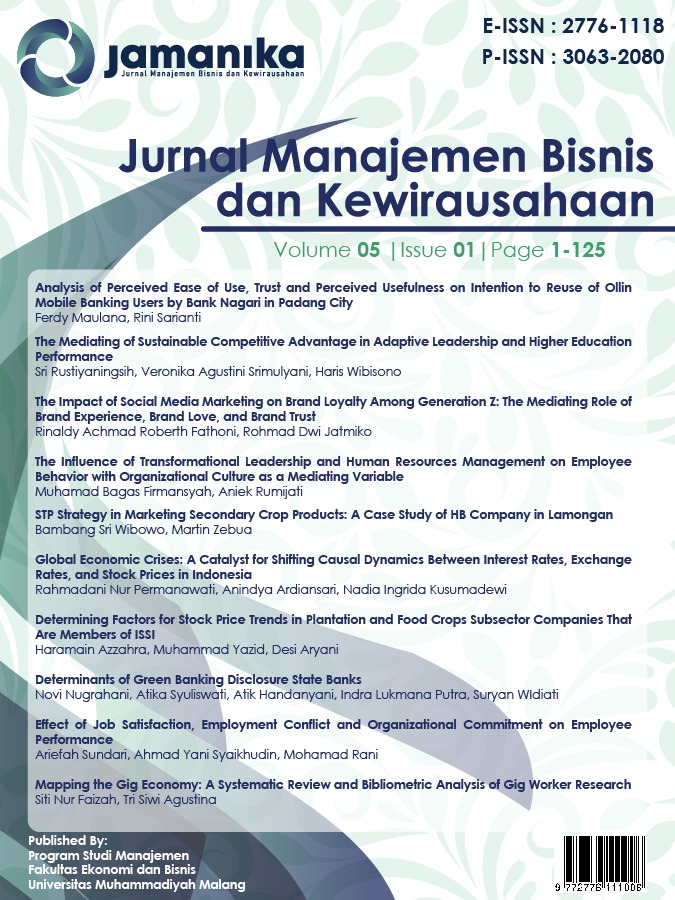
Global Economic Crises: A Catalyst for Shifting Causal Dynamics Between Interest Rates, Exchange Rates, and Stock Prices in Indonesia
DOI:
https://doi.org/10.22219/jamanika.v5i1.39725Keywords:
IDX Composite, Exchange Rate, Interest Rate, Global CrisisAbstract
This study aims to analyze the global crisis's effect on the causal relationship between interest rate, exchange rate, and stock price. The sample used in this study is the IDX Composite, rupiah to US dollar exchange rate, and interest rates in Indonesia with monthly data during the observation period from January 2003 until December 2020. The pre-crisis results indicate a one-way causality relationship between exchange rates and interest rates; there is no causal relationship between the IDX Composite and the exchange rate and the IDX Composite and interest rates. The post-crisis results indicate a one-way causality relationship between the IDX Composite and the exchange rate and the IDX Composite and interest rates. Meanwhile, there is a two-way causality between exchange and interest rates. The study results in all periods indicate a one-way causality relationship between the IDX Composite and the exchange rate and IDX Composite and interest rates. Meanwhile, there is no causal relationship between exchange rates and interest rates
Downloads
References
Abbas Valadkhani, Surachai Chancharat, and Charles Havie. 2006. “The Interplay Between the Thai and Several Other International Stock Markets”.
Andries, Alin Marius, Iulian Ihnatov, dan Aviral Kumar Tiwari. 2014. “Analyzing Time-Frequency Relationship Between Interest Rate, Stock Price and Exchange Rate Through Continuous Wavelet.” Economic Modelling 41 (2014) 227-238.
Bank Indonesia. (2020). Laporan perekonomian Indonesia. Bank Indonesia. https://www.bi.go.id/laporan
Badan Pusat Statistik. (2020). Pertumbuhan ekonomi Indonesia. BPS Indonesia. https://www.bps.go.id/ekonomi
Bloomberg. (n.d.). Latest financial news and market analysis. Bloomberg. https://www.bloomberg.com
Chinn, Menzie D. dan Guy Meredith. 2024. “Monetary Policy and Long-Horizon Uncovered Interest Parity.” IMF Staff Papers, Vol. 51, No. 3.
Choi, I., Park, D., (2018), “Causal relation between interest and exchange rates in the Asian currency crisis”, Japan and World Economy, 20: 435–452.
D’Agostino, Antonello, Luca Sala, dan Paolo Surico. 2015. “The Fed and the Stock Market”.
Faust, J., Rogers, J.H., Shing-Yi, B.W. and Wright, J.H. (2017), “The high-frequency response of exchange rates and interest rates to macroeconomic announcements”, Journal of Monetary Economics, Vol. 54, pp. 1051–1068.
Granger, C.W.J., Bwo-Nung, H., Yang, C.W., 2000. “A Bivariate CausalityBetween Stock Prices and Exchange Rates: Evidence from RecentAsia Flu.” The Quarterly Review of Economics and Finance, 40, 337-54.
Gupta, Jyoti. 2000. “The Causality between Interest Rate, Exchange Rate, and Stock Markets: The Case of the Jakarta Stock Exchange.” EFMA 2000 Athens.
Hacker, S.R., Karlsson, H.K., Mansson, K., (2012), “The relationship between exchange rates and interest rate differentials: a wavelet approach”, World Economy. 35, 1162–1185.
Hanke. J. E, W. D. (2005). Bussines Forecasting (9th Editio). Pearson Prentince Hall.
Ibrahim M.H., Aziz, H., (2023), “Macroeconomic variables and the Malaysian equity market: A view through rolling subsamples.” Journal of Economic Studies, 30(1): 6-27.
Inci, A.C., Lee, B.S., (2014), “Dynamic relations between stock returns and exchange rate changes”, European Financial Management, 20 (1): 71–106.
Jayashankar, Malepati dan Badri Narayan Rath. 2017. “The Dynamic Linkage Between Exchange Rate, Stock Price and Interest Rate in India.” Studies in Economics and Finance, Vol. 34 Issue: 3, pp.383-406.
Liang, Chin-chin., Lin, J.B. and Hsu, H.C. (2013), “Reexamining the relationship between stock prices and exchange rates in ASEAN-5 using panel Granger causality approach”, Economic Modelling, Vol. 32, pp. 560-563.
Lin, C.-H., (2012), “The comovement between exchange rates and stock prices in the Asian emerging markets.” International Review of Economics and Finance, 22: 161–172.
Moore, T., Wang, P., (2014), “Dynamic linkage between real exchange rates and stock prices: evidence from developed and emerging Asian markets”, International Review of Economics and Finance, 29: 1-11.
Muharam, Harjum. 2013. Aplikasi Ekonometri. Semarang: Program Doktor Ilmu Ekonomi Fakultas Ekonomika dan Bisnis.
Sa’diyah, C., & Hilabi, I. I. (2022). The Effect Of Corporate Governance On Company Value In The Indonesia Stock Exchange And Sharia Stock In Indonesia. Jurnal Manajemen, 8(2), 404–415. https://doi.org/10.17358/jabm.8.2.404
Sa’diyah, C., & Widagdo, B. (2020). Indonesia’s Capital Market Reaction Election Events. Sentralisasi, 9(2), 97–107.
Sa’diyah, C., Widagdo, B., & Rahadjeng, E. R. (2022). Financial distress: From bibliometric analysis to current research, future and trends research directions and content analysis. Social and Political Issues on Sustainable Development in the Post Covid-19 Crisis, 131–138. https://doi.org/10.1201/9781003263586-16
Sensoy, A., Cihat, S., (2014), “Effects of volatility shocks on the dynamic linkages between exchange rate, interest rate, and the stock market: The case of Turkey”, Economic Modelling, 43: 448-457.
Smyth, R., Nandha, M., (2023), “Bivariate causality between exchange rates and stock prices in South Asia”, Applied Economics Letters, 10: 699–704.
Simbolon, Lentina dan Purwanto. 2018. “The Influence of Macroeconomic Factors on Stock Price: The Case of Real Estate and Property Companies.” Global Tensions in Financial Markets (Research in Finance, Volume 34) Emerald Publishing Limited, pp.19 – 39.
Tsai, I., (2012), “The relationship between the stock price index and exchange rate in Asian markets: a quantile regression approach”, Journal of International Finance Markets, Institutions and Money, 22(3): 609–621.
Walid, C., Chaker, A., Masood, O., Fry, J., (2011), “Stock market volatility and exchange rates in emerging countries: a Markov-state switching approach”, Emerging Market Review, 12, 272–292.
Widagdo, B., & Sa’diyah, C. (2021). Analysis Of The Effect Of WCTO, FATO And TA On Company Value With ROE As Intervening Variables. International Journal of Economics, Business and Accounting Research (IJEBAR), 5(1), 16–25. https://doi.org/10.31857/s0026898421020051
Widagdo, B., & Sa’diyah, C. (2022). Financial Distress, Dividend Policy, RGEC And Earning Per Share. Trikonomika, 21(1), 37–45.
Downloads
Published
Issue
Section
License
Copyright (c) 2025 Rahmadani Nur Permanawati, Anindya Ardiansari, Nadia Ingrida Kusumadewi

This work is licensed under a Creative Commons Attribution-ShareAlike 4.0 International License.
 This work is licensed under a Creative Commons Attribution (CC BY 4.0) License.