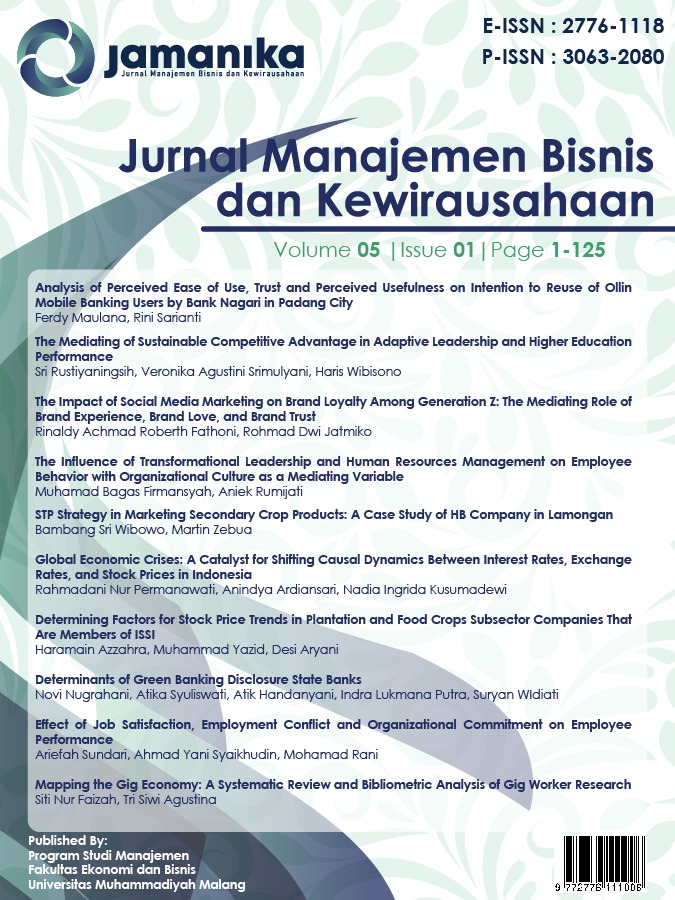
The Impact of Social Media Marketing on Brand Loyalty among Generation Z: The Mediating Role of Brand Experience, Brand Love, and Brand Trust
DOI:
https://doi.org/10.22219/jamanika.v5i1.39796Keywords:
Brand Loyalty, Social Media Marketing, Brand Experience, Brand Love, Brand TrustAbstract
This study aims to analyze the influence of Social Media Marketing (SMM) on brand loyalty, considering brand experience, brand love, and brand trust as mediating variables in the local fashion industry in Malang City. Using a quantitative approach with the purposive sampling method, this study involved 144 respondents from Generation Z who are active social media users and have purchased local fashion products. The results indicate that SMM has a significant direct impact on brand loyalty and an indirect effect through brand experience, brand love, and brand trust as mediators. These findings confirm that effective SMM strategies enhance the brand experience, foster emotional attachment through brand love, and strengthen customer trust, which collectively contribute to increased brand loyalty. Therefore, local fashion brands in Malang City should optimize engaging, interactive, and community-based content, while maintaining transparency to enhance competitiveness and strengthen customer loyalty in the digital era.
Downloads
References
Albert, N., Merunka, D., & Valette-Florence, P. (2008). When consumers love their brands: Exploring the concept and its dimensions. Journal of Business Research, 61(10), 1062–1075. https://doi.org/10.1016/j.jbusres.2007.09.014
Badan Pusat Statistik Kota Malang. (2023). Produk Domestik Regional Bruto Kota Malang. Retrieved from https://malangkota.bps.go.id/
Batra, R., Ahuvia, A., & Bagozzi, R. P. (2012). Brand love. Journal of Marketing, 76(2), 1–16. https://doi.org/10.1509/jm.09.0339
Bıçakcıoğlu, N., Ipek, I., & Bayraktaroğlu, G. (2018). The effect of brand experiences on brand personality, brand love, and word of mouth: An empirical research on Turkish consumers. Journal of Business Economics and Management, 19(1), 111–126. https://doi.org/10.3846/jbem.2018.1477
Brakus, J. J., Schmitt, B. H., & Zarantonello, L. (2009). Brand experience: What is it? How is it measured? Does it affect loyalty? Journal of Marketing, 73(3), 52–68. https://doi.org/10.1509/jmkg.73.3.52
Carroll, B. A., & Ahuvia, A. C. (2006). Some antecedents and outcomes of brand love. Marketing Letters, 17(2), 79–89. https://doi.org/10.1007/s11002-006-4219-2
Chaudhuri, A., & Holbrook, M. B. (2001). The chain of effects from brand trust and brand affect to brand performance: The role of brand loyalty. Journal of Marketing, 65(2), 81–93. https://doi.org/10.1509/jmkg.65.2.81.18255
Delgado-Ballester, E., & Munuera-Alemán, J. L. (2005). Does brand trust matter to brand equity? Journal of Product & Brand Management, 14(3), 187–196. https://doi.org/10.1108/10610420510601058
Dessart, L., Veloutsou, C., & Morgan-Thomas, A. (2020). Brand communities, brand relationships and brand loyalty: A multi-brand study. Journal of Business Research, 109, 321-335
Dick, A. S., & Basu, K. (1994). Customer loyalty: Toward an integrated conceptual framework. Journal of the Academy of Marketing Science, 22(2), 99-113.
Dwivedi, Y. K., Kapoor, K. K., & Chen, H. (2021). Social media marketing and advertising. Journal of Business Research, 132, 279–283. https://doi.org/10.1016/j.jbusres.2021.04.043
Erkan, I., & Evans, C. (2016). The influence of eWOM in social media on consumers’ purchase intentions: An extended approach to information adoption. Computers in Human Behavior, 61, 47–55. https://doi.org/10.1016/j.chb.2016.03.003
Euromonitor. (2023). Apparel and footwear in Indonesia. Retrieved from https://www.euromonitor.com
Ha, H. Y., & Perks, H. (2005). Effects of consumer perceptions of brand experience on the web: Brand familiarity, satisfaction, and brand trust. Journal of Consumer Behavior, 4(6), 438–452. https://doi.org/10.1002/cb.29
Hair, J. F., Black, W. C., Babin, B. J., & Anderson, R. E. (2010). Multivariate data analysis (7th ed.). Pearson.
Harrigan, P., Evers, U., Miles, M., Daly, T., & Schwarz, A. (2017). Customer engagement with tourism social media brands. Tourism Management, 59, 597–609. https://doi.org/10.1016/j.tourman.2016.09.015
Hollebeek, L. D., Srivastava, R. K., & Chen, T. (2021). Customer brand engagement: Nature, dimensions, and outcomes. Journal of Retailing, 97(1), 81–93. https://doi.org/10.1016/j.jretai.2020.11.001
Huang, E. (2017). The influence of social media on knowledge management for innovation in SMEs. Journal of Business Research, 81, 13-23.
Iglesias, O., Markovic, S., Singh, J. J., & Sierra, V. (2019). Do customer perceptions of corporate services brand ethicality improve brand equity? Considering the roles of brand experience and brand authenticity. Journal of Business Ethics, 154(2), 441–459. https://doi.org/10.1007/s10551-017-3457-4
Islam, J. U., Hollebeek, L. D., Rahman, Z., Khan, I., & Rasool, A. (2021). Customer engagement in the digital era: Understanding the role of social media marketing in enhancing brand loyalty. Journal of Retailing and Consumer Services, 60, 102441. https://doi.org/10.1016/j.jretconser.2021.102441
Kim, A. J., & Ko, E. (2012). Do social media marketing activities enhance customer equity? An empirical study of luxury fashion brand. Journal of Business Research, 65(10), 1480–1486. https://doi.org/10.1016/j.jbusres.2011.10.014
Kementerian Pariwisata dan Ekonomi Kreatif Republik Indonesia. (2023). Laporan Ekonomi Kreatif Indonesia. Retrieved from https://www.kemenparekraf.go.id/
Kumar, A., Bezawada, R., Rishika, R., Janakiraman, R., & Kannan, P. K. (2013). From social to sale: The effects of firm-generated content in social media on customer behavior. Journal of Marketing, 77(1), 7–25. https://doi.org/10.1509/jm.11.0417
Ladhari, R., Souiden, N., & Dufour, B. (2017). The role of emotions in utilitarian service settings: The effects on satisfaction and behavioral intentions. Journal of Retailing and Consumer Services, 34, 10-18.
Laroche, M., Habibi, M. R., & Richard, M. O. (2013). To be or not to be in social media: How brand relationships drive brand loyalty. Journal of Business Research, 66(8), 1136–1143. https://doi.org/10.1016/j.jbusres.2012.03.011
Mehrabian, A., & Russell, J. A. (1974). An approach to environmental psychology. MIT Press.
Morgan, R. M., & Hunt, S. D. (1994). The commitment-trust theory of relationship marketing. Journal of Marketing, 58(3), 20–38. https://doi.org/10.2307/1252308
Oliver, R. L. (1999). Whence consumer loyalty? Journal of Marketing, 63(4), 33–44. https://doi.org/10.1177/00222429990634
Schivinski, B., & Dabrowski, D. (2016). The effect of social media communication on consumer perceptions of brands. Journal of Marketing Communications, 22(2), 189–214. https://doi.org/10.1080/13527266.2013.871323
Schmitt, B. (1999). Experiential marketing. Journal of Marketing Management, 15(1–3), 53–67. https://doi.org/10.1362/026725799784870496
Seo, E. J., & Park, J. W. (2018). A study on the effects of social media marketing activities on brand equity and customer response in the airline industry. Journal of Air Transport Management, 66, 36–41. https://doi.org/10.1016/j.jairtraman.2017.09.014
We Are Social, & Hootsuite. (2024). Digital 2024: Indonesia. DataReportal. Retrieved from https://datareportal.com/reports/digital-2024-indonesia
Zeng, F., Huang, L., & Dou, W. (2009). Social factors in user perceptions and responses to advertising in online social networking communities. Journal of Interactive Advertising, 10(1), 1-13.
Downloads
Published
Issue
Section
License
Copyright (c) 2025 Rinaldy Achmad R.F, S.AB, M.M, Rohmad Dwi Jatmiko

This work is licensed under a Creative Commons Attribution-ShareAlike 4.0 International License.
 This work is licensed under a Creative Commons Attribution (CC BY 4.0) License.