Student collaboration skills post-implementation of the WE-ARe model
DOI:
https://doi.org/10.22219/raden.v4i2.33720Keywords:
Collaboration skills, Learning Model, high school students, WE-AReAbstract
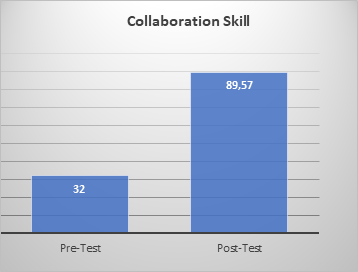
Collaboration skills are fundamental to helping students face challenges in education and work. However, there is limited research on students’ collaboration skills, particularly using a specific model. This present study aims to analyze the influence of the Warm-up, Exploring, Argumentation, Resume (WE-ARe) model on students' collaboration skills. We employed a quasi-experimental design with a Pre-test and Post-test Group Design. The sample was Islamic High School of Eleventh Grade Natural Science Program-2, totalling 28 people. The data was obtained through questionnaires, observation, and interview questions with instruments validated by experts and empirical processes. The t-test results show that the WE-ARe learning model significantly influences students’ collaboration skills with a t-count of 47.753 (sig. 0.000). This finding indicates that the research hypothesis concerning differences in students' pre-test and post-test collaboration skills in the WE-ARe learning model was accepted, signifying that the WE-ARe learning model improves students’ collaboration skills. It can be concluded that the WE-ARe model influences students' collaboration skills. This finding implies that the WE-ARe model can be an alternative innovative model in accommodating students’ collaboration skills in learning.
Downloads
References
Acharya, A., & Sinha, D. A. (2018). Mixed Strategy for Collaborative Group Formation and Its Learning Outcomes. Journal of Educational Technology Systems, 46(4), 440–462. https://doi.org/10.1177/0047239517749246
Adiansyah, R., Asmah, S., Amin, A. M., Rosmawati, Asfat, M. L., & Suadrmi. (2023). Penerapan Model Pembelajaran WE-ARe (Warm-up, Exploring, Argumentation, Resume) terhadap Communication Skills Siswa. Jurnal Biology Science and Education, 12(2), 132–141. https://doi.org/10.33477/bs.v12i2.5667
Adiansyah, R., Muliana, Amin, A. M., Asfat, M. L., & Sunusi, S. A. (2023). Pengaruh Model WE-ARe terhadap Metacognitive Skills. Jurnal Biotek Volume, 11(2), 158–169. https://doi.org/10.24252/jb.v11i2.42447
Aikens, M. L., & Kulacki, A. R. (2023). Identifying Group Work Experiences That Increase Students’ Self-Efficacy for Quantitative Biology Tasks. CBE Life Sciences Education, 22(2), 1–20. https://doi.org/10.1187/cbe.22-04-0076
Ainurhayati, Amin, A. M., & Muna, L. (2023). Pengembangan Lembar Kerja Siswa (LKS) Berbasis Model Pembelajaran WE-ARe (Warm-Up, Exploring, Argumentation, Resume) dalam Memfasilitasi Peningkatan Hasil Belajar Kognitif Siswa Kelas XI Di SMA Negeri 6 Kota Ternate. Jurnal Biology Science and Education, 12(2), 107–120. https://doi.org/10.33477/bs.v12i2.5638
Amin, A. M., Adiansyah, R., & Hujjatusnaini, N. (2023). The Contribution of Communication and Digital Literacy Skills to Critical Thinking. Jurnal Pendidikan Sains Indonesia (Indonesian Journal of Science Education), 11(3), 697–712. https://doi.org/10.24815/jpsi.v11i3.30838
Amin, A. M., Adiansyah, R., Mustami, M. K., Yani, A., Hujjatusnaini, N., & Ahmed, M. A. (2024). The Influence of We-Are (Warm-Up, Exploring, Argumentation, Resume) Model Integrated With 21St-Century Skills on Prospective Biology Teachers’ Communication Skills. Jurnal Pendidikan IPA Indonesia, 13(1), 12–28. https://doi.org/10.15294/jpii.v13i1.47911
Amin, A. M., Karmila, F., Laode, Z. A., Hujjatusnaini, N., Adiansyah, R., & Abbas, S. (2023). The Implementation of WE-ARe Learning Model toward the Critical Thinking of Pre-service Biology Teachers. Advances in Biological Sciences Research. https://doi.org/10.2991/978-94-6463-166-1_50
Amrianto, Rohman, F., Dharmawan, A., & Sari, M. S. (2024). Development of a 4C skills Evaluation Instrument for Biology: A Validity and Reliability Study on Indonesian High School Students Learning. International Journal of Innovative Research and Scientific Studies, 7(2), 701–717. https://doi.org/10.53894/ijirss.v7i2.2873
Andrian, Y., & Rusman. (2019). Implementasi Pembelajaran Abad ke-21 dalam Kurikulum 2013. Jurnal Penelitian Ilmu Pendidikan, 12, 14–23. https://doi.org/10.21831/jpipfip.v12i1.20116
Anwar, K., Asari, S., Husniah, R., & Asmara, C. H. (2020). Students’ Perceptions of Collaborative Team Teaching and Student Achievement Motivation. International Journal of Instruction, 14(1), 325–344. https://doi.org/10.29333/IJI.2021.14119A
Arjaya, I. B. A., Hermawan, I. M. S., Ekayanti, N. W., & Paraniti, A. A. I. (2023). Metacognitive Contribution to Biology Pre-Service Teacher’s Digital Literacy and Self-Regulated Learning During Online Learning. International Journal of Instruction, 16(1), 455–468. https://doi.org/10.29333/iji.2023.16125a
Asmara, C. H., Anwar, K., & Ribeh, M. (2016). EFL Learners’ Perception toward an Outdoor Learning Program. International Journal of Education and Literacy Studies, 4(2), 74–81. https://doi.org/10.7575/aiac.ijels.v.4n.2p.74
Aulia, E. (2022). Effects of 21st Century Learning on the Development of Critical Thinking, Creativity, Communication, and Collaboration Skills. Journal of Nonformal Education, 8(1), 46–53. https://journal.unnes.ac.id/nju/index.php/jne
Badriah, L., Mahanal, S., Lukiati, B., & Saptasari, M. (2023). Collaborative Mind Mapping-Assisted RICOSRE to Promote Students’ Problem-Solving Skills. Participatory Educational Research, 10(4), 166–180. https://doi.org/10.17275/per.23.65.10.4
Bakti, A. M. P., Kristina, D., & Sumardi, S. (2022). An Academic Self-Efficacy as a Predicator of Senior High School Students’ Participation in English Debate Club. AL-ISHLAH: Jurnal Pendidikan, 14(3), 2625–2636. https://doi.org/10.35445/alishlah.v14i3.1771
Bialik, M., & Fadel, C. (2015). Skills for the 21st Century: What Should Student Learn? Center for Curriculum Redesign. https://www.researchgate.net/publication/318681750_Skills_for_the_21st_Century_What_Should_Students_Learn/link/597762f0aca27203ecbdd8c8/download?_tp=eyJjb250ZXh0Ijp7ImZpcnN0UGFnZSI6InB1YmxpY2F0aW9uIiwicGFnZSI6InB1YmxpY2F0aW9uIn19
Bilici, S., & Yilmaz, R. M. (2024). The Effects of Using Collaborative Digital Storytelling on Academic Achievement and Skill Development in Biology Education. Education and Information Technologies, 29, 20243–20266. https://doi.org/10.1007/s10639-024-12638-7
Bryson, C. (2016). Engagement Through Partnership: Students as Partners in Learning and teaching in Higher Education. International Journal for Academic Development, 21(1), 84–86. https://doi.org/10.1080/1360144x.2016.1124966
Callahan, K. P., Peterson, C. N., Martinez-Vaz, B. M., Huisinga, K. L., Galport, N., Koletar, C., Eddy, R. M., Provost, J. J., Bell, J. K., & Bell, E. (2022). External Collaboration Results in Student Learning Gains and Positive STEM Attitudes in CUREs. CBE Life Sciences Education, 21(4), 1–11. https://doi.org/10.1187/cbe.21-06-0167
Cheruvelil, K. S., Palma-Dow, A. D., & Smith, K. A. (2020). Strategies to Promote Effective Student Research Teams in Undergraduate Biology Labs. The American Biology Teacher, 82(1), 18–27. https://doi.org/oi.org/10.1525/abt.2020.82.1.18.
Chiruguru, S. B. (2020). The Essential Skills of 21st Century Classroom (4Cs). In Shingania University (Issue March, pp. 1–13). https://doi.org/10.13140/RG.2.2.36190.59201
Davidsen, J., Ryberg, T., & Bernhard, J. (2020). “Everything Comes Together”: Students’ Collaborative Development of a Professional Dialogic Practice in a Achitecture and Design Education. Thinking Skills and Creativity, 37(100678). https://doi.org/10.1016/j.tsc.2020.100678
Erdoğan, V. (2019). Integrating 4C Skills of 21st Century into 4 Language Skills in EFL Classes. International Journal of Education and Research, 7(11), 113–127. www.ijern.com
Ernawati, E., & Sari, T. M. (2022). Implementation of Free Inquiry Approach Based on Blended Learning on Creative Thinking and Student Collaboration Skills. JPBI (Jurnal Pendidikan Biologi Indonesia), 8(3), 216–225. https://doi.org/10.22219/jpbi.v8i3.22254
Fikri, A. A., & Rahmaniyyah, A. (2023). Development of E-modules Based on Science Literacy and Islamic Values in Ecosystem Materials. Research and Development in Education (RaDEn), 3(2), 58–67. https://doi.org/10.22219/raden.v3i2.23326
Fuller, B., Liu, Y., Bajaba, S., Marler, L. ., & Pratt, J. (2018). Examining how the personality, self-efficacy, and anticipatory cognitions of potential enterpreneurs shape their entrepreneurial intentions. Personality and Individual Differences, 125, 120–125. https://doi.org/10.1016/j.paid.2018.01.005
González-Cespón, J. L., Alonso-Rodríguez, J. A., Rodríguez-Barcia, S., Gallego, P. P., & Pino-Juste, M. R. (2024). Enhancing Employability Skills of Biology Graduates through an Interdisciplinary Project-Based Service Learning Experience with Engineering and Translation Undergraduate Students. Education Sciences, 14(1), 95. https://doi.org/10.3390/educsci14010095
Grooms, J., Enderle, P., & Sampson, V. (2015). Coordinating Scientific Argumentation and the Next Generation Science Standards through Argument Driven Inquiry What Is Scientific Argumentation and Why Is It important in Science? Science Education, 24(1), 45–50. https://eric.ed.gov/?id=EJ1069981
Hariadi, B., Jatmiko, B., Sunarto, M. J. D., Prahani, B. K., Sagirani, T., Amelia, T., & Lemantara, J. (2022). Higher Order Thinking Skills Based Learning Outcomes Improvement with Blended Web Mobile Learning Model. International Journal of Instruction, 15(2), 565–578. https://doi.org/10.29333/iji.2022.15231a
Hasan, A., & Pardjono, P. (2019). The Correlation of Higher Order Thinking Skills and Work Readiness of Vocational High School Students. Jurnal Pendidikan Teknologi Dan Kejuruan, 25(1), 52–61. https://doi.org/10.21831/jptk.v25i1.19118
Hendriyani, M. E., Rifqiawati, I., & Lestari, D. (2022). Online Learning Videos to Develop Creative Thinking Skills of Students. Research and Development in Education, 2(2), 67–75. https://doi.org/10.22219/raden.v2i2.20035
Huang, C. C., Hsu, H. C., Yang, L. Y., Chen, C. H., Yang, Y. Y., Chang, C. C., Chuang, C. L., Lee, W. S., Lee, F. Y., & Hwang, S. J. (2018). Peer-Assisted Learning Model Enhances Clinical Clerk’s Procedural Skills. Journal of the Chinese Medical Association, 81(8), 747–753. https://doi.org/10.1016/j.jcma.2017.06.028
Hujjatusnaini, N., Corebima, A. D., Prawiro, S. R., & Gofur, A. (2022). The Effect of Blended Project-Based Learning Integrated With 21St-Century Skills on Pre-Service Biology Teachers’ Higher-Order Thinking Skills. Jurnal Pendidikan IPA Indonesia, 11(1), 104–118. https://doi.org/10.15294/jpii.v11i1.27148
Hur, J. W., Shen, Y. W., & Cho, M. H. (2020). Impact of Intercultural Online Collaboration Project for Pre-Service Teachers. Technology, Pedagogy and Education, 29(1), 1–17. https://doi.org/10.1080/1475939X.2020.1716841
Hussein, B. (2021). Addressing Collaboration Challenges in Project-Based Learning: The Student’s Perspective. Education Sciences, 11(434), 1–20. https://doi.org/10.3390/educsci11080434
Khoza, H. C. (2024). Dialogue with Students as a Valuable Tool in Teacher Inquiry for Professional Development : A Self-Study of a Novice Science Teacher Educator Learning about Student Interaction in Biology classrooms. Journal of the Scholarship of Teaching and Learning, 24(1), 44–57. https://doi.org/10.14434/josotl.v24i1.35486
Kim, K. H. (2019). Demystifying Creativity: What Creativity Isn’t and Is? Roeper Review, 41(12), 119–128. https://doi.org/10.1080/02783193.2019.1585397
Lai, E., DiCerbo, K., & Foltz, P. (2017). Skills for Today: Collaboration. Executive Development, 3(4), 6–12. https://www.researchgate.net/publication/350922642_Skills_for_Today_What_We_Know_about_Teaching_and_Assessing_Collaboration
Le, H, Janssen, J., & Wubbels, T. (2017). Collaborative Learning Practices: Teacher and Student Perceived Obstacles to Effective Student Collaboration. Cambridge Journal of Education, 48(1), 103–122. https://doi.org/10.1080/0305764X.2016. 1259389
Le, Ha, Janssen, J., & Wubbels, T. (2018). Collaborative Learning Practices: Teacher and Student Perceived Obstacles to Effective Student Collaboration. Cambridge Journal of Education, 48(1), 103–122. https://doi.org/10.1080/0305764X.2016.1259389
Liebech-Lien, B., & Sjølie, E. (2021). Teachers’ Conceptions and Uses of Student Collaboration in the Classroom. Educational Research, 63(2), 212–228. https://doi.org/10.1080/00131881.2020.1839354
Munthe, R. N. S., Agustin, A. S., Putri, Z. A., Kundariati, M., Anggur, M. R. I., Fadilla, N. B., Nurhawa, W. O., Susilo, H., Ibrohim, I., & Sudrajat, A. K. (2023). Implementation of Problem-Based Learning Model Through Lesson Study for Improving Prospective Biology Teachers’ Communication and Collaboration Skills. AIP Conference Proceedings, 2569(020031). https://doi.org/10.1063/5.0112404
Nijat, D. U. S. (2021). Project-Based Learning in Biology Lessons. International Nowruz Conference on Scientific Research March 18-21, Karabagh, Azerbaijan, 470–410. https://www.researchgate.net/publication/362239737_PROJECT-BASED_LEARNING_IN_BIOLOGY_LESSONS
Nungu, L., Mukama, E., & Nsabayezu, E. (2023). Online Collaborative Learning and Cognitive Presence in Mathematics and Science Education. Case Study of University of Rwanda, college of Education. Education and Information Technologies, 28(9), 10865–10884. https://doi.org/10.1007/s10639-023-11607-w
Ölmez, E. (2023). Dijital Öykülemenin Lise Öğrencilerinin İngilizce Yazma Becerilerine Ve Yabanci Dil Kaygi Düzeylerine Etkisi. Eğitim Bilimleri Ana Bilim Dalı. https://openaccess.hacettepe.edu.tr/xmlui/handle/11655/29593
Päivi, H., Järvelä, S., Mäkitalo-Siegl, K., Ahonen, A., Näykki, P., & Valtonen, T. (2017). Preparing Teacher-Students for Twenty-First-Century Learning Practices (PREP 21): a Framework for Enhancing Collaborative Problem-Solving and Strategic Learning Skills. Teachers and Teaching, 23(1). https://doi.org/DOI: 10.1080/13540602.2016.1203772
Popov, V., Brinkman, D., Biemans, H. J. A., Mulder, M., Kuznetsov, A., & Noroozi, O. (2012). Multicultural Student Group Work in Higher Education. International Journal of Intercultural Relations, 36(2), 302–317.
Prajoko, S., Sukmawati, I., Pamungkas, S. J., Permadani, K. G., Alamsyah, M. R. N., & Darmawan, E. (2023). Asynchronous Project-based Learning: Is it Effective in Biology Learning Process? Jurnal Pendidikan Biologi, 16(1), 37–46. https://doi.org/10.21009/biosferjpb.29742
Priyambodo, P., Paidi, Wilujeng, I., & Djukri. (2023). Phenomenological Studies: Strategies for Improving Indonesian Pre-Service Teacher Collaboration Skills. Pegem Journal of Education and Instruction, 13(3), 350–361. https://doi.org/10.47750/pegegog.13.03.35
Putri, R. K., Bukit, N., & Simanjuntak, M. P. (2021). The Effect of Project Based Learning Model’s on Critical Thinking Skills, Creative Thinking Skills, Collaboration Skills, & Communication Skills (4C) Physics in Senior High School. Advances in Social Science, Education and Humanities Research, 591, 323–330. https://doi.org/10.2991/assehr.k.211110.103
Rahardjanto, A., Husamah, & Fauzi, A. (2019). Hybrid-PjBL: Learning Outcomes, Creative Thinking Skills, and Learning Motivation of Preservice Teacher. International Journal of Instruction, 12(2), 179–192. https://doi.org/10.29333/iji.2019.12212a
Rahayu, S. M., Rosidin, U., & Herlina, K. (2021). Development of Collaboration and Communication Skills Assessment Tools Based on Project Based Learning in Improving High School Students the Soft Skills . Proceedings of the International Conference on Educational Assessment and Policy (ICEAP 2020), 545(Iceap 2020), 163–166. https://doi.org/10.2991/assehr.k.210423.082
Ramdani, D., Susilo, H., Suhadi, & Sueb. (2022). The Effectiveness of Collaborative Learning on Critical Thinking, Creative Thinking, and Metacognitive Skill Ability: Meta-Analysis on Biological Learning. European Journal of Educational Research, 11(3), 1607–1628. https://doi.org/10.12973/eu-jer.11.3.1607
Saldo, I. J. P., & Walag, A. M. P. (2020). Utilizing Problem-Based and Project-Based Learning in Developing Students ’ Communication and Collaboration Skills in Physics. American Journal of Educational Research, 8(5), 232–237. https://doi.org/10.12691/education-8-5-1
Senisum, M., Susilo, H., Suwono, H., & Ibrohim. (2022). GIReSiMCo: A Learning Model to Scaffold Students’ Science Process Skills and Biology Cognitive Learning Outcomes. Education Sciences, 12(228), 1–14. https://doi.org/10.3390/educsci12040228
Sholihah, M., Zubaidah, S., Mahanal, S., & Listyorini, D. (2023). Biology Students’ Collaboration Skills in the Pandemic Era. AIP Conference Proceedings, 2569(020028), 1–7. https://doi.org/10.1063/5.0112432
Sigit, D. V., Ristanto, R. H., & Mufida, S. N. (2022). Integration of Project-Based E-Learning with STEAM: An Innovative Solution to Learn Ecological Concept. International Journal of Instruction, 15(3), 23–40. https://doi.org/10.29333/iji.2022.1532a
Van Leeuwen, A., Hornstra, L., & Flunger, B. (2023). Need Supportive Collaborative Learning: are Teachers Necessary or do Students Support Each Other’s Basic Psychological Needs? Educational Studies, 49(1), 131–146. https://doi.org/10.1080/03055698.2020.1835613
Wong, B., Chiu, Y. L. T., Murray, Ó. M., Horsburgh, J., & Copsey-Blake, M. (2023). ‘Biology is Easy, Physics is Hard’: Student Perceptions of the Ideal and the Typical Student Across STEM Higher Education. International Studies in Sociology of Education, 32(1), 118–139. https://doi.org/10.1080/09620214.2022.2122532
Zahra, F., Wanah, H. N., Zubaidah, S., Mahanal, S., & Arsih, F. (2023). The Correlation Between Argumentation Skills, Collaboration Skills and Biology Learning Outcomes in High School. AIP Conference Proceedings, 2569(020015), 1–7. https://doi.org/10.1063/5.0112394
Zanden, P. J. A., van der, Meijer, P. C., & Beghetto, R. A. (2020). A Review Study about Creativity in Adolescence: Where is the Social Context? Thinking Skills and Creativity, 38(100702). https://doi.org/10.1016/j.tsc.2020.100702
Zulkifli, Z., Satria, E., Supriyadi, A., & Santosa, T. A. (2022). Meta-analysis: The Effectiveness of the Integrated STEM Technology Pedagogical Content Knowledge Learning Model on the 21st Century Skills of High School Students in the Science Department. International Journal of Education and Literature, 1(2), 68–76. https://doi.org/10.55606/ijel.v1i2.32
Downloads
Published
How to Cite
Issue
Section
License
Copyright (c) 2024 Romi Adiansyah, Astuti Muh. Amin, Siti Darwa Suryani

This work is licensed under a Creative Commons Attribution-ShareAlike 4.0 International License.
Authors who publish with Research and Development in Education agree to the following terms:
- For all articles published in the Research and Development in Education, copyright is retained by the authors. Authors give permission to the publisher to announce the work with conditions. When the manuscript is accepted for publication, the authors agree to the automatic transfer of non-exclusive publishing rights to the publisher.
- Authors retain copyright and grant the journal right of first publication with the work simultaneously licensed under a Creative Commons Attribution-ShareAlike 4.0 International License that allows others to share the work with an acknowledgment of the work's authorship and initial publication in this journal.
- Authors are able to enter into separate, additional contractual arrangements for the non-exclusive distribution of the journal's published version of the work (e.g., post it to an institutional repository or publish it in a book), with an acknowledgment of its initial publication in this journal.
- Authors are permitted and encouraged to post their work online (e.g., in institutional repositories or on their website) prior to and during the submission process, as it can lead to productive exchanges, as well as earlier and greater citation of published work (See The Effect of Open Access).

This work is licensed under a Creative Commons Attribution-ShareAlike 4.0 International License.