Development of a flipbook-based Javanese language teaching e-module to improve student learning outcomes
DOI:
https://doi.org/10.22219/raden.v4i2.33949Keywords:
e-module, flipbook, learning outcomesAbstract
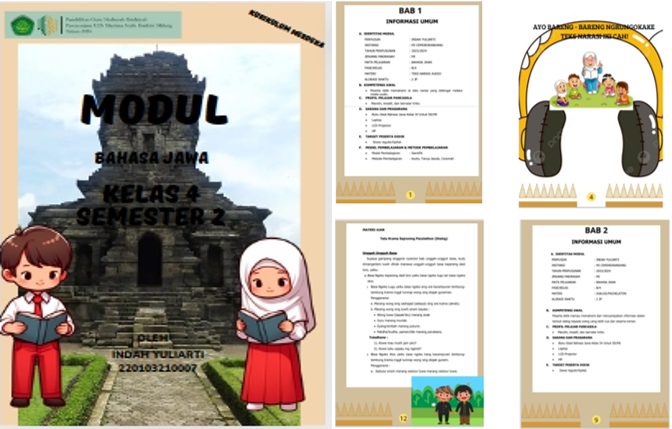
This research produces teaching material products in the form of electronic modules (e-modules) in class IV. The focus of the research discussed in this study is to: (1) Know the design of e-module development products to improve learning outcomes for class IV Javanese language subjects, (2) Find out the validity of e-modules to improve learning outcomes for class IV Javanese language subjects in the city Malang, and (3) Knowing the effectiveness of learning outcomes for class IV Javanese language subjects. This research uses the Research and Development (R&D) research method, referring to the ADDIE development model with stages including Analysis, Design, Development, Implementation and Evaluation. The result of this research is a Javanese e-module consisting of 33 pages. This e-module has validity from design experts of 85%, material experts of 85% and language experts of 93%. The results of the field test on the use of e-modules taken from the results of the fourth grade student questionnaire were 86.66%. Meanwhile, testing the effectiveness of the Javanese e-module on the learning outcomes of class IV students showed positive results. In terms of learning material, the results before using the e-module were 67.19 in the pre-test and increased after using the e-module in the post-test results to 81.19. The development of this e-module will later be useful for learning Javanese at primary level schools/madrasas, which of course this development can continue to be carried out to improve students' abilities and also teachers' abilities in terms of developing teaching materials.
Downloads
References
Afandi, M., Chamalah, E., & Wardani, O. P. (2013). Learning models and methods in schools. UNISSULA PRESS.
Afandi, A., Indah, C. H. R., Susanto, R., Budijanto, B., Rizka, R., & Hadiwiyanti, Y. M. (2023.). Use of flipbook-based motorcycle textbooks for students. SPRINTER: Journal of Sports Science, 4(2), 140–145.
Alsabhan, J. F., Almalag, H. M., Abanmy, N. O., Aljadeed, Y. I., Alhassan, R. M., & Albaker, A. B. (2024). A content-quality and optimization analysis of YouTube as a source of patient information for bipolar disorder. JSPS, https://doi.org/10.1016/j.jsps.2024.101997.
Amanullah, M. A. (2020). Development of digital flipbook learning media to support the learning process in the era of industrial revolution 4.0. Journal of Dimensions of Education and Learning, Special Issue , 37–44.
Arafet, K. & Berlanga, R. (2021). Digital twins in solar farms: An approach through time series and deep learning. Algorithms 2021, 14, 156.
Balaka, M. Y. (2022). Quantitative research methodology. Widina Bhakti Persada Bandung.
Boice, K. L., Alemdar, M., Jackson, J. R., Kessler, T. C., Choi, J., Grossman, S., & Usselman, M. (2024). Exploring teachers' understanding and implementation of STEAM: One size does not fit all. Frontiers Education, https://doi.org/10.3389/feduc.2024.1401191
Dwiyanti, I., Supriatna, A. R., & Marini, A. (2021). Phenomenological study of the use of e_modules in online learning with science content at Muhammadiyah Elementary School 5 Jakarta. Pendas: Scientific Journal of Basic Education, 6(1), 74–88. https://doi.org/10.23969/jp.v6i1.4175
Geograph, G. (2024). Understanding subjects and research objects. https://geografi.id/besarkan/pengertian-subjek-dan-object-penelitian/
Green, L., Condy, J., & Chigona, A. (2012). Developing the language of thinking within a classroom community of inquiry: Pre-service teachers' experiences. South African Journal of Education, 32:319-330.
Hakim, L. N., Agus, W., & Praherdhiono, H. (2020). Electronic module (e-module) to facilitate students studying light and optical devices at home. Jurnal Kajian Teknologi Pendidikan, 3(3), 239–250.
Juliani, R., & Ibrahim, N. (2023.). The influence of flipbook media on the Indonesian language learning outcomes of class IV students in elementary schools. ELSE (Elementary School Education Journal), 7(1). http://dx.doi.org/10.3065
Marizal, Y., & Asri, Y. (2022). Development of electronic modules assisted by the flippingbook PDF professional application learning to write explanatory text. Diglosia: Journal of Language, Literature and Teaching Studies, 5, 138.
Ministry of Education, Culture, Research and Technology of the Republic of Indonesia. (2022). Principles and Procedures for Developing Teaching Modules. Ministry of Education and Culture . https://centralinformation.kolaborasi.kemdikbud.go.id/hc/en-us/articles/5010596304153-Prinsip-dan-Prosedur-Pemembangan-Modul-Ajar
Riwu, I. U., Ngurah, D., Laksana, L., & Dhiu, K. D. (2018). Development of electronic teaching materials containing multimedia on the basic care theme for class IV in Ngada Regency. Journal of Educational Technology, 2(2), 56–64.
Rusmayana, T. (2021). Model pembelajaran addie integrasi pedati di SMK PGRI Karisma Bangsa sebagai pengganti praktek kerja lapangan dimasa pandemi Covid-19. Penerbit Widina. https://repository.penerbitwidina.com/publications/351939/model-pembelajaran-addie-integrasi-pedati-di-smk-pgri-karisma-bangsa-sebagai-pen
Sa'diyah, K. (2021). Developing a digital flipbook-based e-module to facilitate distance learning in high schools. Educative: Journal of Educational Sciences, 3(4), 1298–1308.
Salma, S. (2020.). Flipbook. https://penerbitdeepublish.com/flipbook/
Sappaile, B. I., Pristiwaluyo, T., & Deviana, I. (2021). Learning outcomes from the perspective of parental support and student interest in learning. Global Research and Consulting Institute (Global-RCI).
Sari, W. N., & Mubarak, A. (2021). Development of digital flipbook learning media in elementary schools. Educative: Journal of Educational Sciences, 3(5), 2819 - 2826.
Setiadi, M. I., Muksar, M., & Suprianti, D. (2021). Using flipbook learning media to improve student activities and learning outcomes. Journal of Social Sciences and Education (JISIP) , 5(4). http://dx.doi.org/10.36312/jisip.v5i4.2542
Soleha, U. (2023). learning media: exploring the Advantages and Weaknesses of Flipbook Vs PPT. Kumparan, 2023. https://kumparan.com/ulfiyatus-soleha/media-pembelajaran-menggali-keunggulan-dan-kebesaran-flipbook-vs-ppt-21ErJYcafnU/3
Sumartini, A. T. (2022.). Effectiveness of using flipbook teaching materials with the google classroom platform in distance learning. Journal of Elementary Education Didactics, 6(1),. https://doi.org/10.26811/didaktika.v6i1.752
Thahir, I., Kasman, K., Rauddin, R., & Rhamadan, N. (2022). Making e-module teaching materials using the flip PDF professional application. Journal of Community Service I-Com: Indonesian Community Journal, 2(3), 533-541.
Ulker, U., Ulker, V., Celik, B.,Yildiz, Y., & Bilgin, R. (2021). E-Book reading genre preferences of teachers teaching in foreign languages in private schools (case study / Iraq). International Journal of Social Sciences & Educational Studies, 8(4).
Velarde-Camaqui, D., Celaya-Ramírez, R., Contreras-Fuentes, Y., & Sanabria-Z5, J. (2024). Enhancing STEAM education through augmented reality: The EduAR open platform experience. FEDUC. https://doi.org/10.3389/feduc.2024.1391803
Yavuzalp, N., & Bahcivan, E. (2021). A structural equation modeling analysis of relationships among university students' readiness for e-learning, self-regulation skills, satisfaction, and academic achievement. Yavuzalp and Bahcivan Research and Practice in Technology Enhanced Learning. https://doi.org/10.1186/s41039-021-00162-y
Downloads
Published
How to Cite
Issue
Section
License
Copyright (c) 2024 Indah Yuliarti, Triyo Supriyatno, Mohamad Zubad Nurul Yaqin

This work is licensed under a Creative Commons Attribution-ShareAlike 4.0 International License.
Authors who publish with Research and Development in Education agree to the following terms:
- For all articles published in the Research and Development in Education, copyright is retained by the authors. Authors give permission to the publisher to announce the work with conditions. When the manuscript is accepted for publication, the authors agree to the automatic transfer of non-exclusive publishing rights to the publisher.
- Authors retain copyright and grant the journal right of first publication with the work simultaneously licensed under a Creative Commons Attribution-ShareAlike 4.0 International License that allows others to share the work with an acknowledgment of the work's authorship and initial publication in this journal.
- Authors are able to enter into separate, additional contractual arrangements for the non-exclusive distribution of the journal's published version of the work (e.g., post it to an institutional repository or publish it in a book), with an acknowledgment of its initial publication in this journal.
- Authors are permitted and encouraged to post their work online (e.g., in institutional repositories or on their website) prior to and during the submission process, as it can lead to productive exchanges, as well as earlier and greater citation of published work (See The Effect of Open Access).

This work is licensed under a Creative Commons Attribution-ShareAlike 4.0 International License.