Development of e-modul based on three-dimensional thinking graph to improve critical reasoning of junior high school students
DOI:
https://doi.org/10.22219/raden.v4i2.35894Keywords:
critical reasoning, e-module, three-dimensional thinking graphAbstract
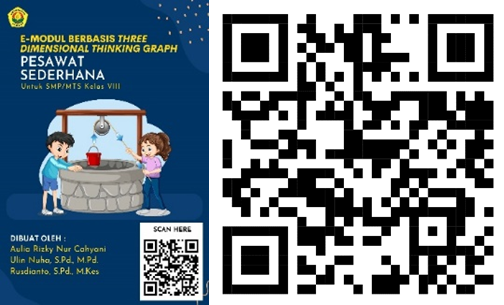
The process of strengthening character education in Indonesia is encapsulated in the initiative to enhance the Profil Pelajar Pancasila, with critical reasoning being one of its key dimensions. In the context of science education, critical reasoning involves engaging students in the development and testing of hypotheses. This study aims to evaluate the validity, practicality, and effectiveness of an e-module designed based on three-dimensional thinking graphs, intended to enhance critical reasoning among junior high school students in science learning. The research employs the ADDIE development model, with data collected through observation, interviews, tests (pretest and posttest), validation sheets, student response questionnaires, and implementation observation sheets. Results indicate that the e-module is highly valid, with a 93% validation score from experts, practical according to both observers (93%) and student responses (84.4%), and moderately effective, with an effectiveness score of 0.62. These findings suggest that the three-dimensional thinking graph-based e-module is a suitable tool for improving critical reasoning in the science learning process.
Downloads
References
Artiniasih, N. K. S., Agung, A. A. G., & Sudatha, I. G. W. 2019. Pengembangan elektronik modul berbasis proyek mata pelajaran ilmu pengetahuan alam kelas viii sekolah menengah pertama. Jurnal EDUTECH. 7(1): 54–65. https://doi.org/10.23887/jeu.v7i1.20008
Asri, A. S., & Dwiningsih, K. 2022. Validitas e-modul interaktif sebagai media pembelajaran untuk melatih kecerdasan visual spasial pada materi ikatan kovalen. Journal of Science Education. 6(2): 465-473. https://doi.org/10.33369/pendipa.6.2.465-473
Chen, J., Wang, M., & Dede, C. 2018. Using a three-dimensional thinking graph to support inquiry learning. Journal of Research in Science Teaching. 55(9): 1239–1263.
https://doi.org/10.1002/tea.21450
Chen, J., Wang, M., Dede, C., & Grotzer, T. A. 2021. Analyzing student thinking reflected in self-constructed cognitive maps and its influence on inquiry task performance. Instructional Science. 49(3): 287–312. https://doi.org/10.1007/s11251-021-09543-8
Cheva, V. K., & Zainul, R. 2019. Pengembangan e-modul berbasis inkuiri terbimbing pada materi sifat keperiodikan unsur untuk sma/ma kelas x. EduKimia. 1(1): 28–36. https://doi.org/10.24036/ekj.v1i1.104077
Dona, P., dan Syafriani. 2022. Validitas e-modul berbasis science, environment, technology, and society untuk meningkatkan kemampuan berpikir kreatif peserta didik kelas x SMA. Jurnal Penelitian dan Pembelajaran Fisika. 8(2): 133-121. https://103.216.87.80/index.php/jppf/article/view/115741/106891
Ernawati, Y., & Rahmawati, F. P. 2022. Analisis profil pelajar pancasila elemen bernalar kritis dalam modul belajar siswa literasi dan numerasi jenjang sekolah dasar. Jurnal Basicedu. 6(4): 6132–6144. https://doi.org/10.31004/basicedu.v6i4.3181
Hake, R.R. 1998. Interactive-engagement versus traditional methods: a six-thousand-student survey of mechanics test data for introductory physics courses. American Journal of Physics. 66(1): 64-74. https://doi.org/10.1119/1.18809
Hayati, N., & Setiawan, D. 2022. Dampak rendahnya kemampuan berbahasa dan bernalar terhadap kemampuan berpikir kritis siswa sekolah dasar. Jurnal Basicedu. 6(5): 8517–8528. https://doi.org/10.31004/basicedu.v6i5.3650
Kahfi, A. 2022. Implementasi profil pelajar pancasila dan implikasinya terhadap karakter siswa di sekolah. DIRASAH: Jurnal Pemikiran Dan Pendidikan Dasar Islam. 5(2): 138-151. https://doi.org/10.51476/dirasah.v5i2.402
Kemendikbudristek. 2022. Dimensi, elemen, dan sub elemen profil pelajar pancasila pada kurikulum merdeka. Jakarta: Badan Standar, Kurikulum, Dan Asesmen Pendidikan Kementerian Pendidikan, Kebudayaan, Riset, Dan Teknologi Republik Indonesia.
Kurniasi, E. R., & Arsisari, A. 2020. Pengembangan instrumen pengukur higher order thinking skills (hots) matematika pada siswa sekolah menengah pertama. AKSIOMA: Jurnal Program Studi Pendidikan Matematika. 9(4): 1213. http://dx.doi.org/10.24127/ajpm.v9i4.3162
Kurniawan, C., & Kuswandi, D. 2021. Pengembangan e-modul sebagai media literasi digital pada pembelajaran abad 21. Lamongan: Academia Publication.
Muhibbin, A., & Fathoni, A. 2021. Filsafat pendidikan. Malang: Muhammadiyah University Press.
Munawaroh, Marlina, L., & Sholeh, M. I. 2020. Pengembangan bahan ajar e-modul kimia pada materi reaksi redoks berbasis problem based learning (pbl) menggunakan aplikasi flip pdf professional. Jurnal Al’ilmi. 11(1): 20–24.
https://jurnal.radenfatah.ac.id/index.php/alilmi/article/view/15869/5493
Mustami, M. K., Suyuti, M., & Maryam. 2017. Validitas, kepraktisan, dan efektivitas perangkat pembelajaran biologi integrasi spiritual islam. Jurnal “Al-Qalam”. 23(1): 70-77. http://dx.doi.org/10.31969/alq.v23i1.392
Mutmainnah, Aunurrahman, & Warneri. 2021. Efektivitas penggunaan e-modul terhadap hasil belajar kognitif pada materi sistem pencernaan manusia di madrasah tsanawiyah. Jurnal Basicedu. 5(3): 1625-1631. https://doi.org/10.31004/basicedu.v5i3.952
Nurhusain, M., dan A. Hadi. 2021. Desain pembelajaran statistika terapan berbasis kasus berkualitas baik (valid, praktis, dan efektif) untuk mahasiswa pendidikan matematika. Indonesian Journal Of Educational Science. 3(2): 105-119.
https://doi.org/10.31605/ijes.v3i2.951
Purnianto, R., Haryudo, S. I., Joko, & Francisca, Y. 2022. Keefektifan dan kepraktisan modul pembelajaran instalasi penerangan listrik 1 fasa berorientasi pada pembelajaran abad 21 untuk kelas xi titl smk rajasa surabaya. Jurnal Pendidikan Teknik Elektro. 11(1): 107-115. https://doi.org/10.26740/jpte.v11n01.p107-115
Purwanti, E., Nurrohman, E., & Pranita, H. S. 2019. Kajian IPA. Malang: UMM Press.
Puspitasari, S. N., Suyono, & Astuningtyas, E. L. 2021. Efektivitas penerapan e-modul dalam meningkatkan pemahaman siswa kelas viii pada materi pola bilangan masa pandemi. Journal of Mathematics Education and Learning. 1(3): 274-286. https://doi.org/10.19184/jomeal.v1i3.26773
Sabrina, F., Hasnawati, & D. Anggraini. 2021. Pengembangan perangkat pembelajaran tematik metode permainan sesiku untuk pengetahuan fenomena gempa bumi siswa sd kabupaten kepahing. Jurnal Riset Pendidikan Dasar. 4(3): 439-452. https://doi.org/10.33369/juridikdas.4.3.%25p
Satria, R., Adiprima, P., Wulan, K. S., & Harjatanaya, T. Y. 2022. Panduan pengembangan projek penguatan profil pelajar pancasila. Jakarta: Badan Standar, Kurikulum, Dan Asesmen Pendidikan Kementerian Pendidikan, Kebudayaan, Riset, Dan Teknologi Republik Indonesia. https://kurikulum.kemdikbud.go.id/file/1679308669_manage_file.pdf
Wisudawati, A. W., & Sulistyowati, E. 2014. Metodologi pembelajaran IPA. Jakarta: PT Bumi Aksara. https://books.google.co.id/books?id=pTFsEAAAQBAJ&pg=PA26&dq=Metodologi+Pembelajaran+IPA&hl=id&newbks=1&newbks_redir=0&sa=X&ved=2ahUKEwi59cfQ_JSEAxUrxzgGHfz6C6sQ6AF6BAgHEAI#v=onepage&q&f=false
Yulianti, E., & Zhafirah, N. N. 2020. Peningkatan kemampuan penalaran ilmiah siswa sekolah menengah pertama melalui model pembelajaran inkuiri terbimbing. Jurnal Penelitian Pendidikan IPA. 6(1): 125. 10.29303/jppipa.v6i1.341
Downloads
Published
How to Cite
Issue
Section
License
Copyright (c) 2024 Ulin Nuha, Aulia Rizky Nur Cahyani, R. Rusdianto, S. Supeno, Diah Wahyuni, Rizka Elan Fadhilah

This work is licensed under a Creative Commons Attribution-ShareAlike 4.0 International License.
Authors who publish with Research and Development in Education agree to the following terms:
- For all articles published in the Research and Development in Education, copyright is retained by the authors. Authors give permission to the publisher to announce the work with conditions. When the manuscript is accepted for publication, the authors agree to the automatic transfer of non-exclusive publishing rights to the publisher.
- Authors retain copyright and grant the journal right of first publication with the work simultaneously licensed under a Creative Commons Attribution-ShareAlike 4.0 International License that allows others to share the work with an acknowledgment of the work's authorship and initial publication in this journal.
- Authors are able to enter into separate, additional contractual arrangements for the non-exclusive distribution of the journal's published version of the work (e.g., post it to an institutional repository or publish it in a book), with an acknowledgment of its initial publication in this journal.
- Authors are permitted and encouraged to post their work online (e.g., in institutional repositories or on their website) prior to and during the submission process, as it can lead to productive exchanges, as well as earlier and greater citation of published work (See The Effect of Open Access).

This work is licensed under a Creative Commons Attribution-ShareAlike 4.0 International License.