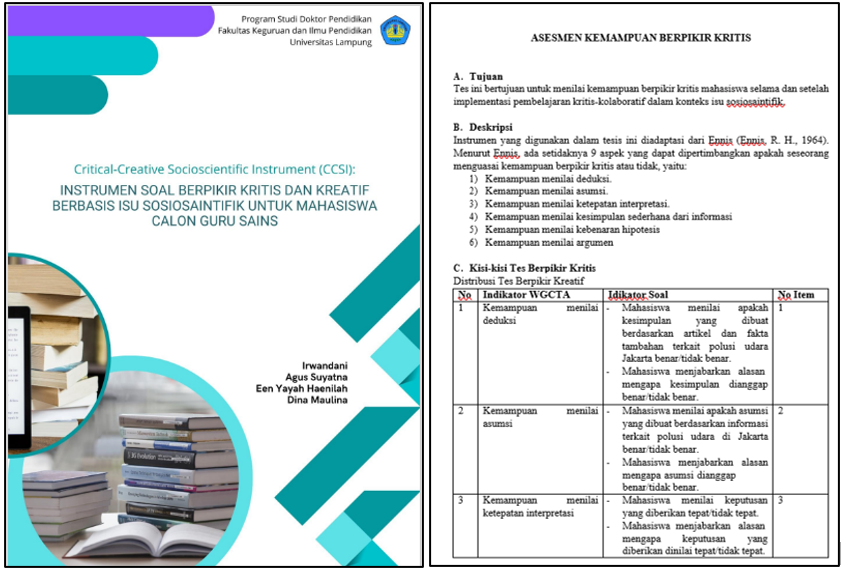
Development of a critical-creative socioscientific instrument for prospective science teachers
DOI:
https://doi.org/10.22219/raden.v4i2.36119Keywords:
socioscientific issues, critical-creative thinking, instrumentAbstract
The current educational challenges highlight a lack of focus on developing critical and creative thinking skills, especially related to socioscientific issues such as biodiversity. Existing learning systems tend to center on knowledge transfer, leaving many prospective teachers feeling underprepared to foster these skills in their classrooms. This underscores the need for an effective instrument to develop critical and creative thinking skills within a socioscientific context. This study aims to develop the Critical-Creative Development Socioscientific Instrument (CCSI) tailored for assessing students' critical and creative thinking skills on socioscientific issue. This research is Research and Development (RnD) development research which refers to the ADDIE development model. The type of research used is mixed methods research with an embedded experimental model design. CCSI was meticulously validated by experts in the field, with five validators for the model and research instruments. The validation process demonstrated high levels of content and construct validity, with final percentages of 88.80% and 91.20%, respectively. The results indicate that the CCSI is "Very Valid" and "Appropriate to Use" as a tool for enhancing and assessing 21st-century skills, particularly in the context of socioscientific issue. This instrument is therefore recommended for use in educational settings where the development of critical and creative thinking is essential.
Downloads
References
Abdulrahaman, M. D., Faruk, N., Oloyede, A. A., Surajudeen-Bakinde, N. T., Olawoyin, L. A., Mejabi, O. V, Imam-Fulani, Y. O., Fahm, A. O., & Azeez, A. L. (2020). Multimedia tools in the teaching and learning processes: A systematic review. Heliyon, 6(11), e05312. https://doi.org/10.1016/j.heliyon.2020.e05312
Aizikovitsh-Udi, E., & Amit, M. (2011). Developing the skills of critical and creative thinking by probability teaching. Procedia - Social and Behavioral Sciences, 15, 1087–1091. https://doi.org/10.1016/j.sbspro.2011.03.243
Akmam, A., Anshari, R., Jalinus, N., & Amran, A. (2019). Factors influencing the critical and creative thinking skills of college students in computational physics courses. Journal of Physics: Conference Series, 1317(1), 012172. https://doi.org/10.1088/1742-6596/1317/1/012172
Al amin, Y., & Najah, Z. (2023). Developmental Research: An Android-Based Arabic Language Learning Application as a Means to Improve Middle School Students’ Learning Outcomes. Language, Technology, and Social Media, 1(1), 52–64. https://doi.org/10.70211/ltsm.v1i1.26
Alias, A., Mohtar, L. E., Ayop, S. K., & Rahim, F. R. (2022). A Systematic Review on Instruments to Assess Critical Thinking & Problem-Solving Skills. EDUCATUM Journal of Science, Mathematics and Technology, 9(Sp), 38–47. https://doi.org/10.37134/ejsmt.vol9.sp.5.2022
Amariza, A. H., Safitri, N. S., Mulyaningsih, W. J., & Susilo, B. E. (2024). Systematic Literature Review: Mengurangi Tingkat Kecemasan Peserta Didik Menyelesaikan Persoalan Matematika dalam Model Pembelajaran Problem Based Learning. PRISMA, Prosiding Seminar Nasional Matematika, 7, 852–872. https://journal.unnes.ac.id/sju/index.php/prisma/
Amirova, A., Iskakovna, J. M., Zakaryanovna, T. G., Nurmakhanovna, Z. T., & Elmira, U. (2020). Creative and research competence as a factor of professional training of future teachers: Perspective of learning technology. World Journal on Educational Technology: Current Issues, 12(4), 278–289. https://doi.org/10.18844/wjet.v12i4.5181
Antara, K., Diri, H., & Diri, K. (2024). Pada Peserta Didik Kelas Xi. 4(5), 0–4. https://doi.org/10.17977/um065.v4.i4.2024.1
Arjaya, I. B. A., & Surata, S. P. K. (2024). Systematic Review: Trends Socioscientific Issues in Climate Change Materials. Jurnal Santiaji Pendidikan (JSP), 14(1), 52–65. https://doi.org/10.36733/jsp.v14i1.8666
Ashari, M. K., Athoillah, S., & Faizin, M. (2023). Model E-Asesmen Berbasis Aplikasi pada Sekolah Menengah Atas di Era Digital: Systematic Literature Review. TA’DIBUNA: Jurnal Pendidikan Agama Islam, 6(2), 132. https://doi.org/10.30659/jpai.6.2.132-150
Aulia, R., & Hendriani, W. (2022). E-Learning Pada Visual Impairment: Studi Literatur. Psikovidya, 26(2), 40–49. https://doi.org/10.37303/psikovidya.v26i2.199
Aziz, M. A. (2023). The Philosophical Foundation of Western Higher Education: A Critical Review of Theory and Practice. International Journal of Educational Research Review, 8(2), 208–219. https://doi.org/10.24331/ijere.1238148
Barnosky, A. D., Brown, J. H., Daily, G. C., Dirzo, R., Ehrlich, A. H., Ehrlich, P. R., Eronen, J. T., Fortelius, M., Hadly, E. A., Leopold, E. B., Mooney, H. A., Myers, J. P., Naylor, R. L., Palumbi, S., Stenseth, N. C., & Wake, M. H. (2014). Introducing the scientific consensus on maintaining humanity’s life support systems in the 21st century: Information for policy makers. In Anthropocene Review (Vol. 1, Issue 1). https://doi.org/10.1177/2053019613516290
Berg, T. B., Achiam, M., Poulsen, K. M., Sanderhoff, L. B., & Tøttrup, A. P. (2021). The Role and Value of Out-of-School Environments in Science Education for 21st Century Skills. Frontiers in Education, 6(May), 1–8. https://doi.org/10.3389/feduc.2021.674541
Boone, K., Roets, G., & Roose, R. (2019). Raising critical consciousness in the struggle against poverty: Breaking a culture of silence. Critical Social Policy, 39(3), 434–454. https://doi.org/10.1177/0261018318820233
Bradbeer, C., Mahat, M., Byers, T., & Imms, W. (2019). Bradbeer, C., Mahat, M., Byers, T., & Imms, W. (2019). A systematic review of the effects of innovative learning environments on teacher mind frames. https://www.iletc.com.au/wp-content/uploads/2019/12/ILETC_TR5_Web.pdf
Brooks, S. D., Braun, S. M., & Prince, D. . (2022). Critical Consciousness in High School Outdoor Experiential Environmental Education. Journal of Experiential Education, 3, 392-407. https://journals.sagepub.com/doi/10.1177/10538259211068800
Burgess, A., & McGregor, D. (2018). Peer teacher training for health professional students: A systematic review of formal programs 13 Education 1303 Specialist Studies in Education 13 Education 1302 Curriculum and Pedagogy. BMC Medical Education, 18(1). https://doi.org/10.1186/s12909-018-1356-2
Chen, L., & Xiao, S. (2021). Perceptions, challenges and coping strategies of science teachers in teaching socioscientific issues: A systematic review. Educational Research Review, 32(February 2020), 100377. https://doi.org/10.1016/j.edurev.2020.100377
Chung, Y., Yoo, J., Kim, S. W., Lee, H., & Zeidler, D. L. (2016). Enhancing Students’ Communication Skills in the Science Classroom Through Socioscientific Issues. International Journal of Science and Mathematics Education, 14(1), 1–27. https://doi.org/10.1007/s10763-014-9557-6
Creswell, J. W., & Clark, V. L. P. (2007). Designing and Conducting Mixed Methods Research. SAGE. https://books.google.co.id/books/about/Designing_and_Conducting_Mixed_Methods_R.html?id=YcdlPWPJRBcC&redir_esc=y
Edmonds, W. A., & Kennedy, T. D. (2017). An applied guide to research designs: Quantitative, qualitative, and mixed methods (2nd ed.). SAGE. https://methods.sagepub.com/book/an-applied-guide-to-research-designs-2e
Falloon, G. (2020). From digital literacy to digital competence: the teacher digital competency (TDC) framework. Educational Technology Research and Development, 68(5), 2449–2472. https://doi.org/10.1007/s11423-020-09767-4
Fernandes, G. W. R., Rodrigues, A. M., & Ferreira, C. A. (2020). Professional Development and Use of Digital Technologies by Science Teachers: a Review of Theoretical Frameworks. Research in Science Education, 50(2), 673–708. https://doi.org/10.1007/s11165-018-9707-x
Freire, P. (2000). Pedagogy of the oppressed (30th ed.). https://www.taylorfrancis.com/chapters/edit/10.4324/9781003060635-5/pedagogy-oppressed-paulo-freire
Gai Mali, Y. C., Kurniawan, D., Januardi, J. I., Swara, S. J., Lokollo, N. C. E., Picauly, I. A., Paramitha, N. G., Tanore, J. A., Dewani, M. S., & Pakiding, R. W. (2023). Issues and Challenges of Technology Use in Indonesian Schools: Implications for Teaching and Learning. IJIET (International Journal of Indonesian Education and Teaching), 7(2), 221–233. https://doi.org/10.24071/ijiet.v7i2.6310
Goldan, J., & Schwab, S. (2020). Measuring students’ and teachers’ perceptions of resources in inclusive education–validation of a newly developed instrument. International Journal of Inclusive Education, 24(12), 1326–1339. https://doi.org/10.1080/13603116.2018.1515270
González‐salamanca, J. C., Agudelo, O. L., & Salinas, J. (2020). Key competences, education for sustainable development and strategies for the development of 21st century skills. A systematic literature review. Sustainability (Switzerland), 12(24), 1–17. https://doi.org/10.3390/su122410366
Gutiérrez-Ujaque, D., & Degen, M. M. (2023). Beyond critical pedagogy of place: sensory-embodied learning through the university campus. Journal of Geography in Higher Education, 00(00), 1–20. https://doi.org/10.1080/03098265.2023.2267489
Halewood, M., Chiurugwi, T., Sackville Hamilton, R., Kurtz, B., Marden, E., Welch, E., Michiels, F., Mozafari, J., Sabran, M., Patron, N., Kersey, P., Bastow, R., Dorius, S., Dias, S., McCouch, S., & Powell, W. (2018). Plant genetic resources for food and agriculture: opportunities and challenges emerging from the science and information technology revolution. New Phytologist, 217(4), 1407–1419. https://doi.org/10.1111/nph.14993
Harasim, L. (2017). Learning Theory and Online Technologies (2nd ed.). Routledge. https://doi.org/10.4324/9781315716831
Hernández-Ramos, J., Pernaa, J., Cáceres-Jensen, L., & Rodríguez-Becerra, J. (2021). The effects of using socio-scientific issues and technology in problem-based learning: A systematic review. Education Sciences, 11(10). https://doi.org/10.3390/educsci11100640
Hu, D., Zhou, S., Crowley-Mchattan, Z. J., & Liu, Z. (2021). Factors that influence participation in physical activity in school-aged children and adolescents: A systematic review from the social ecological model perspective. International Journal of Environmental Research and Public Health, 18(6), 1–20. https://doi.org/10.3390/ijerph18063147
Irwandani, I., Suyatna, A., Haenilah, E. Y., & Maulina, D. (2024). Readiness of Indonesian pre-service science teachers for society 5.0. Journal of Education and Learning, 18(2), 391–402. https://doi.org/10.11591/edulearn.v18i2.21343
Jakubik, M. (2023). Cultivating the Future in Higher Education: Fostering Students’ Life-World Becoming with Wisdom Pedagogy. Trends in Higher Education, 2(1), 45–61. https://doi.org/10.3390/higheredu2010004
Kasmawati, Y. (2019). Pentingnya budaya kolaboratif : suatu tinjauan literatur. Jurnal Manajemen Strategi Dan Aplikasi Bisnis, 2(2), 203–214. https://doi.org/10.36407/jmsab.v2i2.97
Khalid, J., & Purnawati, N. K. (2024). Achieving Blessings Through the Flagship Zero Waste Program at SMAN 4 Mataram. SAKAGURU: Journal of Pedagogy and Creative Teacher, 1(1), 27–41. https://doi.org/10.70211/sakaguru.v1i1.44
Koivuniemi, M., Järvenoja, H., Järvelä, S., & Thomas, V. (2021). An overview of instruments for assessing and supporting elementary school students’ self-regulated learning. Learning: Research and Practice, 7(2), 109–146. https://doi.org/10.1080/23735082.2020.1859123
Lemrow, E. M. (2017). Créolization and the new cosmopolitanism: examining twenty-first-century student identities and literacy practices for transcultural understanding. Journal of Multilingual and Multicultural Development, 38(5), 453–467. https://doi.org/10.1080/01434632.2016.1186680
Lorencová, H., Jarošová, E., Avgitidou, S., & Dimitriadou, C. (2019). Critical thinking practices in teacher education programmes: a systematic review. Studies in Higher Education, 44(5), 844–859. https://doi.org/10.1080/03075079.2019.1586331
Mantau, B. A. K., & Talango, S. R. (2023). Pengintegrasian Keterampilan Abad 21 Dalam Proses Pembelajaran (Literature Review). Irfani, 19(1), 86–107. https://doi.org/10.30603/ir.v19i1.3897
Martin, F., Dennen, V. P., & Bonk, C. J. (2020). A synthesis of systematic review research on emerging learning environments and technologies. Educational Technology Research and Development, 68(4), 1613–1633. https://doi.org/10.1007/s11423-020-09812-2
Merchie, E., Tuytens, M., Devos, G., & Vanderlinde, R. (2018). Evaluating teachers’ professional development initiatives: towards an extended evaluative framework. Research Papers in Education, 33(2), 143–168. https://doi.org/10.1080/02671522.2016.1271003
Misiaszek, G. W. (2020). Ecopedagogy: Educating for sustainability in globalized contexts. Teaching in Higher Education (5th ed.). https://doi.org/https://doi.org/10.1080/13562517.2020.1754787
Miterianifa, M., & Mawarni, M. F. (2024). Penerapan Model Pembelajaran Literasi Lingkungan dalam Meningkatkan Pengetahuan dan Kesadaran Lingkungan. Jurnal Sains Dan Edukasi Sains, 7(1), 68–73. https://doi.org/10.24246/juses.v7i1p68-73
Mohamad, M., Palani, K., Nathan, L. S., Sandhakumarin, Y., Indira, R., & Jamila, E. (2023). Educational Challenges in the 21st Century: A Literature Review. International Journal of Academic Research in Progressive Education and Development, 12(2), 1221–1227. https://doi.org/10.6007/ijarped/v12-i2/16865
Novak, J. D. (2013). Meaningful learning is the foundation for creativity. Revista Qurriculum (26th ed.). https://www.ull.es/revistas/index.php/qurriculum/article/view/64/37
Nurhuda, A., Al Fajri, M., Shahrulerizal, T. E., & Rahman, E. A. (2023). The Concept of Facilities and Infrastructure Management in Schools: A Literature Review. International Journal of Education & Curriculum Application, 6(3), 248–260. http://journal.ummat.ac.id/index.php/IJECA
Prasetya, A. D., Utama, A. H., & Mastur, M. (2024). Pemanfaatan Sosial Media Sebagai Penyajian Konten Pembelajaran Digital: Study Literature Review. Jurnal Riset Dan Inovasi Pembelajaran, 4(2), 1004–1017. https://doi.org/10.51574/jrip.v4i2.1702
Rahardjanto, A., & Husamah, H. (2022). Publication Trend of Environmental Topics in The Journal of Biological Education in Indonesia (Sinta 2; 2017-2021): A Systematic Literature Review. Jurnal Pembelajaran Dan Biologi Nukleus, 8(1), 17–40. https://doi.org/10.36987/jpbn.v8i1.2453
Ramírez-Montoya, M. S., Andrade-Vargas, L., Rivera-Rogel, D., & Portuguez-Castro, M. (2021). Trends for the Future of Education Programs for Professional Development. Sustainability, 13(13), 7244. https://doi.org/10.3390/su13137244
Richardson, C., & Mishra, P. (2018). Learning environments that support student creativity: Developing the SCALE. Thinking Skills and Creativity, 27, 45–54. https://doi.org/10.1016/j.tsc.2017.11.004
Romijn, B. R., Slot, P. L., & Leseman, P. P. M. (2021). Increasing teachers’ intercultural competences in teacher preparation programs and through professional development: A review. Teaching and Teacher Education, 98, 103236. https://doi.org/10.1016/j.tate.2020.103236
Rowan, L., Bourke, T., L’Estrange, L., Lunn Brownlee, J., Ryan, M., Walker, S., & Churchward, P. (2021). How Does Initial Teacher Education Research Frame the Challenge of Preparing Future Teachers for Student Diversity in Schools? A Systematic Review of Literature. In Review of Educational Research (Vol. 91, Issue 1). https://doi.org/10.3102/0034654320979171
Sanchez, J. M. P., Picardal, M. T., Fernandez, S. R., & Caturza, R. R. A. (2024). Socio-Scientific Issues in Focus: A Meta-analytical Review of Strategies and Outcomes in Climate Change Science Education. Science Education International, 35(2), 119–132. https://doi.org/10.33828/sei.v35.i2.6
Saputra, W. T., Rochintaniawati, D., & Agustin, R. R. (2024). The Role of Learning Models in Enhancing Scientific Literacy : A Critical Review Evaluation. 12(3), 462–476. https://doi.org/https://doi.org/10.33394/j-ps.v12i3.10827
Setiawan, H. R., Rakhmadi, A. J., & Raisal, A. Y. (2021). Pengembangan media ajar lubang hitam menggunakan model pengembangan addie. Jurnal Kumparan Fisika, 4(2), 112–119. https://doi.org/10.33369/jkf.4.2.112-119
Setiyati, S., Tarman, T., Metta, M., & Warman, W. (2024). Perencanaan Strategik dalam Membangun Mutu Pendidikan di Madrasah Syaichona Kholil Teluk Pandan. Jurnal Tarbiyah Dan Ilmu Keguruan Borneo, 5(2), 267–281. https://doi.org/10.21093/jtikborneo.v5i2.8749
Shivanna, K. R. (2022). Climate change and its impact on biodiversity and human welfare. Proceedings of the Indian National Science Academy, 88(2), 160–171. https://doi.org/10.1007/s43538-022-00073-6
Sims, S., & Fletcher-Wood, H. (2021). Identifying the characteristics of effective teacher professional development: a critical review. School Effectiveness and School Improvement, 32(1), 47–63. https://doi.org/10.1080/09243453.2020.1772841
Smitsman, A., Laszlo, A., & Luksha, P. (2020). Evolutionary Learning Ecosystems for Thrivable Futures: Crafting and Curating the Conditions for Future-Fit Education. World Futures, 76(4), 214–239. https://doi.org/10.1080/02604027.2020.1740075
Spiteri, M., & Chang Rundgren, S. N. (2020). Literature Review on the Factors Affecting Primary Teachers’ Use of Digital Technology. Technology, Knowledge and Learning, 25(1), 115–128. https://doi.org/10.1007/s10758-018-9376-x
Sumarni, W., & Kadarwati, S. (2020). Ethno-stem project-based learning: Its impact to critical and creative thinking skills. Jurnal Pendidikan IPA Indonesia, 9(1), 11–21. https://doi.org/10.15294/jpii.v9i1.21754
Sutanto. (2024). Transformasi Pendidikan di Sekolah Dasar: Peran Guru dalam Mengimplementasikan Kurikulum Merdeka di Indonesia. Jurnal Guru Sekolah Dasar, 1(1), 68–75. https://doi.org/10.5281/zenodo.12734150
Takyi, S. A., Amponsah, O., Asibey, M. O., & Ayambire, R. A. (2021). An overview of Ghana’s educational system and its implication for educational equity. International Journal of Leadership in Education, 24(2), 157–182. https://doi.org/10.1080/13603124.2019.1613565
Thornhill-Miller, B., Camarda, A., Mercier, M., Burkhardt, J. M., Morisseau, T., Bourgeois-Bougrine, S., Vinchon, F., El Hayek, S., Augereau-Landais, M., Mourey, F., Feybesse, C., Sundquist, D., & Lubart, T. (2023). Creativity, Critical Thinking, Communication, and Collaboration: Assessment, Certification, and Promotion of 21st Century Skills for the Future of Work and Education. Journal of Intelligence, 11(3). https://doi.org/10.3390/jintelligence11030054
Turugare, M., & Rudhumbu, N. (2020). Integrating technology in teaching and learning in universities in Lesotho: opportunities and challenges. Education and Information Technologies, 25(5), 3593–3612. https://doi.org/10.1007/s10639-019-10093-3
Uerz, D., Volman, M., & Kral, M. (2018). Teacher educators’ competences in fostering student teachers’ proficiency in teaching and learning with technology: An overview of relevant research literature. Teaching and Teacher Education, 70, 12–23. https://doi.org/10.1016/j.tate.2017.11.005
Vithanapathirana, M., & Nettikumara, L. (2020). Improving secondary science instruction through content and language integrated learning (CLIL) in Sri Lanka. International Online Journal of Education and Teaching, 7, 141–148. http://iojet.org/index.php/IOJET/article/view/684
Welsh, R. O., & Little, S. (2018). The School Discipline Dilemma: A Comprehensive Review of Disparities and Alternative Approaches. Review of Educational Research, 88(5), 752–794. https://doi.org/10.3102/0034654318791582
Yahya. (2024). Meningkatkan minat membaca dengan menggunakan media puzzel dari rangkaian gambar pada siswa kelas III SD Negeri 5 rikit gaib. Cendekia Pendidikan, 3(6), 101–112. https://doi.org/10.9644/sindoro.v3i6.2236
Yoon, S. A., Chinn, C., Noushad, N., Richman, T., Hussain-Abidi, H., Hunkar, K., Cottone, A., Katz, J., Mitkus, E., & Wendel, D. (2023). Seven design principles for teaching complex socioscientific issues: the design of a complex systems agent-based disease epidemic model and the application of epistemic practices in high school biology. Frontiers in Education, 8(September), 1–16. https://doi.org/10.3389/feduc.2023.1210153
Zidny, R., Sjöström, J., & Eilks, I. (2020). A Multi-Perspective Reflection on How Indigenous Knowledge and Related Ideas Can Improve Science Education for Sustainability. Science and Education, 29(1), 145–185. https://doi.org/10.1007/s11191-019-00100-x
Downloads
Published
How to Cite
Issue
Section
License
Copyright (c) 2024 I. Irwandani, Agus Suyatna, Een Yayah Haenilah, Dina Maulina, Anggun Septi Rahayu

This work is licensed under a Creative Commons Attribution-ShareAlike 4.0 International License.
Authors who publish with Research and Development in Education agree to the following terms:
- For all articles published in the Research and Development in Education, copyright is retained by the authors. Authors give permission to the publisher to announce the work with conditions. When the manuscript is accepted for publication, the authors agree to the automatic transfer of non-exclusive publishing rights to the publisher.
- Authors retain copyright and grant the journal right of first publication with the work simultaneously licensed under a Creative Commons Attribution-ShareAlike 4.0 International License that allows others to share the work with an acknowledgment of the work's authorship and initial publication in this journal.
- Authors are able to enter into separate, additional contractual arrangements for the non-exclusive distribution of the journal's published version of the work (e.g., post it to an institutional repository or publish it in a book), with an acknowledgment of its initial publication in this journal.
- Authors are permitted and encouraged to post their work online (e.g., in institutional repositories or on their website) prior to and during the submission process, as it can lead to productive exchanges, as well as earlier and greater citation of published work (See The Effect of Open Access).

This work is licensed under a Creative Commons Attribution-ShareAlike 4.0 International License.