Creative and adaptive sports learning model to increase participation of students with special needs
DOI:
https://doi.org/10.22219/raden.v4i2.36746Keywords:
creative and adaptive, inclusive education, special needs, sports learning, student participationAbstract
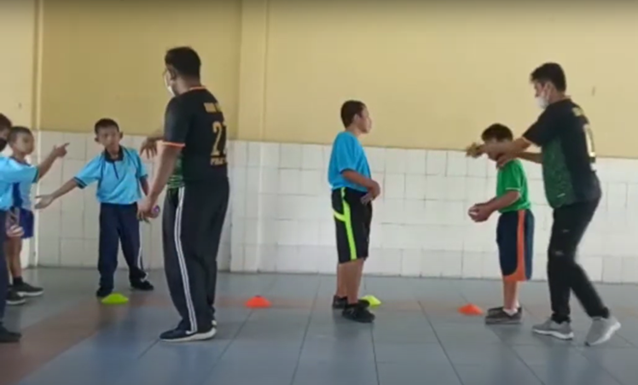
This study aims to develop and test the effectiveness of a creative and adaptive sports learning model in increasing the participation of students with special needs. The study used an experimental quantitative approach involving 30 students with special needs in an inclusive elementary school. Data were collected through participant observation, structured interviews with teachers and therapists, and questionnaires to parents, after which the data were analyzed using descriptive and inferential statistical techniques. Descriptive statistical analysis showed an average student participation of 86.94 after the implementation of the learning model, which showed a significant increase. The Wilcoxon Signed Ranks Test inferential test also showed a significant difference (p<0.05) between student participation before and after the implementation of the model. The results of interviews with parents revealed a positive impact not only on the physical aspects, but also the social and emotional aspects of their children. Adjustments to equipment, environment, and sports methods allowed students with special needs to be more actively involved in physical activities. These findings support the principles of inclusive education and indicate that the creative and adaptive learning model is effective in creating an inclusive learning environment. This study recommends the implementation of the model in other inclusive schools to increase the participation of students with special needs and support their holistic development.
Downloads
References
Abbott, R. D., Donnell, J. O., Hawkins, J. D., Hill, K. G., Kosterman, R., & Catalano, R. F. (1998). Changing teaching practices to promote achievement and bonding to school. American Journal of Orthopsychiatry, 68(4), 542–552. https://pubmed.ncbi.nlm.nih.gov/9809114/
Ackerman-Barger, K., Boatright, D., Gonzalez-Colaso, R., Orozco, R., & Latimore, D. (2020). Seeking inclusion excellence: Understanding racial microaggressions as experienced by underrepresented medical and nursing students. Academic Medicine, 95(5), 758–763. https:// doi.org/10.1097/ACM.0000000000003077
Alnahdi, G. H., & Schwab, S. (2021). Inclusive education in Saudi Arabia and Germany: students’ perception of school well-being, social inclusion, and academic self-concept. European Journal of Special Needs Education, 36(5), 773–786. https://doi.org/10.1080/08856257.2020.1823163
Alvarado-Alcantar, R., & Keeley, R. (2020). Students with specific learning disabilities’ experiences with instructional materials and programs in a blended high school history classroom: A phenomenological study of accessibility. Journal of Online Learning Research, 6(3), 201–220. https://www.ijme.net/archive/4/students-with-specific-learning-difficulties.pdf
Arsil, A., Okilanda, A., Antoni, D., Rozi, M. F., Saputra, M., Mortejo, A. L., Suganda, M. A., & Suryadi, D. (2024). Effectiveness of teaching methods and motor abilities: an experimental study on football passing ability. Retos, 54, 625–632. https://doi.org/10.47197/RETOS.V54. 104407
Artiluhung, R. R., Mahendra, A., Yulianto, A. G., & Aman, M. S. (2023). Systematic literature review: Strategies for active and creative learning in Elementary School Physical Education. Journal of Physical Education, Sport, Health and Recreations, 12(3), 247–253. https://journal.unnes.ac.id/jour nals/peshr/article/download/13854/2136/48919
Bartz, J. (2020). All inclusive?! empirical insights into individual experiences of students with disabilities and mental disorders at german universities and implications for inclusive higher education. Education Sciences, 10(9), 1–25. https://doi.org/10.3390/educsci10090223
Bridges, D., Wulff, E., & Bamberry, L. (2023). Resilience for gender inclusion: Developing a model for women in male-dominated occupations. Gender, Work and Organization, 30(1), 263–279. https://doi.org/10.1111/gwao.12672
Carbone, P. S., Smith, P. J., Lewis, C., & LeBlanc, C. (2021). Promoting the participation of children and adolescents with disabilities in sports, recreation, and physical activity. Pediatrics, 148(6). https://doi.org/10.1542/peds.2021-054664
Castleberry, A., & Nolen, A. (2018). Thematic analysis of qualitative research data: Is it as easy as it sounds? Currents in Pharmacy Teaching and Learning, 10(6), 807–815. https://doi.org/10. 1016/j.cptl.2018.03.019
Ccanto, F. F., Maldonado, D. M. C., Huaman, V. C. D., Zuniga, A. G. C., Cauti, F. T., Condori, J. C. V., Huatuco, W. R. Y., Chaupis, Y. M., Moscoso, D. J. C., & Medina, G. R. E. (2020). Case study module with SPSS for the learning of statistics seminar applied to educational research in Doctoral Students of the National University of Education Enrique Guzmán y Valle. 3rd International Conference of Inclusive Technology and Education, CONTIE 2020, 196–201. https:// doi.org/10.1109/contie51334.2020.00043
Cousineau, D. (2020). In-class activity comparing standard errors as a function of sample size with SPSS. The Quantitative Methods for Psychology, 16(2), v4–v7. https://doi.org/10.20982/tqmp. 16.2.v009
Eslahchi, M. (2023). Leadership and collective learning: a case study of a social entrepreneurial organisation in Sweden. Learning Organization, 30(6), 815–833. https://doi.org/10.1108/TLO-11-2022-0133
Fernández-Batanero, J. M., Montenegro-Rueda, M., Fernández-Cerero, J., & García-Martínez, I. (2022). Assistive technology for the inclusion of students with disabilities: a systematic review. Educational Technology Research and Development, 70(5), 1911–1930. https://doi.org/10.1007 /s11423-022-10127-7
Finn, C., Abbeel, P., & Levine, S. (2017). Model-agnostic meta-learning for fast adaptation of deep networks. 34th International Conference on Machine Learning, ICML 2017, 3, 1856–1868. https://proceedings.mlr.press/v70/finn17a.html
Hahs-Vaughn, D. L. . (2017). Applied multivariate statistical analysis. In Applied Multivariate Statistical Analysis. Routledge. https://doi.org/10.1007/978-3-030-26006-4
Hermanto, H., & Pamungkas, B. (2023). Teacher strategies for providing access to learning for students with special needs in elementary schools. International Journal of Learning, Teaching and Educational Research, 22(4), 345–361. https://doi.org/10.26803/ijlter.22.4.20
Heyder, A., Südkamp, A., & Steinmayr, R. (2020). How are teachers’ attitudes toward inclusion related to the social-emotional school experiences of students with and without special educational needs? Learning and Individual Differences, 77(July 2018), 101776. https://doi.org /10.1016/j.lindif.2019.101776
Jones, I. (2022). Research methods for sports studies (Fourth, Issue 1). Taylor & Francis. https://doi. org/10.4324/9781003195467
Khaleel, N., Alhosani, M., & Duyar, I. (2021). The role of school principals in promoting inclusive schools: A teachers’ perspective. Frontiers in Education, 6(April), 1–14. https://doi.org/10.3389/ feduc.2021.603241
Kwon, E. H., & Block, M. E. (2017). Implementing the adapted physical education E-learning program into physical education teacher education program. Research in Developmental Disabilities, 69(May), 18–29. https://doi.org/10.1016/j.ridd.2017.07.001
Lindner, K. T., Schwab, S., Emara, M., & Avramidis, E. (2023). Do teachers favor the inclusion of all students? A systematic review of primary schoolteachers’ attitudes towards inclusive education. European Journal of Special Needs Education, 38(6), 766–787. https://doi.org/10. 1080/08856257.2023.2172894
Madry, A., Makelov, A., Schmidt, L., Tsipras, D., & Vladu, A. (2019). Towards deep learning models resistant to adversarial attacks. 6th International Conference on Learning Representations, 1–28. https://doi.org/10.48550/arXiv.1706.06083
Nottingham, P. M. I. (2020). Professional artefacts: evaluating creative outcomes for work-based inquiry. Journal of Work-Applied Management, 12(2), 127–139. https://doi.org/10.1108/JWAM-03-2020-0014
O’Connor, J., Jeanes, R., & Alfrey, L. (2016). Authentic inquiry-based learning in health and physical education: a case study of ‘r/evolutionary’ practice. Physical Education and Sport Pedagogy, 21(2), 201–216. https://doi.org/10.1080/17408989.2014.990368
O’Regan, F. (2018). Teaching and managing students with ADHD: Systems, strategies solutions (pp. 12–16). https://www.adhdfoundation.org.uk/wp-content/uploads/2022/03/Teaching-and-Manag ing-Students-with-ADHD.pdf
Paszke, A., Gross, S., Massa, F., Lerer, A., Bradbury, J., Chanan, G., Killeen, T., Lin, Z., Gimelshein, N., Antiga, L., Desmaison, A., Köpf, A., Yang, E., DeVito, Z., Raison, M., Tejani, A., Chilamkurthy, S., Steiner, B., Fang, L., … Chintala, S. (2019). PyTorch: An imperative style, high-performance deep learning library. 33rd Conference on Neural Information Processing Systems, 8026–8037. https://papers.nips.cc/paper_files/paper/2019/hash/bdbca288fee7f92f2bf a9f7012727740-Abstract.html
Paulsrud, D., & Nilholm, C. (2023). Teaching for inclusion–a review of research on the cooperation between regular teachers and special educators in the work with students in need of special support. International Journal of Inclusive Education, 27(4), 541–555. https://doi.org/10.1080 /13603116.2020.1846799
Peng, X. (2020). Adapted physical education and sport:Research on education of physical rehabilitation for special children. Educational Review, 72(2), 262–262. https://doi.org/10.1080 /00131911.2019.1670910
Rahman, A., & Muktadir, M. G. (2021). SPSS: An imperative quantitative data analysis tool for social science research. International Journal of Research and Innovation in Social Science, 05(10), 300–302. https://doi.org/10.47772/ijriss.2021.51012
Roldán, S. M., Marauri, J., Aubert, A., & Flecha, R. (2021). How inclusive interactive learning environments benefit students without special needs. Frontiers in Psychology, 12(April). https://doi.org/10.3389/fpsyg.2021.661427
Rowlands, A., Abbott, S., Bevere, G., & Roberts, C. M. (2013). Medical students’ perceptions and understanding of their specific learning difficulties. International Journal of Medical Education, 4, 200–206. https://doi.org/10.5116/ijme.524f.cd3f
Royani, Y. M., Herdiana, D., Najmudin, D., & Muthia, R. (2021). The implementation of adaptive physical education with Futbolnet method at inclusive Islamic Elementary School. IConIGC: International Conference on Islamic and Global Civilization, 99–115. https://www.research gate.net/publication/353244414_the_implementation_of_adaptive_physical_education_with_futbolnet_method_at_inclusive_islamic_elementary_school
Salcinovic, B., Drew, M., Dijkstra, P., Waddington, G., & Serpell, B. G. (2022). Factors influencing team performance: What can support teams in high-performance sport learn from other industries? A systematic scoping review. Sports Medicine - Open, 8(1). https://doi.org /10.1186/s40798-021-00406-7
Sharma, L. R., & Jha, S. (2023). Applying major parametric tests using SPSS in research. International Research Journal of MMC, 4(2), 85–97. https://doi.org/10.3126/irjmmc.v4i2.56017
Strogilos, V., Lim, L., & Buhari, N. B. M. (2023). Differentiated instruction for students with SEN in mainstream classrooms: contextual features and types of curriculum modifications. Asia Pacific Journal of Education, 43(3), 850–866. https://doi.org/10.1080/02188791.2021.1984873
Yuan, J., & Wu, Y. (2020). Blended teaching model in foreign language course-an action research based on the analysis of SPSS. International Conference on Information Science and Education, 282–285. https://doi.org/10.1109/ICISE51755.2020.00068
Downloads
Published
How to Cite
Issue
Section
License
Copyright (c) 2024 Setiya Yunus Saputra, Frendy Aru Fantiro, Vivi Kurnia Herviani, Abdurrohman Muzakki, Reza Fauzan Akbar

This work is licensed under a Creative Commons Attribution-ShareAlike 4.0 International License.
Authors who publish with Research and Development in Education agree to the following terms:
- For all articles published in the Research and Development in Education, copyright is retained by the authors. Authors give permission to the publisher to announce the work with conditions. When the manuscript is accepted for publication, the authors agree to the automatic transfer of non-exclusive publishing rights to the publisher.
- Authors retain copyright and grant the journal right of first publication with the work simultaneously licensed under a Creative Commons Attribution-ShareAlike 4.0 International License that allows others to share the work with an acknowledgment of the work's authorship and initial publication in this journal.
- Authors are able to enter into separate, additional contractual arrangements for the non-exclusive distribution of the journal's published version of the work (e.g., post it to an institutional repository or publish it in a book), with an acknowledgment of its initial publication in this journal.
- Authors are permitted and encouraged to post their work online (e.g., in institutional repositories or on their website) prior to and during the submission process, as it can lead to productive exchanges, as well as earlier and greater citation of published work (See The Effect of Open Access).

This work is licensed under a Creative Commons Attribution-ShareAlike 4.0 International License.