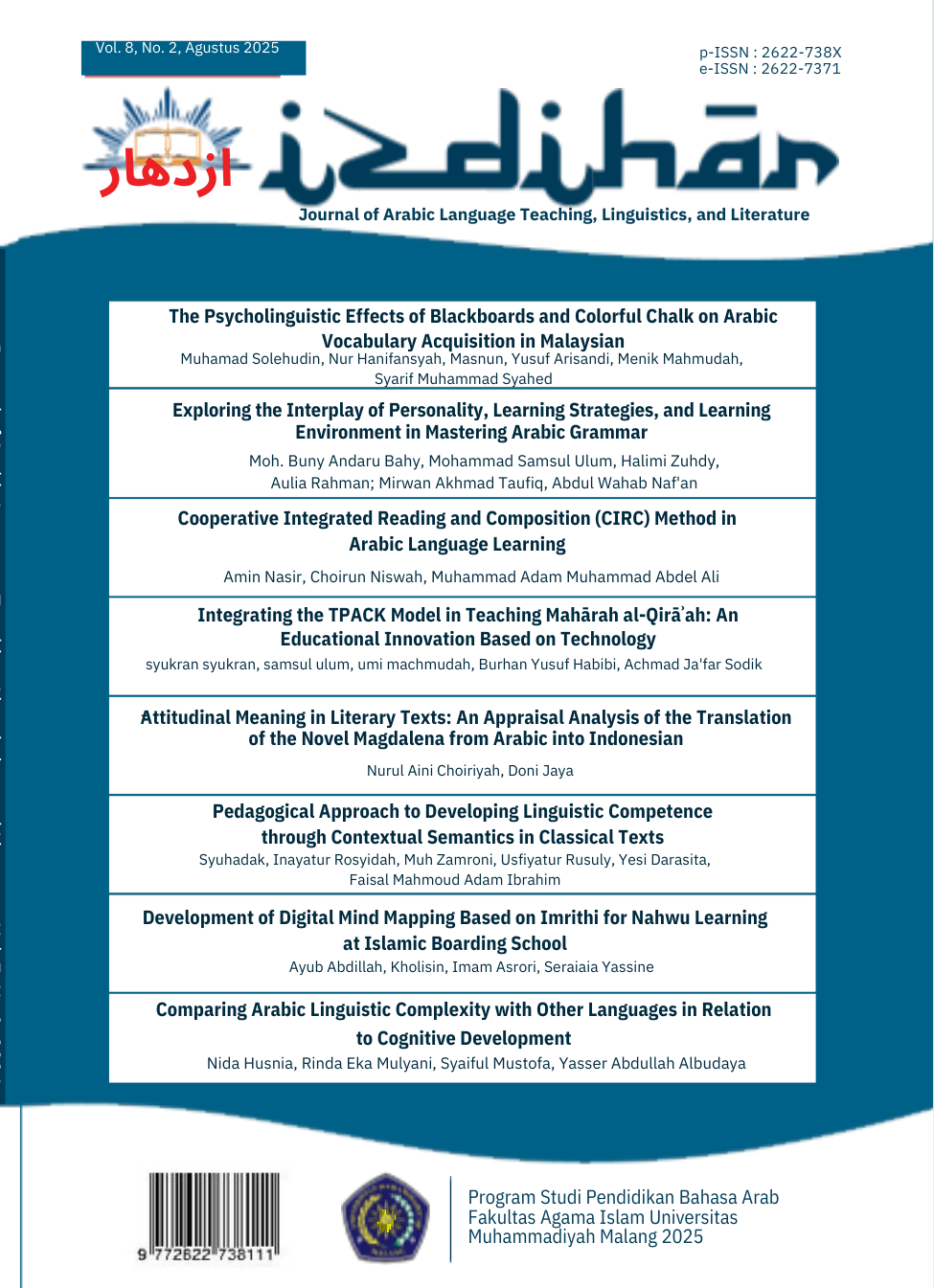
Development of Digital Mind Mapping Based on Imrithi for Nahwu Learning at Islamic Boarding School
DOI:
https://doi.org/10.22219/jiz.v8i2.36850Keywords:
Digital Mind Mapping Materials; Nadzam Imrithi; Teaching of NahwuAbstract
The teaching of nahwu in Islamic boarding schools often still relies on traditional methods, which tend to be monotonous. This research aimed to develop digital mind mapping materials based on the Nazham Imrithi text as an alternative learning medium that is more interactive and effective. The research subjects were female students at Al Ishlahiyah Female Islamic Boarding School. The development method used was the ADDIE model (Analyze, Design, Develop, Implement, Evaluation). The results of this research and development showed that the validity score from content experts was 3.9, while the validity score from media experts was 4.1, both of which fall into the good category and are feasible for use. The practicality level based on teachers' responses was 4.2, which falls into the agree category, while the practicality level based on students' responses was 3,9 or agree. Thus, the interactive media developed by the researcher is considered both feasible and practical for use.
Downloads
Downloads
Published
How to Cite
Issue
Section
License
Copyright (c) 2025 Ayub Abdillah, Kholisin, Imam Asrori, Seraiaia Yassine

This work is licensed under a Creative Commons Attribution-ShareAlike 4.0 International License.
Copyright Notice
Authors who publish with this journal agree to the following terms:
- Authors retain copyright and grant the journal right of first publication with the work simultaneously licensed under a Creative Commons Attribution-ShareAlike 4.0 International License that allows others to share the work with an acknowledgment of the work's authorship and initial publication in this journal.
- Authors are able to enter into separate, additional contractual arrangements for the non-exclusive distribution of the journal's published version of the work (e.g., post it to an institutional repository or publish it in a book), with an acknowledgment of its initial publication in this journal.
- Authors are permitted and encouraged to post their work online (e.g., in institutional repositories or on their website) prior to and during the submission process, as it can lead to productive exchanges, as well as earlier and greater citation of published work (See The Effect of Open Access).
Copyright (c) 2019 Izdihar : Journal of Arabic Language Teaching, Linguistics, and Literature

This work is licensed under a Creative Commons Attribution-ShareAlike 4.0 International License.