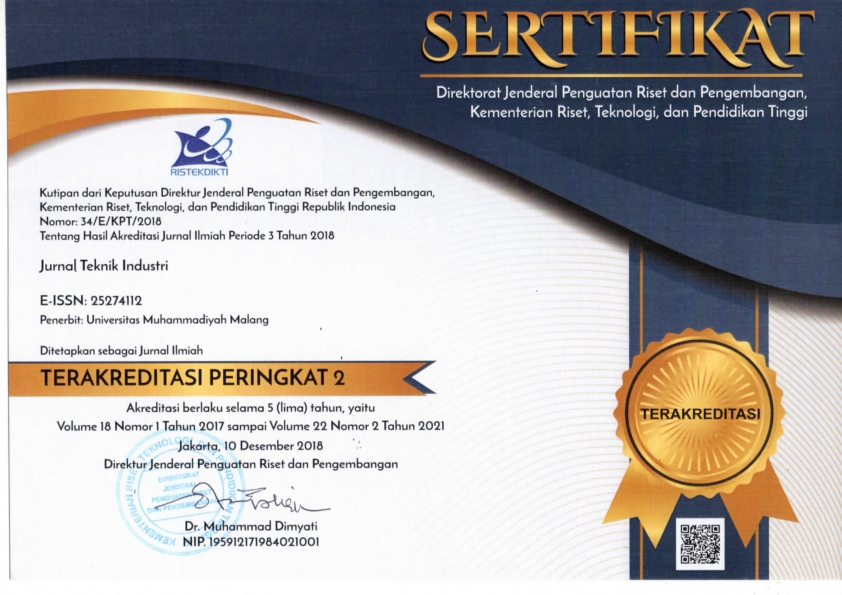
Risk Assessment and Mitigation of Halal Meat Supply Chain Systems Using Best-Worst Method and Promethee
DOI:
https://doi.org/10.22219/JTIUMM.Vol26.No2.161-182Keywords:
Halal , Halal supply chain, Halal meat supply chain, BWM, PrometheeAbstract
The halal meat supply chain is exposed to a series of identifiable and significant risks, including incomplete information about the origin and health of livestock, non-compliance with halal slaughtering procedures, and inadequate post-slaughter inspections. These risks pose serious threats to the integrity, traceability, and consumer trust in halal products. However, prior studies often address risk assessment and mitigation in isolation, lacking an integrated framework that links risk prioritisation with targeted mitigation strategies. This study proposes a comprehensive model for assessing and mitigating risks in the halal meat supply chain using the Best-Worst Method (BWM) and the Preference Ranking Organisation Method for Enrichment Evaluation (Promethee). Risks were identified through a literature analysis and expert validation, and then prioritised using the BWM. Promethee was applied to rank alternative mitigation strategies based on these prioritised risks. The findings highlight that the most critical risks include incomplete information about delivered cattle (S4), slaughterers not following standard operating procedures (PP6), and cattle that do not meet health standards (S2). The top-ranked mitigation strategies include: establishing formal agreements detailing halal standards (M16), routine monitoring of slaughtering processes (M12), staff education on SOP compliance (M6), and enforcement of disciplinary measures (M10). Academically, this study introduces a novel BWM–Promethee integration within halal supply chain risk management, an area with limited existing literature. Practically, it offers a structured decision-making tool to enhance halal integrity through risk-informed management interventions at the operational level.
Downloads
References
[1] N. Indarti, A. S. Lukito-Budi, and A. M. Islam, “A systematic review of halal supply chain research: to where shall we go?,” Journal of Islamic Marketing, vol. 12, no. 9, pp. 1930-1949, 2020. https://doi.org/10.1108/JIMA-05-2020-0161.
[2] T. N. Ma’rifat and A. Rahmawan, "Pengembangan kerangka konseptual model rantai pasok halal pada komoditas daging ayam di Kabupaten Ponorogo," Jurnal Pertanian Cemara, vol. 15, no. 2, pp. 29-35, 2018. https://doi.org/10.24929/fp.v15i2.655.
[3] A. Kadir and A. Efendi, “Strategi Pengembangan Industri Produk Halal,” Economics and Digital Business Review, vol. 4, no. 2, pp. 217-228, 2023. https://doi.org/10.37531/ecotal.v4i2.637.
[4] B. V. Kristiana, A. Indrasari, and I. Giyanti, "Halal Supply Chain Management dalam Optimalisasi Penerapan Sertifikasi Halal UMKM," Performa: Media Ilmiah Teknik Industri, vol. 19, no. 2, pp. 113-120, 2020. https://doi.org/10.20961/performa.19.2.46379.
[5] I. Sandela, A. Yuana, and P. K. Sari, "Pengaturan Sertifikasi Halal bagi Rumah Pemotongan Hewan (RPH) di Indonesia," Ius Civile: Refleksi Penegakan Hukum dan Keadilan, vol. 7, no. 2, pp. 56-69, 2023. https://doi.org/10.35308/jic.v7i1.8451.
[6] C. Lutfi, “Critical Review of Halal Industry Policy in Indonesia,” Ascarya: Journal of Islamic Science, Culture, and Social Studies, vol. 5, no. 1, pp. 1-12, 2025. https://doi.org/10.53754/iscs.v5i1.717.
[7] N. Rishelin and R. Ardi, “Prioritizing risks of halal meat supply chain in Indonesian downstream sector using DEMATEL-based ANP,” Industrial Engineering and Engineering Management (IEEM) vol. 1, no. 1, pp. 711-715, 2020. https://doi.org/10.1109/IEEM45057.2020.9309875.
[8] R. b. M. Azli et al., “Risk Assessment on Bird Slaughterhouses in Negeri Sembilan,” 2021, pp. 407-418: Springer, 2021. https://doi.org/10.1007/978-981-33-4854-7_34.
[9] D. Wahyuni, A. H. Nasution, I. Budiman, and N. Arfidhila, “Halal Risk Analysis at Indonesia Slaughterhouses Using the Supply Chain Operations Reference (SCOR) and House of Risk (HOR) Methods,” Journal of Physics: Conference Series, vol. 1542, no. 1, pp. 1-8, 2020. 10.1088/1742-6596/1542/1/012001.
[10] Y. Kusuma, "Analisis Risiko dan Rekayasa Sistem Pada Pemotongan Ayam Berdasarkan Prinsip Halal Supply Chain (Studi Kasus: Rumah Pemotongan Ayam XYZ)," In Talenta Conference Series: Energy and Engineering (EE), vol. 6, no. 1, pp. 1125-1130, 2023. https://doi.org/10.32734/ee.v6i1.1929.
[11] H. C. Wahyuni, I. Vanany, U. Ciptomulyono, and J. D. T. Purnomo, “Integrated risk to food safety and halal using a Bayesian Network model,” 2020, vol. 21, no. 4, pp. 260-273: Taylor & Francis, 2020. https://doi.org/10.1080/16258312.2020.1763142.
[12] M. H. Ramli, A. S. Rosman, M. T. Ajmain, A. M. Sikin, and M. A. Jamaludin, “Halal Critical Point Assessment for Chicken Broiler Upstream Operations,” International Journal of Business and Technology Management, vol. 5, no. 4, pp. 107-120, 2023.
[13] M. H. Ramli, A. S. Rosman, and M. A. Jamaludin, “Application Of FMEA Method In Halal Risk Determination On Halal Poultry Slaughtering Operations,” Journal of Fatwa Management and Research, vol. 29, no. 3, pp. 1-30, 2024. https://doi.org/10.33102/jfatwa.vol29no3.587.
[14] A. Mansur, A. Farida, and M. U. Albab, “Operation risk mitigation on halal meat supply chain management,” IOP Conference Series: Materials Science and Engineering Applications of Artificial Intelligence, vol. 215, no. 1, pp. 12-27, 2017. 10.1088/1757-899X/215/1/012027.
[15] S. Khan, A. Haleem, and M. I. Khan, “Assessment of risk in the management of Halal supply chain using fuzzy BWM method,” Supply Chain Forum: An International Journal, vol. 22, no. 1, pp. 57-73, 2021. https://doi.org/10.1080/16258312.2020.1788905.
[16] E. Sumarliah, T. Li, B. Wang, and I. Indriya, “An Examination of Halal Fashion Supply Chain Management Risks Based on the Fuzzy Best-Worst Approach,” Information Resources Management Journal (IRMJ), vol. 34, no. 4, pp. 69-92, 2021. 10.4018/IRMJ.2021100104.
[17] S. Khan, M. I. Khan, A. Haleem, and A. R. Jami, “Prioritising the risks in Halal food supply chain: an MCDM approach,” Journal of Islamic Marketing, vol. 13, no. 1, pp. 45-65, 2022. https://doi.org/10.1108/JIMA-10-2018-0206.
[18] M. Krstić, S. Tadić, P. P. Miglietta, and D. Porrini, “Biodiversity Protection Practices in Supply Chain Management: A Novel Hybrid Grey Best–Worst Method/Axial Distance-Based Aggregated Measurement Multi-Criteria Decision-Making Model,” Applied Sciences, vol. 15, no. 3, pp. 1-24, 2025. https://doi.org/10.3390/app15031354.
[19] V. A. Wankhede and S. Vinodh, “Analysis of Industry 4.0 challenges using best worst method: A case study,” Computers & Industrial Engineering, vol. 159, no. 1, pp. 1-13, 2021. https://doi.org/10.1016/j.cie.2021.107487.
[20] E. Alfonsius and Bonitalia, “Decision Support System for Granting of Credit Using Website-Based PROMETHEE Method (Case Study at BPR Abc Bank),” CHAIN: Journal of Computer Technology, Computer Engineering, and Informatics, vol. 1, no. 3, pp. 123-136, 2023. https://doi.org/10.58602/chain.v1i3.49.
[21] A. M. Qureshi and A. Rachid, “Comparative analysis of multi-criteria decision-making techniques for outdoor heat stress mitigation,” Applied Sciences, vol. 12, no. 23, pp. 1-14, 2022. https://doi.org/10.3390/app122312308.
[22] S. Kheybari, M. Javdanmehr, F. M. Rezaie, and J. Rezaei, “Corn cultivation location selection for bioethanol production: An application of BWM and extended PROMETHEE II,” Energy, vol. 228, no. 1, p. 120593, 2021. https://doi.org/10.1016/j.energy.2021.120593.
[23] A. Taghipour, A. Fooladvand, M. Khazaei, and M. Ramezani, “Criteria clustering and supplier segmentation based on sustainable shared value using BWM and PROMETHEE,” Sustainability, vol. 15, no. 11, p. 8670, 2023. https://doi.org/10.3390/su15118670.
[24] P. Priyati, S. Suharjito, and E. Tanuwijaya, "Analisis Pemilihan Pemasok Hijau Komoditi Kaolin Dengan Menggunakan Integrasi Metode BWM-PROMETHEE Pada PT. XYZ," Eqien-Jurnal Ekonomi dan Bisnis, vol. 10, no. 2, pp. 425-428, 2022. https://doi.org/10.34308/eqien.v10i2.640.
[25] Y. Kazançoglu, Y. Ozturkoglu, S. K. Mangla, M. Ozbiltekin-Pala, and A. Ishizaka, “A proposed framework for multi-tier supplier performance in sustainable supply chains,” International Journal of Production Research, vol. 61, no. 14, pp. 4742-4764, 2023. https://doi.org/10.1080/00207543.2022.2025942.
[26] A. Ishizaka and G. Resce, “Best-Worst PROMETHEE method for evaluating school performance in the OECD’s PISA project,” Socio-Economic Planning Sciences, vol. 73, p. 100799, 2021. https://doi.org/10.1016/j.seps.2020.100799.
[27] J. Rezaei, “Best-worst multi-criteria decision-making method,” Omega, vol. 53, no. 1, pp. 49-57, 2015. https://doi.org/10.1016/j.omega.2014.11.009.
[28] Mohani, C. Suhery, and U. Ristian, "Implementasi Metode PROMETHEE Dalam Menentukan Calon Penerima Bantuan PKH Berbasih Web (Studi Kasus: Desa Tengguli Kecamatan Sajad)," Jurnal Komputer dan Aplikasi, vol. 8, no. 2, pp. 43-54, 2020. http://dx.doi.org/10.26418/coding.v8i2.41496.
[29] BPJPH, "Pedoman Penyelenggaraan Sistem Jaminan Produk Halal Dalam Pemotongan Hewan Ruminansia Dan Unggas," 2023.
[30] BSN, "SNI 99003:2018 Pemotongan Halal Pada Hewan Ruminansia.," 2018.
[31] I. Masudin, P. E. Zuliana, D. M. Utama, and D. P. Restuputri, “Assessment and risk mitigation on halal meat supply chain using fuzzy best-worst method (BWM) and risk mitigation number (RMN),” Journal of Islamic Marketing, vol. 15, no. 3, pp. 842-865, 2024. https://doi.org/10.1108/JIMA-08-2022-0240.
[32] A. N. Islamadina and I. Vanany, “A Proposed risk model for the halal supply chain,” In Proceedings of the Second Asia Pacific International Conference on Industrial Engineering and Operations Management, vol. 1, no. 1, pp. 1325-1336, 2021.
[33] A. Puška, M. Nedeljković, S. Hashemkhani Zolfani, and D. Pamučar, “Application of Interval Fuzzy Logic in Selecting a Sustainable Supplier on the Example of Agricultural Production,” Symmetry, vol. 13, no. 5, 2021. 10.3390/sym13050774.
[34] N. N. Qisthani, S. Hidayatuloh, and Y. U. Kasanah, “Analysis of Beef Halal Critical Points with Halal Logistics Approach and Risk Management,” Jurnal Ilmiah Teknik Industri, vol. 22, no. 1, pp. 40-48, 2023. https://doi.org/10.23917/jiti.v22i1.20617.
[35] N. Rishelin, R. Ardi, and I. Suryadi, "Pengembangan Model Kriteria Penilaian Manajemen Risiko Halal Supply Chain Daging pada Bagian Downstream di Indonesia," Jurnal Penelitian dan Aplikasi Sistem & Teknik Industri (PASTI), vol. 17, no. 1, pp. 126-137, 2023.
[36] A. M. E. Sulieman, I. M. Abu Zeid, and A. Haddad, Contamination of Halal Beef Carcasses by Bacteria Grow or Survive During Cold Storage (Halal and Kosher Food: Integration of Quality and Safety for Global Market Trends). Champ: Springer, 2023, pp. 201-214.
[37] A. A. Arifin, S. Musafa’ah, M. M. Basya, and M. I. S. Pratikto, "Mekanisme Pengawasan Halal Supply Chains di Pasar Tradisional Indonesia sebagai Upaya Perlindungan Konsumen (Studi Kasus: Komoditi Daging Ayam dan Sapi di Empat Pasar Tradisional Surabaya)," OECONOMICUS Journal of Economics, vol. 8, no. 2, pp. 140-162, 2024. https://doi.org/10.15642/oje.2024.8.2.140-162.
[38] N. D. S. H. Effendi and S. Gunardi, “Halal Certification For Imported Meat In Johor: An Overview Of Standard Operating Procedures And Compliance Challenges. ,” SALAM Digest: Syariah and Law Undergraduate Symposium, vol. 1, no. 1, pp. 142-151, 2023.
[39] E. O. Njoga et al., “Pre-slaughter, slaughter and post-slaughter practices of slaughterhouse workers in Southeast, Nigeria: Animal welfare, meat quality, food safety and public health implications,” PLoS One, vol. 18, no. 3, pp. 1-24, 2023. https://doi.org/10.1371/journal.pone.0282418.
[40] B. E. Syahputri and S. Sucipto, “Monitoring of beef cold chain to ensure quality, safety, and halal using RFID: A review,” IOP Conference Series: Earth and Environmental Science, vol. 924, no. 1, p. 012001, 2021. 10.1088/1755-1315/924/1/012001.
[41] R. O. Sujarwanta, U. Afidah, E. Suryanto, Rusman, E. Triyannanto, and L. C. Hoffman, “Review: Goat and Sheep Meat Production in Indonesia,” Journal, Type of Article vol. 16, no. 11, 2024. https://doi.org/10.3390/su16114448.
[42] A. Jumiono, "Identifikasi Titik Kritis Kehalalan Bahan Hewani dan Produk Turunan Hewan," Jurnal Ilmiah Pangan Halal, vol. 4, no. 2, pp. 51-58, 2022. https://doi.org/10.30997/jiph.v4i2.9909.
[43] M. F. M. Ariffin, W. S. N. W. Sulong, F. M. Othman, H. H. Abdillah, and K. A. M. Bayoumi, “Hadith Meets Hazard Analysis and Critical Control Point: A Path to Sustainable Food Safety Practice for SMEs,” Islāmiyyāt, vol. 47, no. 1, pp. 35–52, 2025. https://doi.org/10.17576/islamiyyat-2025-4701-04.
Downloads
Published
How to Cite
Issue
Section
License
Copyright (c) 2025 Danang Setiya Wijaya, Trisita Novianti , Retno Indriartiningtias

This work is licensed under a Creative Commons Attribution-ShareAlike 4.0 International License.